
SATS Revenue Rises 9% as Meal Demand Grows but Conflict Costs Squeeze Margin

SATS recorded stronger demand for airline and non aviation meals in its second quarter, lifting group revenue 9% to S$1.71 billion. Yet the Singapore based catering and logistics group converted less of that growth into operating profit as conflict related input costs and operational disruption weighed on the quarter.
The result matters beyond a single earnings report. SATS describes itself as the world’s largest air cargo handler and Asia’s leading airline caterer. Its network therefore offers a useful view of two connected flows in the physical economy: food prepared for aviation and goods moving through airports.
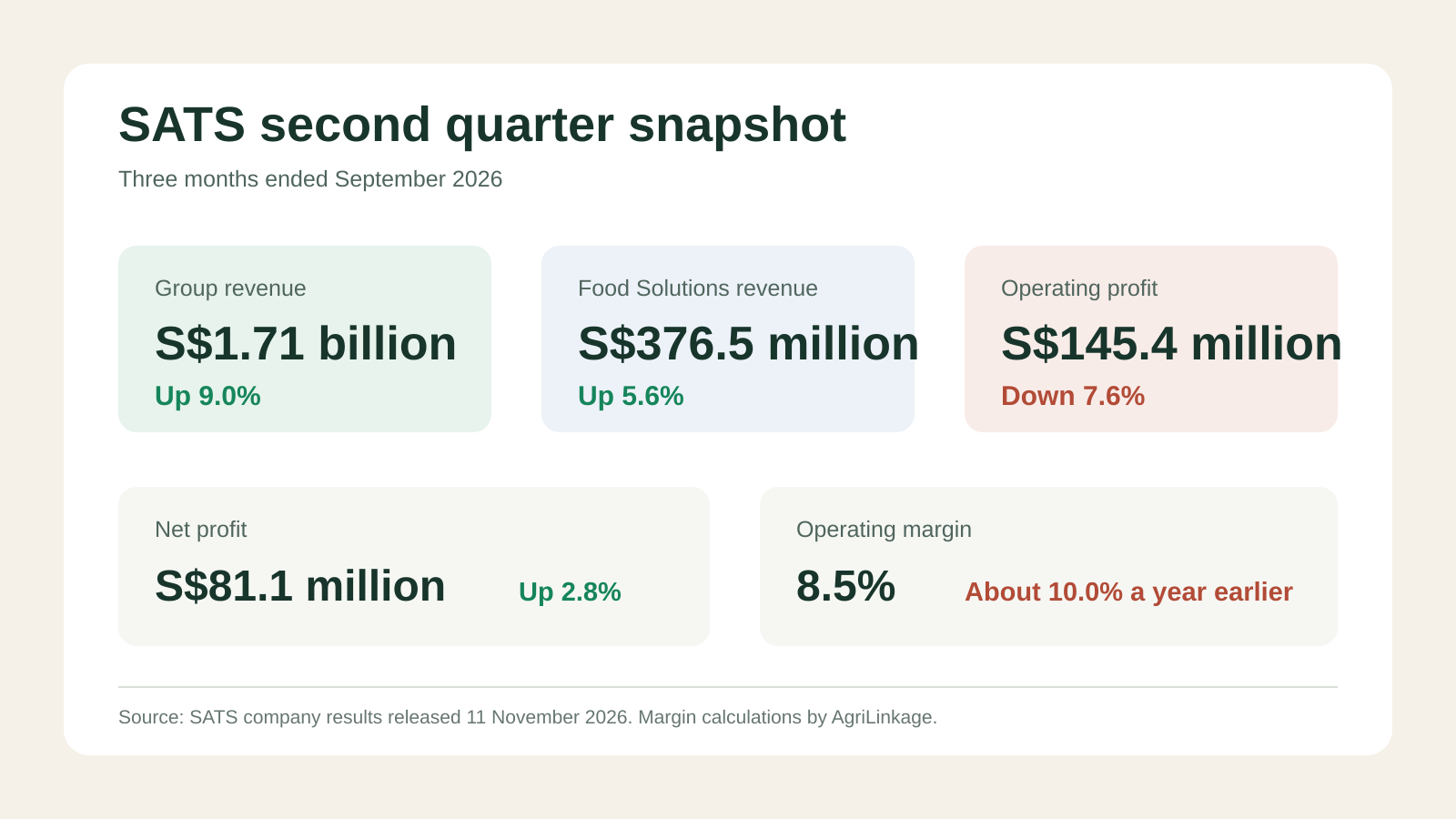
For the three months ended 30 September 2026, net profit rose 2.8% from a year earlier to S$81.1 million. Operating profit moved in the opposite direction, falling 7.6% to S$145.4 million even as revenue increased. That divergence is the central signal in the results released on 11 November.
Meal demand supported the top line
Food Solutions revenue increased 5.6% to S$376.5 million. SATS attributed the gain to stronger aviation and non aviation meal demand, showing that the catering recovery is not limited to food loaded onto aircraft. The segment represented about 22% of group revenue in the quarter, based on AgriLinkage calculations.
Gateway Services remained the larger engine. Revenue from that business rose 10% to S$1.3 billion. Cargo revenue reached S$900.4 million, up 10.9%, while ground handling revenue increased 8% to S$436.2 million. The group processed 2.6 million tonnes of cargo, an 8% increase, with volume in the Americas rising 19.4%.
This mix matters for food companies because global catering and cargo networks share labor, energy, cold storage, airport access and transport capacity. Stronger passenger meal demand can raise kitchen utilization, while cargo growth can improve the use of handling infrastructure. Neither automatically produces higher margins when input and disruption costs rise at the same time.
Revenue growth did not prevent margin compression
AgriLinkage calculates an operating margin of about 8.5% for the quarter, compared with about 10.0% a year earlier. That is a contraction of roughly 1.5 percentage points. The calculation uses reported operating profit divided by reported revenue for each period.
The comparison also needs context. SATS said the earlier period benefited from tariff related front loading and a temporary efficiency gain associated with higher volumes. A difficult comparison base therefore contributed to the decline. The company also reported that the Middle East conflict raised input costs and disrupted operations.
Those explanations point to more than one pressure. Energy and transport costs can affect catering through refrigeration, cooking, vehicle movements and delivery to aircraft. Disruption can also reduce planning efficiency when routes, schedules or airport operations change. The results do not prove that every cost increase came through food production, so the segment and group effects should not be treated as identical.
Sequentially, the picture was firmer. Operating profit rose 8.7% from the first quarter and margin improved from 8.0% to 8.5%, according to the reported figures. That suggests focused cost management had some effect, although the year on year decline shows that recovery was incomplete.
Why the food business signal is important
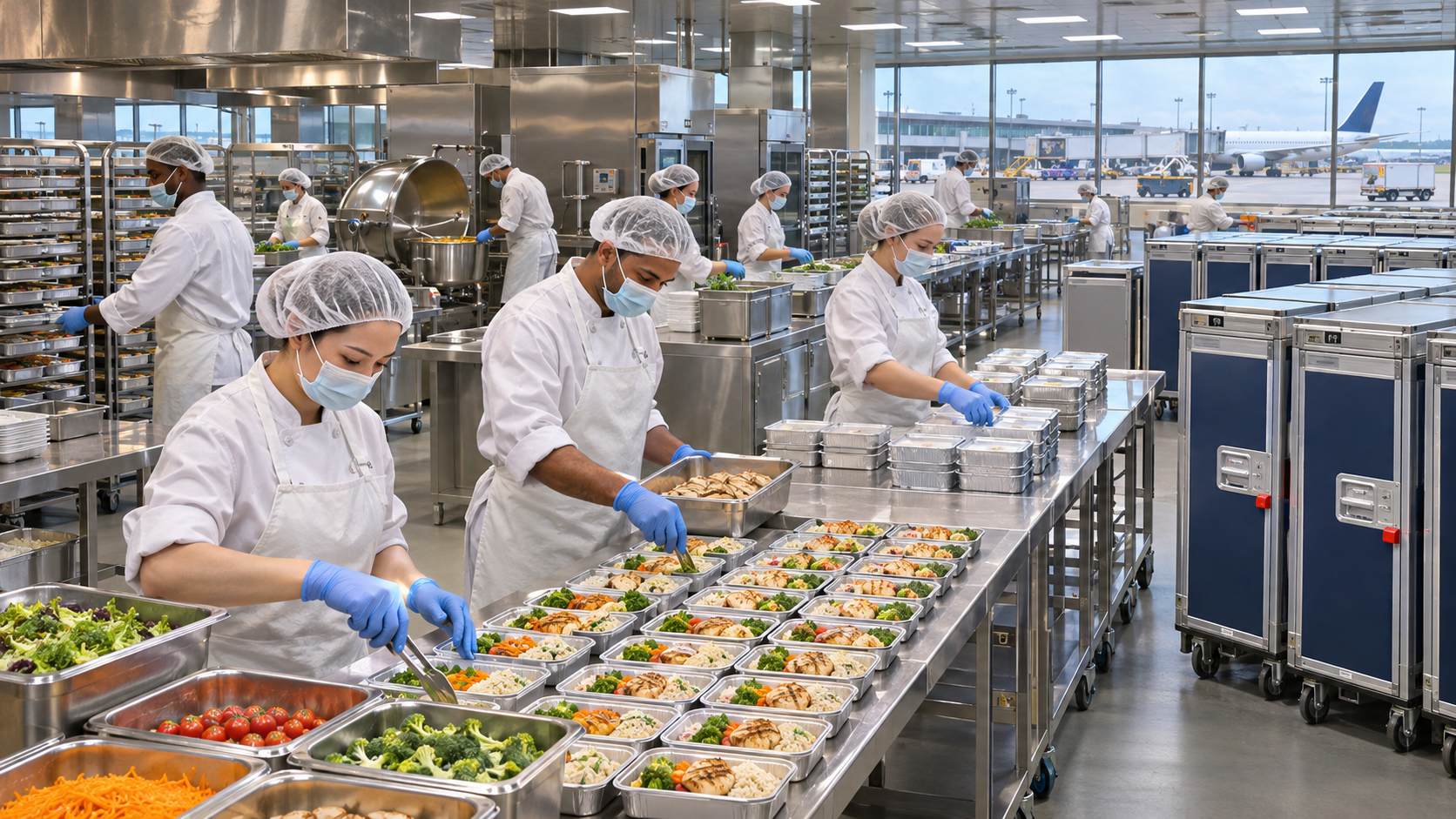
Airline catering sits at the intersection of food manufacturing and transport. Operators must forecast meals against passenger schedules, source ingredients across markets, maintain strict safety controls, assemble products to airline specifications and deliver them within narrow airport windows. A volume increase can spread fixed costs over more meals, but sudden changes in energy, ingredients, labor or routes can erode that benefit.
The latest SATS figures show both sides of that equation. Demand was sufficient to lift Food Solutions revenue, and management expects food volumes to grow with new customer wins. At the same time, group operating leverage weakened. For suppliers and competitors, this is a reminder that recovering travel demand does not guarantee a proportionate profit gain.
The cargo result adds another layer. Food ingredients, seafood, perishables and high value products often rely on air freight when time matters more than transport cost. SATS said its cargo volumes had outpaced industry growth for a twelfth consecutive quarter. That supports utilization, but it also exposes the network to global trade timing, route changes and geopolitical disruption.
What to watch next
The next test is whether cost pressure eases while meal volumes continue to expand. A durable improvement would appear in operating margin as well as revenue. If sales rise without margin recovery, it would suggest that pricing, productivity or contract terms are not fully absorbing higher inputs.
Three indicators deserve attention. The first is Food Solutions volume and revenue growth, especially the balance between aviation and non aviation meals. The second is group operating margin, which will show whether cost measures are converting demand into profit. The third is the company’s commentary on energy prices and disruptions, because management has described the pressure as temporary rather than structural.
For food processors and service providers, the practical lesson is not simply that airline meals are returning. The more useful conclusion is that demand recovery and margin recovery can move at different speeds. Contract pricing, route stability, kitchen utilization and input costs will determine how much of the next increase in meals becomes operating profit.
Sources and methodology
The company announcement and financial materials are available on the SATS financial results page.
The release date and latest announcement are also shown on the SATS company website.
The exchange announcement reference and attached documents are listed in the SGXNet filing mirror.
AgriLinkage calculated the operating margins, the approximate margin change and the Food Solutions share of group revenue from the company’s reported figures. Percentages are rounded. Company explanations are identified as such and are not presented as independent confirmation of causation.
The cover is an original contextual editorial illustration of airline catering production and does not depict a specific SATS facility or event. The body graphic was created by AgriLinkage from the reported figures.
By AgriLinkage Food. Published 12 November 2026.


Comments