
Mars Invests £161 Million to Make Melton Its Main UK Pouched Pet Food Factory

Mars has announced a £161 million modernisation of its pet food factory in Melton Mowbray, England, a program running through 2031 that is intended to make the site the company’s primary UK factory for pouched pet food.
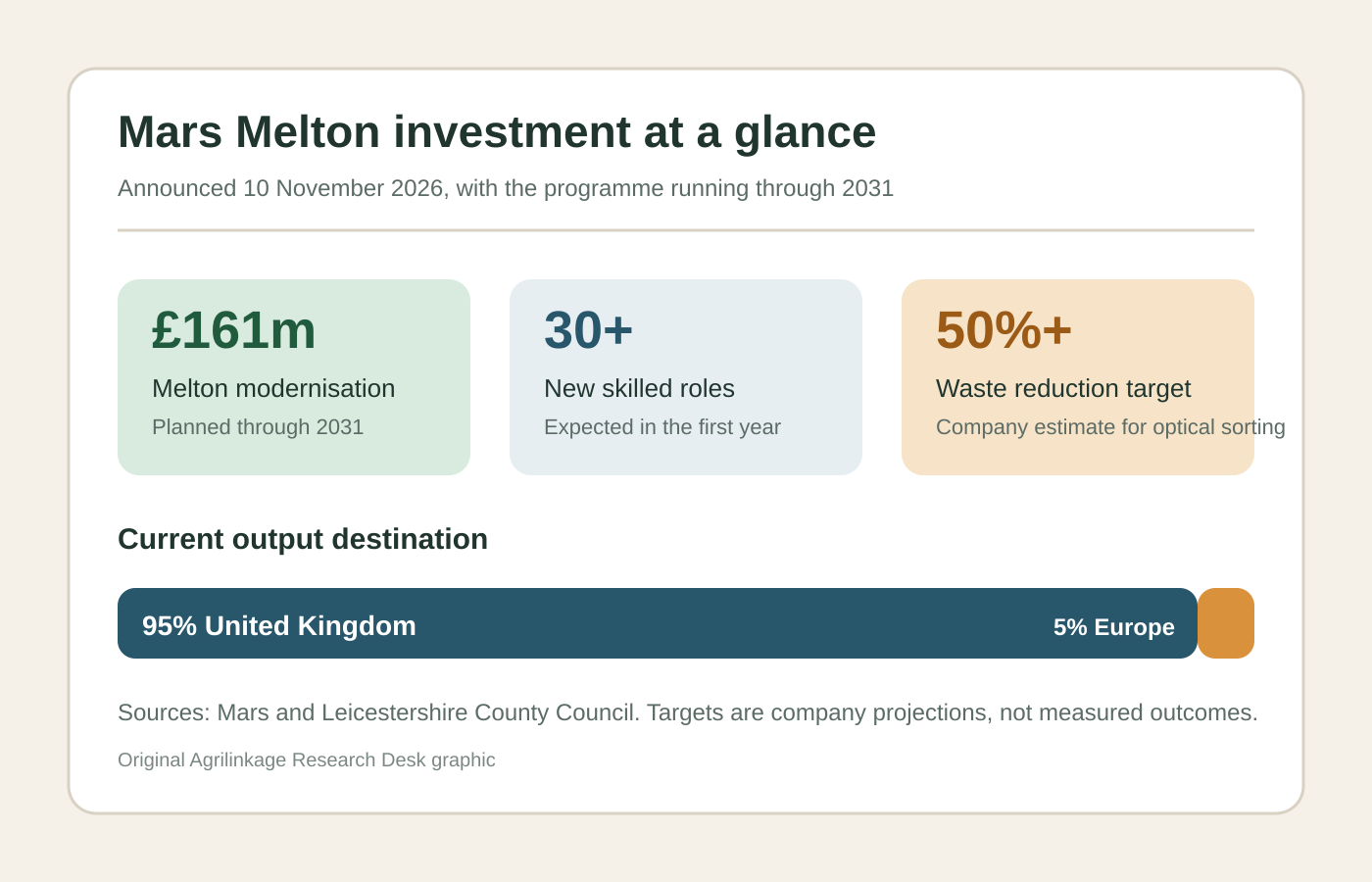
The plan, announced on 10 November, will add new pouch lines, smart optical sorting and utility upgrades. Mars says the investment will create more than 30 skilled technical and engineering roles in its first year and expand the permanent apprentice cohort from 26 positions to 33 by 2027.
The size and duration matter because this is not a single new machine or a routine maintenance project. It is a multiyear reconfiguration of a 75 year old production site that supplies a mature but strategically important segment of the British food manufacturing economy.
What the investment changes
Mars says the new lines will support flexible pouches made from mono polypropylene, a structure designed to be recyclable. Moving toward one main plastic family can make sorting and reprocessing easier than with traditional multilayer laminates, although real recycling still depends on collection systems, consumer participation and processing capacity.
The company also plans to install smart optical sorting and says this will cut production waste by more than 50 percent. That is a forward looking company target, not an independently measured outcome. Mars did not disclose the current waste baseline, the date by which the reduction should be achieved or the measurement boundary.
No annual capacity figure, pouch count or expected percentage increase in output was disclosed. The announcement therefore supports a conclusion about modernisation and strategic concentration, but not a calculation of how much more pet food the factory will produce.
A factory aimed mainly at the British market
Leicestershire County Council said the existing Melton site supplies 95 percent of its output to British households and exports the remaining 5 percent to European markets. That makes the investment primarily a UK supply and manufacturing story, with a smaller but still relevant role in cross border trade.
The program should make Mars less dependent on older pouch equipment at a plant that has operated for 75 years. Concentrating primary UK pouched production at Melton may also simplify maintenance, quality control and workforce training, though the company has not published an operating cost forecast or a schedule for commissioning individual lines.
For suppliers, the most immediate opportunities are likely to sit in construction, engineering, automation, packaging materials and technical services. The company and local authorities have not disclosed procurement values or named contractors, so those opportunities should not be treated as awarded business.
The wider capital program
Mars says the Melton commitment takes its total UK capital investment since 2021 to £661 million across pet care, food, snacking and services. The total includes a £190 million investment announced earlier in 2026 for its chocolate factory in Slough and a £1.2 million upgrade at its pet nutrition research and development hub in Birstall.
That cumulative figure signals a broader effort to renew older British manufacturing assets rather than a stand alone bet on one pet food format. Mars operates eight UK manufacturing facilities and describes Britain as its second largest market.
The employment effect is material locally but modest relative to the investment value. More than 30 new roles in the first year implies that much of the spending will go into equipment, buildings and automation rather than labour intensive expansion. The more durable workforce effect may come through technical skills and apprenticeships.
What remains unknown
Mars has not disclosed the number of new pouch lines, their rated speed, the factory’s current or future annual tonnage, expected energy use, return on investment or the precise construction sequence through 2031. It also has not said whether production will be transferred from another UK site.
Those omissions matter. A modernised factory can improve reliability, packaging flexibility and waste control without necessarily increasing total output. Readers should therefore avoid equating the £161 million headline with a specific capacity gain until Mars publishes production data or commissioning milestones.
Sources and methodology
Agrilinkage reviewed the Mars announcement dated 10 November 2026 and the Leicestershire County Council statement dated 11 November 2026. Company projections are identified as such. No interviews or site visit were conducted.
Cover image: original conceptual editorial illustration created for Agrilinkage. It does not depict the Melton factory or a specific Mars production line.


Comments