
Royal Unibrew Lifts Margin but Narrows Profit Outlook as Costs Rise

Royal Unibrew increased third quarter operating profit faster than revenue and lifted its operating margin, but narrowed its full year profit growth range as inflation, weak conditions in Finland and supply chain problems in Benelux weighed on the outlook.
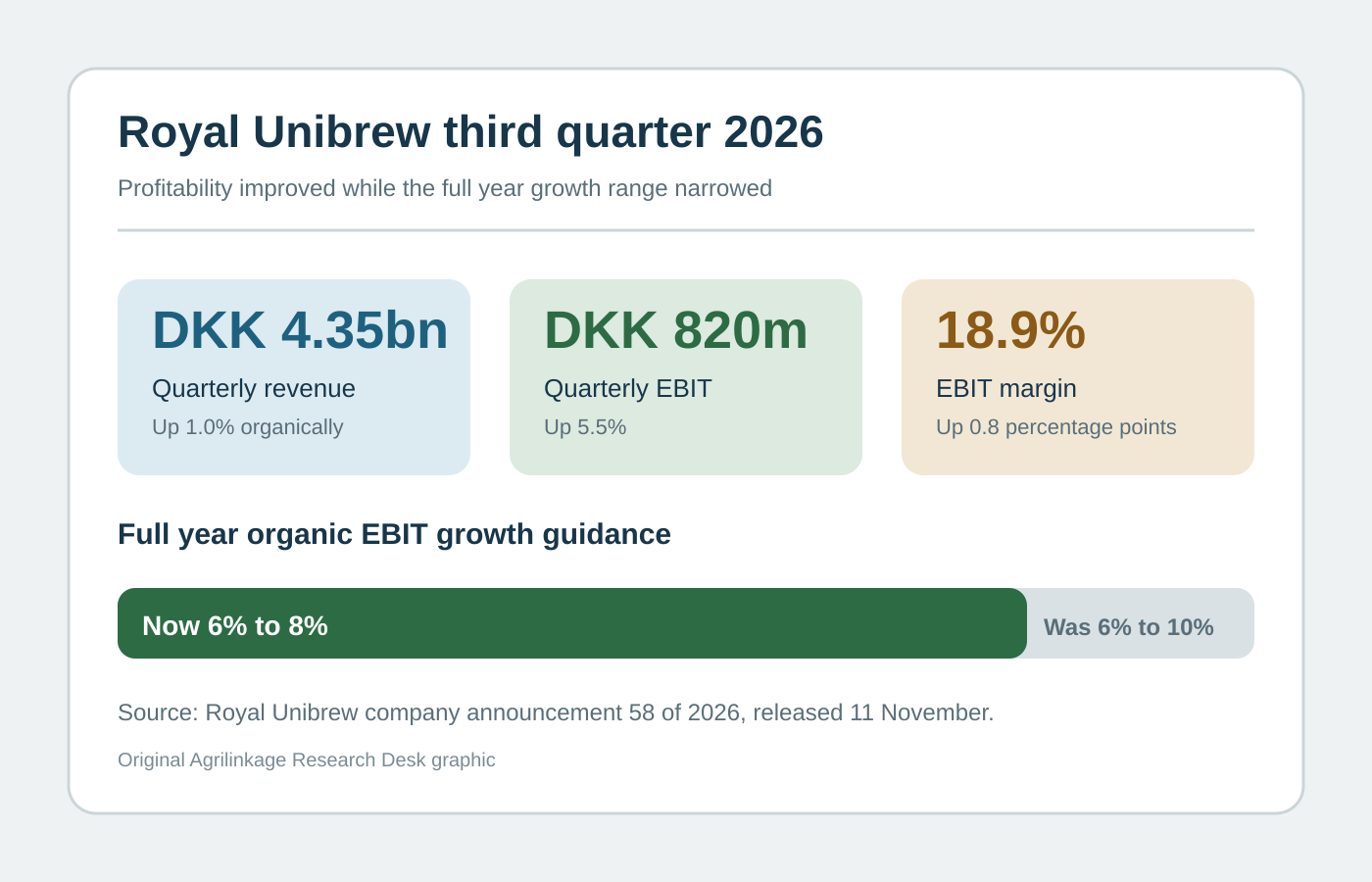
The Danish beverage group reported third quarter revenue of DKK 4.35 billion, up 1.0 percent organically, while earnings before interest and tax rose 5.5 percent to DKK 820 million. Its operating margin increased to 18.9 percent from 18.1 percent a year earlier.
The result shows a beverage producer still converting modest reported sales growth into stronger profit, but the narrower guidance signals that management sees less room for upside during the final part of the year.
Volume rose, but the two revenue measures tell different stories
Quarterly volume reached 5.0 million hectolitres, 1.4 percent above the comparable period. Reported organic revenue growth was 1.0 percent.
Royal Unibrew also highlighted underlying net revenue growth of 4.0 percent. That adjusted figure excludes the effect of planned exits from low margin contracts. It is useful for judging the continuing business, but it should not be confused with the reported organic rate.
The gap matters for readers assessing demand. A company can improve its revenue mix by leaving unattractive contracts even if total reported growth remains modest. The stronger margin is consistent with that strategy, but the trading statement does not provide enough detail to isolate how much came from price, product mix, efficiency or lower contract volume.
Profitability improved despite higher costs
Gross margin rose to 46.3 percent from 45.8 percent. Operating profit increased to DKK 820 million from DKK 777 million, and the operating margin gained 0.8 percentage points.
The improvement is notable because Royal Unibrew also reported increasing cost inflation and weather related headwinds in parts of the Nordic region. For beverage businesses, input pressure can arrive through sugar and sweeteners, aluminium, glass, packaging, energy, freight and labour, while cool or wet weather can reduce consumption in important seasonal periods.
Royal Unibrew did not disclose a single company wide inflation rate in the trading statement. It would therefore be misleading to infer the size of future price increases or the precise contribution of each cost category.
Why guidance narrowed
Management now expects full year organic operating profit growth of 6 percent to 8 percent, compared with its previous range of 6 percent to 10 percent. The lower end is unchanged, but the removal of the top two percentage points reduces the most optimistic outcome.
The company said the narrower range reflects market conditions in Finland, supply chain challenges in Benelux and rising inflation. It translates into expected operating profit of about DKK 2.33 billion to DKK 2.38 billion, compared with DKK 2.20 billion in 2025.
Capital spending is now expected to equal about 6 percent of revenue rather than about 7 percent because some projects have moved into 2027. That is a timing change, not necessarily a permanent reduction in investment.
Cash flow gives management room
Free cash flow for the first nine months reached DKK 1.16 billion, up 19.6 percent, while earnings per share rose 10.2 percent. The cash performance supports the continuing share buyback and gives management more flexibility while costs and regional trading remain uneven.
For suppliers and distributors, the key question is whether the margin gains continue without a material reduction in volumes. For investors, the important test is whether the Finland and Benelux pressures are temporary or persist into 2027.
What to watch next
Three indicators will help test the outlook. First, reported organic revenue should be compared with the adjusted underlying measure to see whether contract exits continue to obscure the demand trend. Second, quarterly margin movement will show whether mix and efficiency can keep offsetting inflation. Third, the timing of delayed capital projects will reveal whether lower 2026 spending simply shifts cash requirements into 2027.
The company has not published a detailed fourth quarter forecast by region or category, so any claim that a specific market will recover quickly would go beyond the available evidence.
Sources and methodology
Agrilinkage reviewed Royal Unibrew company announcement 58 of 2026 and the company’s official reports and downloads page. Calculations use the reported company figures. No interviews were conducted.
Cover image: original conceptual editorial illustration created for Agrilinkage. It does not depict a Royal Unibrew facility or a specific production event.


Comments