
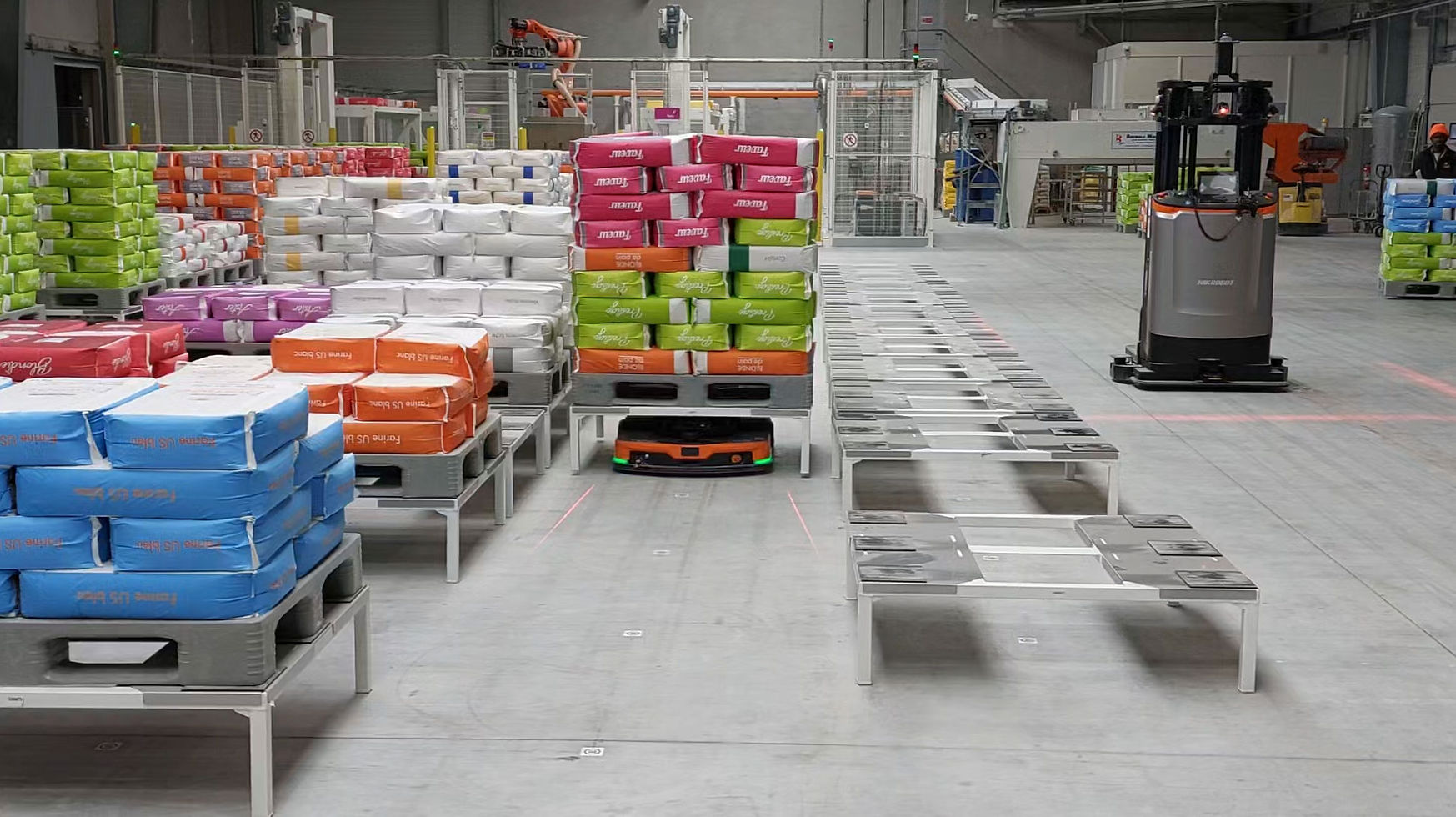
Moulins Dumée Automates Flour Orders at 515 Bags an Hour

Updated: 7 days ago
Moulins Dumée has inaugurated a robotic order fulfillment system at its flour mill in Gron, France, turning a physically demanding bag handling operation into a coordinated flow of mobile robots, pallet transport and automated picking. Fives, which designed and implemented the system with support from Etyo, said the installation entered operation after an inauguration on September 24, 2026.
The project occupies about 1,000 square metres and is designed to prepare as many as 515 flour bags an hour across 45 product references. Moulins Dumée is a family owned milling business with about 80 employees, and the automated zone serves orders for artisan bakers, industrial customers and export shipments rather than changing the milling process itself.
The equipment combines a rail mounted palletising robot, seven autonomous mobile robots, two fork mobile robots and a telescopic conveyor for export loading. A Fives warehouse control system connects with the mill's warehouse management system, coordinating the movement of pallets between storage, picking and shipping areas.
That architecture matters because mixed product orders are harder to automate than full pallets of a single flour type. The mobile robots bring pallets to the picking cell as needed, allowing the system to assemble customer specific loads while using less fixed conveyor infrastructure than a fully mechanised layout.
Fives says the installation virtually eliminates manual handling of 25 kilogram flour bags and improves order accuracy, traceability and responsiveness. Those are supplier reported operating benefits, not independently audited performance results, but they identify the practical targets behind the investment: fewer repetitive lifts, clearer product tracking and faster preparation of complex orders.
The supplier places capacity at up to 150 tonnes a day for this part of the operation. It also says the relevant bagged flour segment represents about 3,000 tonnes a month, roughly one third of the mill's monthly volume, showing that the project addresses a material distribution bottleneck rather than a small demonstration cell.
The system was integrated with an existing stacker crane and, according to Fives, completed without interrupting mill operations. That brownfield element is commercially important because food manufacturers often need to modernise logistics while continuing to serve customers and preserving equipment that still has useful life.
For flour processors, the broader lesson is that warehouse automation can unlock capacity even when the production line itself is not the constraint. The commercial value will depend on sustained uptime, software integration and maintenance performance, but the Gron project offers a concrete model for automating heavy mixed order preparation in an established food plant.


Comments