
Albertsons Pulls 2026 Outlook as Grocery Sales Slip and Costs Rise

Albertsons Companies has withdrawn its fiscal 2026 outlook and begun a wider review of its customer strategy, cost structure, operating model, banners, markets, assets and businesses after a quarter in which sales stalled and profit fell sharply. The October 13 results turn an ordinary grocery earnings report into a potentially consequential restructuring story for one of the largest food retailers in the United States.
The company’s SEC-filed second-quarter release shows net sales and other revenue of $18.895 billion for the 12 weeks ended September 12, down 0.1% from a year earlier. Identical sales, which compare stores operating in both periods and exclude fuel, fell 0.8%. Net income dropped to $51.5 million from $168.5 million.
Agrilinkage calculates that the year-on-year fall in net income was about 69%, while operating income declined roughly 41%, from $295.3 million to $174.5 million. Adjusted EBITDA fell 7.6% to $784 million. Those differences matter because nearly flat revenue can look stable at first glance, but the profit figures show that less of each sales dollar is reaching the bottom line.

The quarter’s key operating signals
Albertsons reported three contrasting trends. Core identical sales contracted, digital sales rose 11%, and pharmacy remained a relative source of strength. At the same time, the gross-margin rate slipped to 26.8% from 27.0%. Excluding fuel and the company’s accounting charge for last-in, first-out inventory, gross margin declined by 17 basis points.
Management attributed the underlying margin pressure mainly to higher delivery and handling costs as digital sales expanded, as well as higher shrink. In grocery retail, shrink includes inventory that is lost, damaged, spoiled, stolen or otherwise cannot be sold. It is therefore both a financial measure and an operational warning: food waste, inventory accuracy, loss prevention and labor execution can all influence the number.
Digital growth is not automatically equivalent to profitable growth. Online orders can add picking labor, delivery fees, substitutions, packaging and technology costs that an in-store basket does not carry in the same way. Albertsons’ results show the tension clearly: an 11% digital-sales increase supported customer access and sales mix, but the associated delivery and handling expense was one of the factors reducing gross margin.
A much broader turnaround is now on the table
Albertsons had already announced an operating realignment called ACI Edge in July, consolidating 11 divisions into four regions and centralizing center-store merchandising. The newly announced review goes further. It includes the portfolio of banners, geographic markets, assets and businesses, as well as customer strategy, capital allocation and the operating model.
That wording does not mean a specific sale, closure or breakup has been decided. It does mean management has explicitly widened the set of possibilities it will examine. The company said it will not issue a replacement fiscal 2026 outlook until the review is complete and expects to provide a refreshed short- and long-term financial framework with its fourth-quarter earnings call. An investor day is planned for spring 2027.
For suppliers, the centralization of merchandising may change how products are ranged, promoted and negotiated across banners. Greater regional consolidation can create scale and speed, but it can also concentrate purchasing decisions. For food manufacturers, private-label suppliers and local brands, the practical questions will be whether Albertsons simplifies assortments, changes promotion intensity, renegotiates service levels or redirects spending toward price investment.
Store investment continues despite the review
The grocer is not freezing investment while it evaluates the business. During the first 28 weeks of fiscal 2026, capital expenditure reached $899.6 million. Albertsons completed 38 remodels, opened seven stores and continued investing in digital and technology platforms. At quarter end it operated 2,240 stores, 1,709 in-store pharmacies, 408 fuel centers, 22 dedicated distribution centers and 19 manufacturing facilities.
The store count was 17 lower than a year earlier, when the company reported 2,257 locations. A falling count alone does not establish that the estate is shrinking strategically: openings, closures, relocations and period timing can all affect the comparison. But together with $42.4 million of property-disposition and impairment losses—up from $4.4 million a year earlier—it gives investors and suppliers a reason to watch the next portfolio decisions closely.
What the results mean for shoppers and the food chain
Albertsons said it wants to reinvest savings in customer value. In practice, that can mean sharper pricing, more targeted promotions, better availability or investment in store standards. Whether customers see durable benefits will depend on the size and timing of the savings, competitive responses, food inflation and how aggressively the company protects margins.
The quarter also illustrates a wider retail problem: supermarkets must fund labor, refrigeration, logistics, technology and digital fulfilment while remaining price-competitive on frequently purchased food. When identical sales decline, those fixed and semi-fixed costs are spread across a weaker sales base. Albertsons said selling and administrative expenses were relatively flat in dollars, but they increased as a share of revenue because of sales deleveraging.
For the upstream food economy, a retailer of this scale can transmit changes quickly. Assortment reductions affect processor volumes; promotion changes alter demand timing; distribution-centre decisions reshape freight lanes; and tighter working-capital discipline can influence supplier terms. None of those outcomes has yet been announced, but they are the operational channels through which the review could matter beyond shareholders.
What to watch next
The most useful indicators are concrete rather than rhetorical: identical-sales direction, gross margin excluding fuel and LIFO, shrink, digital fulfilment economics, store openings and closures, asset impairments, capital expenditure and any changes to banners or markets. The fourth-quarter call will be the first planned point for a new financial framework. Until then, the withdrawn outlook increases uncertainty rather than providing a new forecast.
Related reading: DMart Adds 15 Stores, but Profit Growth Trails Sales examines a different retailer facing a similar question: how quickly store and sales growth translate into profit.
Sources and methodology
Primary source: Albertsons Companies’ October 13, 2026 earnings release filed with the U.S. Securities and Exchange Commission. Percentage changes identified as Agrilinkage calculations use the reported current- and prior-year figures and are rounded to the nearest tenth where appropriate. Adjusted EBITDA is a company-defined non-GAAP measure and is presented alongside, not instead of, GAAP net income and operating income.
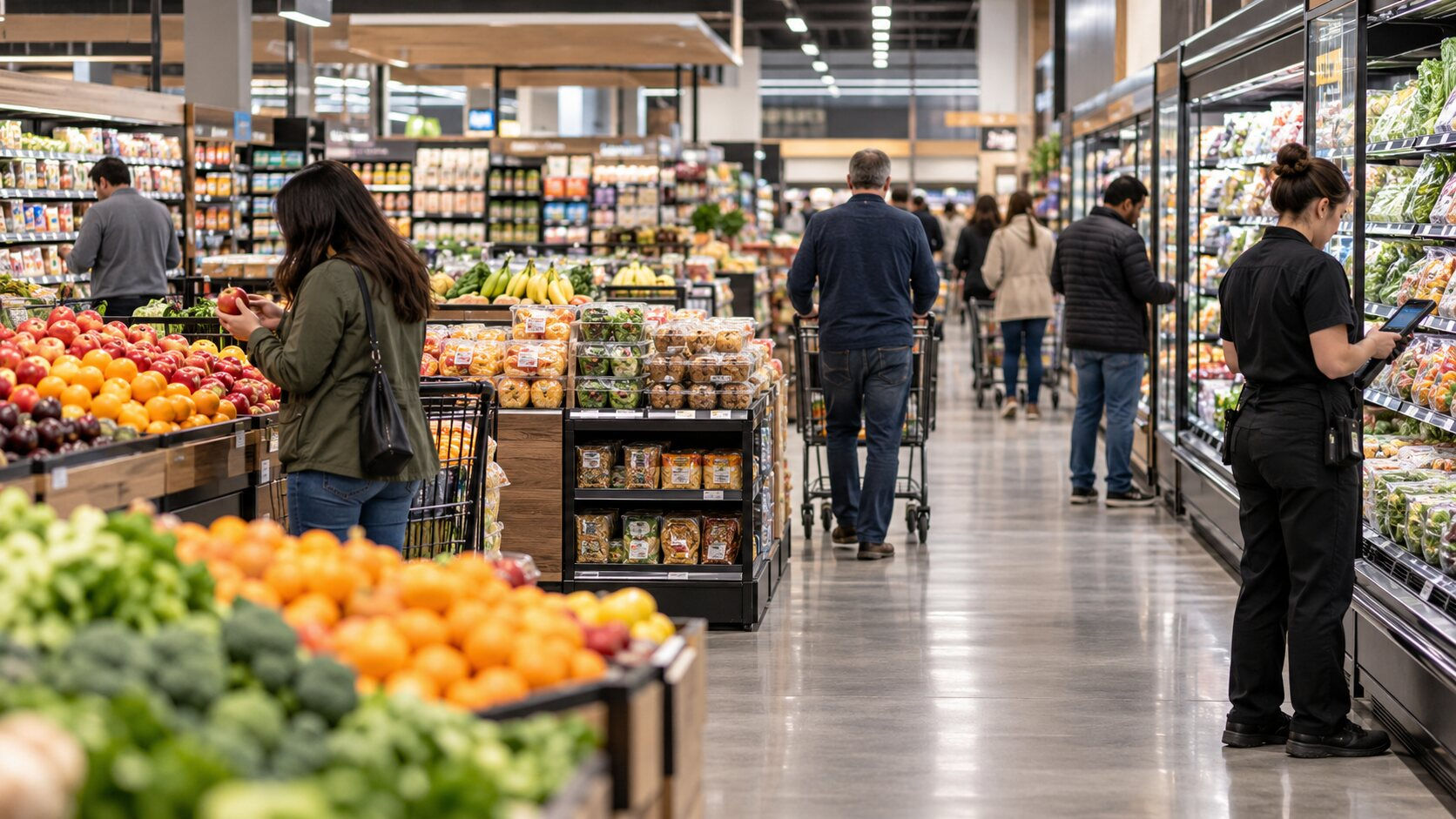
Visual note: The image is an original contextual editorial illustration created for Agrilinkage. It depicts a generic supermarket environment and does not show an actual Albertsons store or the October 13 corporate announcement. No interviews were conducted for this article.


Comments