
DMart Adds 15 Stores, but Profit Growth Trails Sales

India’s DMart supermarket chain opened 15 stores in the three months to September 30, 2026, taking its network to 518 locations as revenue grew faster than profit.
Avenue Supermarts, the listed company behind DMart, reported standalone quarterly revenue of ₹19,206 crore, up 18.4% from a year earlier. Earnings before interest, tax, depreciation and amortisation—EBITDA, a measure of operating profit before major non-cash charges—rose 14.1% to ₹1,403 crore. Profit after tax increased 7.6% to ₹804 crore.
The gap is the important part of the result. Sales momentum remained strong, including at established stores, but the share of revenue reaching operating profit and the bottom line declined. For a retailer built around low prices and tight operating discipline, that makes costs as consequential as store growth.
DMart’s quarter in numbers
Q2 FY27 standalone | Reported | Year-on-year change |
Total revenue | ₹19,206 crore | +18.4% |
EBITDA | ₹1,403 crore | +14.1% |
Profit after tax | ₹804 crore | +7.6% |
EBITDA margin | 7.3% | Down from 7.6% |
PAT margin | 4.2% | Down from 4.6% |
New stores | 15 | 518 total |
All figures in the table are standalone results. The company also reported consolidated revenue of ₹19,644 crore and consolidated profit after tax of ₹743 crore, which include its subsidiaries and consolidation adjustments.
The incremental revenue produced thinner profit
Standalone revenue increased by ₹2,987 crore from the same quarter last year. Over that period, EBITDA increased by ₹173 crore and profit after tax by ₹57 crore.
Put another way, for each ₹100 of additional revenue reported year on year, the arithmetic shows about ₹5.80 of additional EBITDA and ₹1.90 of additional profit after tax. This is a comparison of two quarterly income statements, not a claim that each new rupee of sales caused those exact profit amounts. It does, however, show why the headline sales growth should not be read as equivalent profit growth.
The EBITDA margin narrowed to 7.3% from 7.6%, while the profit-after-tax margin fell to 4.2% from 4.6%. Avenue Supermarts identified entry-level wage inflation as one factor raising operating expenses. The results do not provide a full cost bridge, so it would be too strong to assign the entire margin decline to wages.
Older stores are growing, not only the footprint
Stores that had been open for at least two years grew sales by 9.5% during the quarter, up from 6.8% growth for the same cohort measure a year earlier. That suggests the expansion was not solely a matter of adding locations: the mature estate also sold more.
The reported figures do not disclose enough information to divide total growth precisely between new stores, existing-store volumes, price changes and mix. Readers should therefore resist treating the 9.5% figure as a pure volume measure or as a direct proxy for food inflation.
DMart’s 518-store network covered 21.4 million square feet at September 30. A simple division gives roughly 41,300 square feet per listed store, but that is only an estate-wide average; individual formats vary, and one Navi Mumbai store in the count was closed to customers for reconstruction.
Why the result matters beyond one retailer
DMart is one of India’s largest food and grocery retailers, so its results offer a useful view of the tension between value pricing, expansion and rising operating costs. Strong sales and faster growth at older stores point to continued demand. Narrower margins show that scale does not automatically protect profit when labour and other expenses rise.
For suppliers, the addition of 15 stores expands routes to market for packaged foods, household products, dairy, produce and other everyday goods. For competitors, the result raises the pressure to match value while funding their own distribution, property and staffing needs. For shoppers, DMart’s commitment to low prices remains central, but the company’s margin trend shows the cost of sustaining that proposition.
The online unit, DMart Ready, gave no separate revenue or profitability figure in the release. Management said its focus was operating efficiency and customer experience in existing cities. Without segment numbers, investors cannot yet judge from this release how much the online business contributed to consolidated growth or the group’s margin movement.
What to watch next
Three indicators will clarify whether the quarter represents healthy expansion with temporary cost pressure or a more persistent squeeze: growth at stores open for at least two years, the pace and location of store additions, and whether EBITDA and profit margins stabilise as the new estate matures.
The first half of FY27 provides some context. Standalone revenue rose 16.8% to ₹37,550 crore, EBITDA increased 15.2% to ₹2,930 crore, and profit after tax grew 10.3% to ₹1,739 crore. The company added 18 stores during the six months, meaning 15 of those openings occurred in the second quarter.
Primary source: Avenue Supermarts’ October 10, 2026 filing and Q2 FY27 press release submitted to the National Stock Exchange of India and BSE.
Related reading: How retail food prices can diverge from farm and wholesale signals.
Also from Agrilinkage: Morrisons and Just Eat’s robot grocery-delivery test.
Method note: Agrilinkage calculated the changes in rupee amounts and the incremental revenue-to-profit comparisons from the company’s reported standalone Q2 FY27 and Q2 FY26 figures. The calculations are descriptive and do not isolate causation.
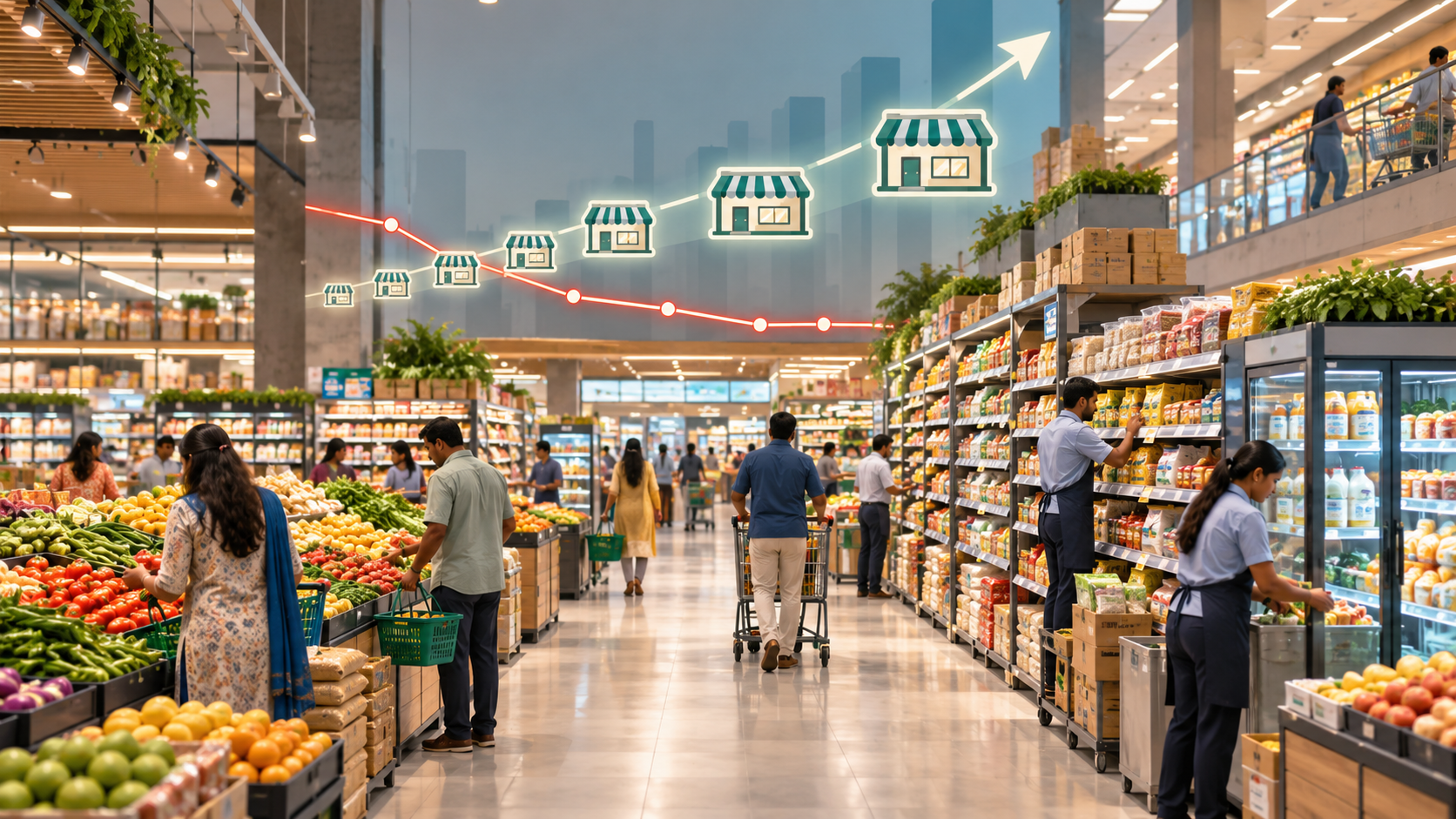
Image note: The cover is an original Agrilinkage editorial illustration generated with OpenAI. It represents supermarket growth and margin pressure and does not depict an actual DMart store or location.


Comments