
Global Crop Outlook Splits as El Niño Strengthens

Updated: 1 day ago
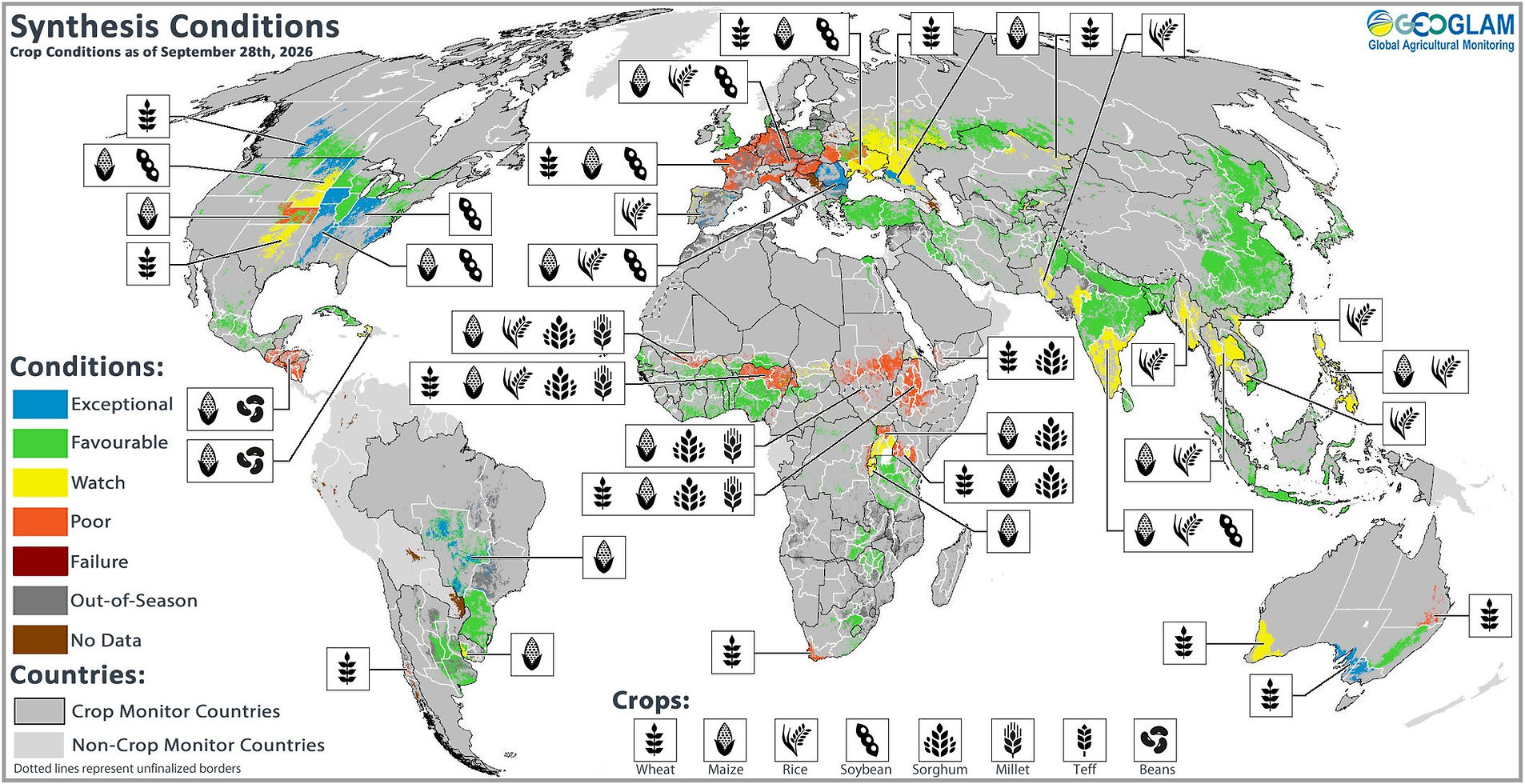
A new global crop assessment shows a deceptively calm headline masking unusually wide differences between major producing regions. Overall conditions for wheat, maize, rice and soybeans were generally positive at the end of September, yet the same report pairs good U.S. soybean prospects with poor European crops, strong Brazilian maize yields with drought-damaged harvests in Central America, and exceptional wheat conditions in parts of Australia with yield threats elsewhere.
The contrast matters because global supply is increasingly being decided by offsetting regional outcomes rather than a uniformly good or bad season. It also arrives as El Niño strengthens, raising the value of crop-by-crop and region-by-region monitoring over broad assumptions about what the climate pattern will do.
A global map with local stress points
GEOGLAM Crop Monitor’s report No. 48, published on October 1 and based on conditions through September 28, combines satellite observations, field reports, ground observations and assessments from national and regional specialists. Its synthesis map shows broadly favorable global conditions, but flags drought, heat, flooding, conflict and other hazards where they affect active crops.
For soybeans, the clearest split is across the Atlantic. The U.S. harvest was beginning faster than normal with good yields expected in most regions. Canada was also expected to produce slightly above-average yields. In the European Union, however, high temperatures and dry weather left soybean conditions poor, while Ukraine was expecting below-average yields after a season of low rainfall and above-average temperatures.
Russia provided a counterweight, with soybean conditions described as favorable to exceptional, particularly in the south after good rainfall. China’s crop was also favorable as it moved through late grain filling and ripening. The result is not a single global soybean story but a redistribution of production performance among origins.
Maize prospects diverge inside major markets
The maize picture is similarly fragmented. Brazil’s larger, summer-planted crop was finishing with above-average yields, while its smaller spring crop was being sown. In the United States, harvest was starting with below-average yields expected in the Plains but good yields in parts of the central Corn Belt.
Europe’s outlook was weaker. Persistent rainfall deficits and episodes of hot weather continued to worsen maize conditions across western and parts of central Europe. Western Ukraine was expecting poor yields after drought and high temperatures, while Russia was reporting good yields. Across Guatemala, El Salvador, Honduras and Nicaragua, extended dry spells and high temperatures left first-season maize crops in poor condition.
Those observations align with the Food and Agriculture Organization’s October cereal update. FAO cut its global coarse-grain forecast by 3.3 million tonnes to 1.612 billion tonnes, mainly because hot and dry weather reduced maize yield potential in the European Union and the United States. That downgrade was partly offset by improved Australian barley prospects.
Wheat and rice carry different regional risks
Wheat conditions also resist simple global labels. U.S. spring wheat harvesting was finishing with above-average yields, but persistent heat and dryness in the Southern Plains was a concern as winter wheat sowing began. Australia showed exceptional conditions in South Australia and Victoria, while dryness reduced prospects in Queensland and threatened yields in Western Australia.
FAO nevertheless raised its 2026 global wheat forecast by 3.2 million tonnes to 813.9 million tonnes after better-than-expected Australian weather in July and August improved yield expectations. The agency cautioned that Australian yields were still expected to remain below average and that dry conditions late in the season could still erode results.
Rice conditions were generally favorable globally, but several Asian production zones were under stress. Thailand’s wet-season rice had been hurt by drought. Heavy rain and strong winds reduced yield expectations in the Philippines, while a tropical cyclone and mid-September rainfall damaged northern Vietnamese crops. In India, conditions were broadly favorable, although western and southern states faced dryness.
FAO’s separate supply assessment put 2026/27 global rice output at 552.5 million tonnes on a milled basis, 2.4 percent below the previous season’s record. It cited lower and poorly distributed monsoon rainfall in India, including tighter irrigation water supplies in southern producing states, as part of the reduction.
El Niño raises risk, but not everywhere in the same way
GEOGLAM reported that El Niño was present and strengthening. Based on the September NOAA outlook, the event had a greater than 90 percent chance of being very strong from September 2026 through January 2027, with an 80 percent chance that El Niño conditions would persist through April.
That forecast is a risk signal, not a deterministic yield forecast. El Niño tends to shift rainfall probabilities differently across regions: some production zones become more likely to be wet, others dry, and the timing relative to planting, flowering or grain filling can be decisive. Irrigation, soil moisture reserves, crop choice and local temperatures further shape the result.
The practical message for producers, buyers and input suppliers is to watch exposure rather than the global label. A strong U.S. soybean harvest cannot erase every consequence of weak European yields, just as a higher wheat forecast does not remove the downside risk in Australia or dry sowing conditions in the U.S. Southern Plains.
Why the dispersion matters
FAO still expects world cereal production of 2.979 billion tonnes in 2026, down 2.1 percent from the previous year’s record but the second-largest harvest on record. That large aggregate can make the system look comfortable. Yet the crop monitor shows why regional dispersion matters operationally: quality, feed availability, import needs, freight routes and local prices respond to where grain is produced, not only to the worldwide total.
For farm businesses, the immediate decisions are local—whether soil moisture justifies planting, whether heat has reduced yield enough to alter harvest logistics, and whether expected crop quality changes storage or marketing plans. For agribusiness, the same map points to shifting demand for seed, crop protection, irrigation, grain handling and feed substitution.
The October evidence therefore supports a disciplined reading of the season: global production remains large, but it is being assembled from sharply different regional outcomes. As El Niño intensifies, those gaps—not a single global average—are likely to be the most useful guide to production risk.


Comments