
ADNOC Opens AED60 Billion UAE Manufacturing Pipeline Through 2030

ADNOC has opened a manufacturing demand pipeline worth more than AED60 billion, about US$16.3 billion, for companies prepared to make industrial equipment and critical spare parts in the United Arab Emirates through 2030. The state energy group announced the programme in Abu Dhabi on 25 October 2026, pairing the demand signal with a redesign of supplier registration, procurement and local-content rules.
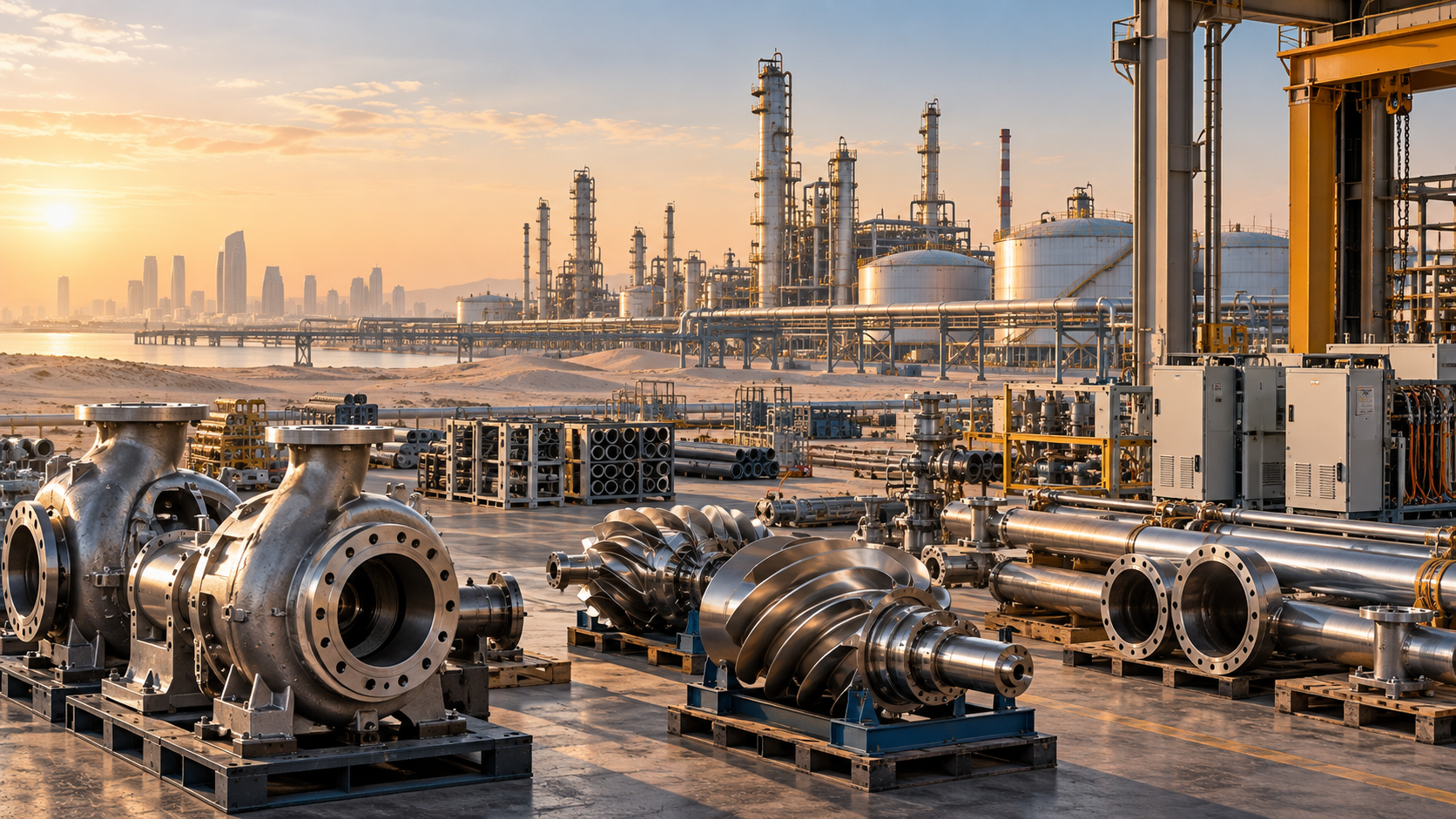
The official announcement covers more than 200 products, including pumps, compressors and other rotating equipment, electrical and automation systems, drilling and completion equipment, chemicals, catalysts, piping, fabricated components, heavy machinery and advanced spare parts. Many are currently imported.
The headline number needs careful interpretation. It is not a single factory budget, an awarded contract value or a promise that every listed product will be localized. It is ADNOC's estimate of procurement opportunities that could support investment if manufacturers qualify, compete successfully and can meet the required price, quality and delivery standards.

Original conceptual editorial illustration. It does not depict a specific ADNOC facility or announced factory.
A demand map, not a cheque
The programme's economic significance lies in demand visibility. Industrial suppliers often hesitate to build local capacity when orders are uncertain, qualification is slow and a large customer buys in short cycles. ADNOC is attempting to reverse that sequence by publishing a multi-year view of products it expects to need, then connecting eligible manufacturers with industrial databases, investment support and financing through the National Industrial Resilience Fund.
Dividing AED60 billion evenly across 200 products produces a rough average of AED300 million per product. That is not a forecast because demand will be concentrated unevenly across equipment classes, models and years. The calculation is useful only as a scale check: the pipeline is large enough to support multiple specialized investments, but no manufacturer should treat the aggregate as an implied order book.
UAE industry officials said the published list identifies the required products and estimated demand value year by year. That detail matters more to a factory investment committee than the headline total. A manufacturer needs to know whether annual volumes can support machinery, certification, working capital and skilled labor before building or expanding capacity.
What ADNOC wants made locally
The product groups reach across the physical systems that keep oil, gas, petrochemical and industrial sites operating: rotating machinery and power systems; electrical, control and automation equipment; drilling and well-completion components; chemicals and catalysts; piping and fabrication; heavy equipment; and critical spare parts. The breadth means the opportunity is not limited to large engineering contractors. It can also reach foundries, machine shops, electrical-panel builders, valve and pump specialists, chemical formulators and maintenance-parts producers.
This has indirect relevance for food and agriculture even though the programme is centered on energy. Reliable gas, power, chemicals and industrial maintenance support the region's fertilizer, desalination, cold-chain and processing systems. Localization can shorten replacement-part lead times during disruptions, but it does not automatically reduce prices for downstream users. Local suppliers still have to demonstrate competitive total cost, consistent quality and dependable delivery.
ADNOC says local production can reduce exposure to global supply shocks. That claim is plausible for time-critical components, especially where imported spares create long outages. Yet localization also creates concentration risk if a single approved domestic source replaces a diversified international supplier base. Resilience depends on redundancy, inventories, quality assurance and access to raw materials, not merely the address of the final factory.
The procurement reform may matter as much as the product list
A large opportunity list is of limited value if qualification takes too long or if smaller suppliers cannot predict how local-content rules affect bids. ADNOC says its redesigned registration and prequalification process aims to cut completion time by as much as 80 percent, halve the number of required documents and remove prequalification requirements for 60 percent of service categories. A single digital window is intended to combine registration, qualification and compliance.
The group is also integrating commercial and In-Country Value offers into one evaluation model rather than using the previous bid-matching process. The stated objective is to make suppliers submit their strongest commercial and local-value terms from the outset. Automated calculation and release of ICV-related retention payments could also improve cash-flow visibility for suppliers once obligations are met.
Reporting from The National adds operational detail: the new evaluation is weighted 70 percent to commercial terms and 30 percent to ICV, contracts below AED2 million are exempt from ICV requirements, and contracts below AED50 million no longer face ICV retention obligations. These thresholds can materially change the working-capital burden for smaller contractors.
Local+ expands, but approval is not an order
ADNOC has expanded its Local+ programme to more than 100 UAE manufacturers from 70 when it launched in May 2026. That is an increase of at least about 43 percent in roughly five months. Local+ requires engineering, procurement and construction contractors bidding on new projects to source eligible products from approved manufacturers.
The mechanism can create a stronger route to market for factories that pass the approval process. It can also raise barriers for firms outside the approved pool. Manufacturers therefore need to distinguish three milestones: inclusion on a product opportunity list, approval under a sourcing programme and receipt of an actual purchase order. Only the third creates revenue, and even then margins depend on contract terms and input costs.
ADNOC says its ICV programme has redirected more than AED307 billion into the UAE economy since 2018, supported localization of more than 130 products, contributed to the development of 95 factories and supported employment opportunities for more than 27,500 Emiratis in participating private-sector companies. Those figures show that the model has a track record, but they do not reveal utilization, profitability or export competitiveness at the individual-factory level.
What would turn the pipeline into industrial capacity
The next evidence should come in product-level procurement schedules, supplier approvals and factory investment decisions. The strongest signals will be long-term purchase arrangements, disclosed annual volumes, named manufacturers, construction timetables, equipment orders and financing commitments. Without those details, the AED60 billion figure remains a market opportunity rather than committed capital spending.
Investors and suppliers should also watch how much of the listed demand is genuinely contestable. Some items may require proprietary designs, existing original-equipment-manufacturer relationships or lengthy operating qualification. Others may be viable for local production only if manufacturers can export beyond ADNOC once the initial demand cycle matures.
The strategic test is therefore not how many products appear on the list. It is whether ADNOC's purchasing visibility and faster qualification produce factories that remain competitive after initial support, meet technical standards consistently and serve customers beyond one procurement ecosystem.
Methodology and disclosure
This article was prepared by the AgriLinkage Companies & Investment desk from ADNOC's 25 October announcement published by the Emirates News Agency, a related statement from UAE industry officials, ADNOC's official supplier portal and contemporaneous reporting from The National. Monetary conversions use the official announcement's stated US-dollar equivalent. Calculations are original and are labeled as illustrations, not forecasts. No interviews were conducted for this article.



Comments