
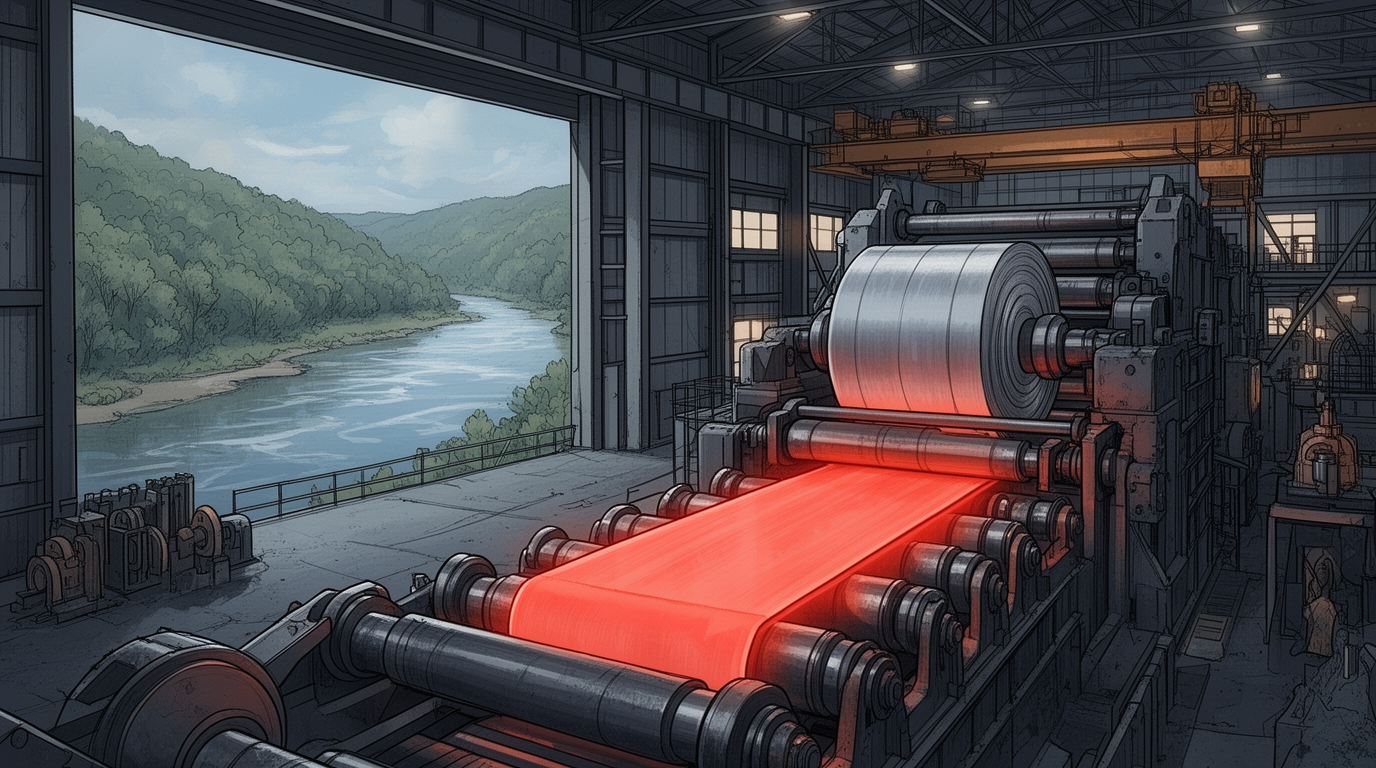
U.S. Steel Approves Nearly $3 Billion Mon Valley Hot Strip Mill

U.S. Steel’s board has authorized full funding for a new hot strip mill at Mon Valley Works near Pittsburgh, moving a nearly $3 billion modernization from a broad commitment into an approved capital project. The company announced the decision on 22 October 2026. Construction remains subject to required permits, and initial production is targeted for late 2029.
The company’s announcement says annual hot-strip capacity at Mon Valley Works is expected to rise from about 2.2 million tons to about 3.5 million tons. That is an increase of 1.3 million tons, or approximately 59%, based on Agrilinkage’s calculation. The comparison is a capacity target, not a production forecast: actual output will depend on permitting, construction, commissioning, demand and utilization.
What the authorization changes
U.S. Steel had already committed at least $1 billion to Mon Valley Works in 2024. A company-commissioned economic-impact study published in June 2026 evaluated construction scenarios of $2.0 billion and $2.5 billion. The board’s new authorization of nearly $3 billion is therefore more specific and larger than the study’s upper scenario—roughly 20% higher if “nearly $3 billion” is compared with $2.5 billion. The precise approved amount was not disclosed, and the study and board decision may not cover identical scopes, so the percentage is a directional comparison rather than an audited cost escalation.
Board approval does not mean construction has begun. The company says work will proceed after required permits are secured. Engineering, equipment procurement, site preparation, construction, commissioning and customer qualification still separate the authorization from commercial output. The late-2029 production date is a company target rather than a guaranteed completion date.
Capacity is up 59%, but the comparison needs care
The planned mill is not simply 1.3 million tons of greenfield capacity added alongside every existing asset. U.S. Steel’s June 2026 economic-impact study says the new hot strip mill is intended to replace the 87-year-old mill at the Irvin Plant, which is slated for decommissioning. The useful comparison is therefore the company’s stated before-and-after annual capacity for the Mon Valley operation: approximately 2.2 million tons today versus 3.5 million tons after the project.
That distinction matters for steel buyers and regional planners. Nameplate capacity describes what an asset is designed to produce, not what it will necessarily ship each year. Utilization, maintenance, raw-material availability, product mix and market demand can all create a gap between capacity and realized production. The announcement does not provide a year-by-year ramp-up curve.
The technical case
Hot strip mills reheat steel slabs and roll them into thinner coils used by downstream manufacturers. U.S. Steel says the Mon Valley design will include walking-beam furnaces and an in-line slab-sizing press. The company expects the configuration to lower fuel use, eliminate a cutting step, reduce scrap and improve product quality and flexibility.
Those benefits have not yet been measured in commercial operation at the proposed mill. They should be treated as design claims until operating data are available. The targeted markets—automotive, appliances, construction and line pipe—also require different grades, dimensions and customer qualifications. For agriculture and food supply chains, flat steel is an upstream input into machinery, storage, processing equipment and infrastructure, but the project alone does not determine those sectors’ steel prices.
U.S. Steel is separately constructing an approximately $100 million slag granulator at Mon Valley Works. That project is distinct from the hot strip mill authorization. Taken together, the investments indicate a broader effort to modernize the integrated complex rather than a single isolated equipment replacement.
Jobs and tax estimates need an explicit label
The company cites 5,100 to 6,300 jobs and $46 million to $58 million in Pennsylvania state and local tax revenue over a three-year construction period. Those figures come from the June study by Parker Strategy Group, which U.S. Steel commissioned. They are modeled economic impacts, not confirmed permanent jobs or tax receipts.
The study says its analysis used company-provided inputs and an IMPLAN economic model, and that actual outcomes may differ. It also excluded equipment purchases from the Pennsylvania impact model because the origin of that equipment was uncertain. The job figures include direct, indirect and induced employment supported during construction; they should not be read as 5,100 to 6,300 new permanent positions at the mill.
There is another limitation: the study modeled $2.0 billion and $2.5 billion construction scenarios, while the board has now authorized nearly $3 billion. It would be inappropriate to scale the study’s jobs or tax estimates mechanically without knowing how the additional spending is divided among local labor, out-of-state equipment and other costs.
Why buyers and suppliers should care
If completed and ramped as planned, the 1.3-million-ton increase in annual capacity could materially change the volume and product mix available from the Mon Valley complex. That is relevant to flat-rolled steel buyers, fabricators and distributors, and to suppliers of industrial equipment, automation, refractories, construction services and logistics. It also signals long-horizon capital deployment by U.S. Steel under Nippon Steel ownership.
The project does not by itself establish a price outlook. North American flat-steel prices will continue to reflect demand, trade policy, competing capacity, imports, energy and raw-material costs, maintenance outages and inventory decisions. The mill’s commercial effect will become clearer only as U.S. Steel discloses its product mix, customer qualifications, transition plan for the Irvin mill and ramp-up schedule.
What to watch next
The next verifiable milestones are permit applications and approvals, a confirmed construction start, major equipment and construction contract awards, and a detailed transition timetable for the Irvin mill. Buyers should also watch for customer-qualification schedules and a clearer split between commodity volume and higher-value grades.
After commissioning, the most useful evidence will be actual throughput, yield, fuel consumption, scrap rates and product-quality results compared with the company’s design claims. Updated disclosures should also separate temporary construction employment from permanent operating headcount and explain whether the larger authorized budget changes the earlier economic-impact estimates.
Methodology and sources
Agrilinkage reviewed U.S. Steel’s 22 October 2026 announcement and the company’s June 2026 economic-impact study. Capacity and budget comparisons were calculated from figures in those documents and rounded. Company projections and commissioned-model estimates are identified as such. This article is desk research by Agrilinkage Companies & Investment; no site visit or interview was conducted.


Comments