
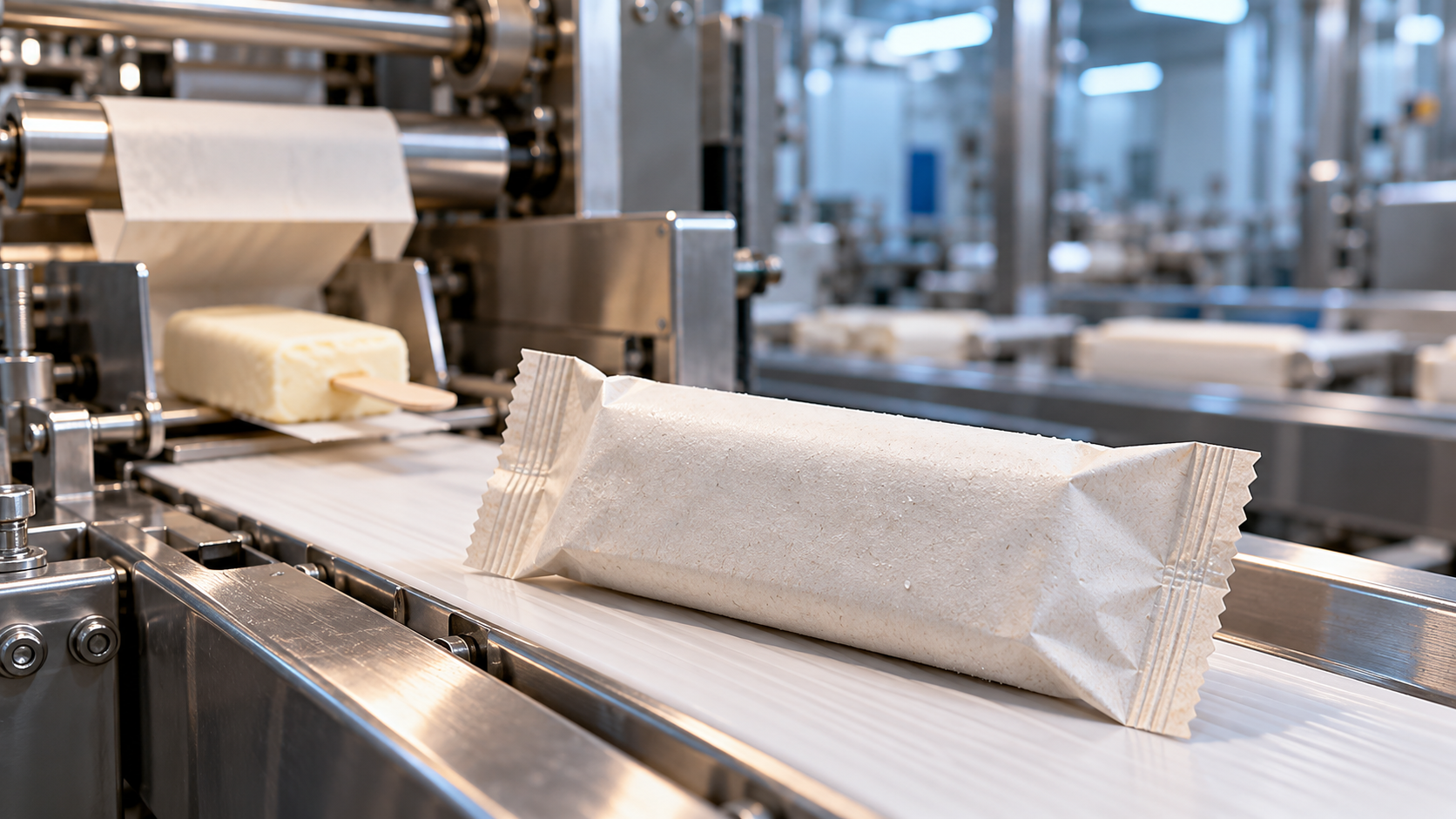
Tetra Pak Starts European Trials of Ice Cream Wrap Made With Up to 85% Paper

Tetra Pak has moved a new paper-heavy ice cream wrapper into live production trials in Europe, a step that will test whether a material change that looks simple to shoppers can work reliably on industrial packaging lines and through a frozen-food supply chain.
The company announced the Tetra Pak Ice Cream Wrap on October 6, 2026. It says the wrapper is made with up to 85% paper sourced from Forest Stewardship Council-certified forests and other controlled sources. A phased commercial rollout is planned for the fourth quarter of 2026, starting in Europe before expansion to other markets.
The product is not a paper-only wrapper. Tetra Pak says the paper-based structure also contains polymer, ink and lacquer. Those additional materials provide protective and converting functions, but they also mean the 85% figure should be read as a material-composition claim, not as proof that the finished pack is plastic-free, recyclable everywhere or accepted by every local paper-recovery system.
Trials will decide whether the wrapper works at factory speed
Swedish ice cream producer Triumf Glass is among the European companies validating the wrap in production. That detail matters because frozen confectionery packaging has to do more than look good on a shelf. It must run through forming, filling and sealing equipment without excessive stoppages, hold its seals at low temperatures, resist moisture and grease, protect the product during distribution and preserve print quality despite condensation and handling.
Tetra Pak says the material has a thin profile and a multilayer structure designed to protect the product while using materials efficiently. The announcement does not disclose line speeds, sealing temperatures, barrier specifications, shelf-life results, waste rates or the cost difference compared with the film structures ice cream producers already use. The current trials are therefore a commercial and operational test, not just a marketing exercise.
For a manufacturer, a packaging change becomes valuable only if the total system works. A wrapper with more paper could support brand and material-reduction goals, but lost output, higher reject rates, damaged products or a need for major line modifications could erase those gains. The phased rollout gives Tetra Pak and its customers time to measure those trade-offs before broad deployment.
What up to 85% paper means—and what it does not
The paper share is the clearest technical number Tetra Pak has released. It indicates that fiber is the dominant material by weight in the new structure. The company describes the barrier as paper-based and says the remaining components include polymer, ink and lacquer. It has not published a full layer-by-layer composition in the launch announcement.
That distinction is important for buyers and sustainability teams. Paper content, renewable content, recyclability and actual recycling rates are different measures. A package can contain a high share of paper yet still need a specialized recovery route if coatings or barriers affect how it behaves in a paper mill. Collection rules also vary between countries and municipalities.
Tetra Pak did not make a universal recyclability claim in the October 6 release. Producers evaluating the wrap will therefore need market-specific evidence: recognized design-for-recycling assessments, confirmation from relevant collection and sorting systems, and clear disposal instructions for consumers in each country where the product is sold.
Why ice cream brands are looking beyond flavor
Packaging has become a more visible competitive tool in frozen desserts. Tetra Pak cited consumer research indicating that 24% of consumers globally consider sustainability important in ice cream packaging and 16% prefer paper packaging for the category. Those figures describe preferences, not guaranteed buying behavior, but they help explain why suppliers are testing a paper-forward format in a product category still dominated by tubs, cartons, sleeves and flexible wraps.
A matte paper appearance can make a product feel different in a freezer cabinet, where glossy plastic films and coated cartons are common. For brands, that creates a potential design advantage as well as a sustainability message. For retailers, however, the pack still has to remain legible, clean and intact after storage, transport and repeated exposure to freezer condensation.
The launch also broadens Tetra Pak's role beyond the beverage cartons most consumers associate with the company. It applies the group's paper-based packaging experience to an individually wrapped frozen product, where heat sealing, cold-chain durability and line performance create a different engineering problem.
The questions producers should ask before adopting it
Ice cream manufacturers considering the new wrap will need to examine more than the headline paper percentage. Key questions include whether existing wrapping machines can use the material with only minor adjustments; how the seal performs across product temperatures; whether the wrapper tears cleanly for consumers; and how much material is rejected during start-up, changeovers and full-speed production.
Procurement teams will also need pricing, minimum-order volumes, print specifications and supply assurances. Sustainability teams should ask for a verified life-cycle comparison against the exact incumbent pack, not a generic comparison between paper and plastic. Recycling guidance should reflect the infrastructure in the sales market rather than a single global claim.
The live trials with Triumf Glass should provide some of that evidence. Tetra Pak says they are being used to assess performance in real production environments and gather consumer insights before wider commercialization. Until those results are published, the strongest conclusion is limited but meaningful: the wrapper has advanced from a concept to industrial validation with a named producer and a near-term European launch plan.
What happens next
Tetra Pak plans to introduce the wrap in phases during the fourth quarter of 2026. The most important next disclosures will be the markets and ice cream formats included in the rollout, whether customers need new equipment or retrofits, independently verified environmental performance, and the disposal route recommended on pack.
If the material performs at commercial speeds and survives the cold chain without increasing product loss, it could give ice cream brands another option for reducing their reliance on conventional flexible film. If it cannot meet those operational tests, a high paper percentage alone will not be enough. The European rollout will show whether the new wrapper is a scalable packaging platform or a narrower premium-format solution.



Comments