

Philippine Rice Output Falls 17.8% as Harvested Area Shrinks

Philippine palay production fell 17.8% in the third quarter of 2026, but the most important detail is where the loss occurred: farmers harvested far less land while average yield barely moved. The distinction matters because it points to a contraction in planted and harvested activity—not a nationwide collapse in crop performance—as the immediate driver of the shortfall.
The Philippine Statistics Authority said on 4 November that July–September palay output was 3.08 million tonnes, down from 3.75 million tonnes a year earlier and the lowest third-quarter total since 2019. Harvested area fell 17.6% to 755,370 hectares from 916,770 hectares. Yield slipped only 0.2%, to 4.08 tonnes per hectare from 4.09 tonnes.
The PSA’s Palay Situation Report provides the official production, area and yield comparison. The figures show that the scale of the output loss closely tracked the loss of harvested hectares.
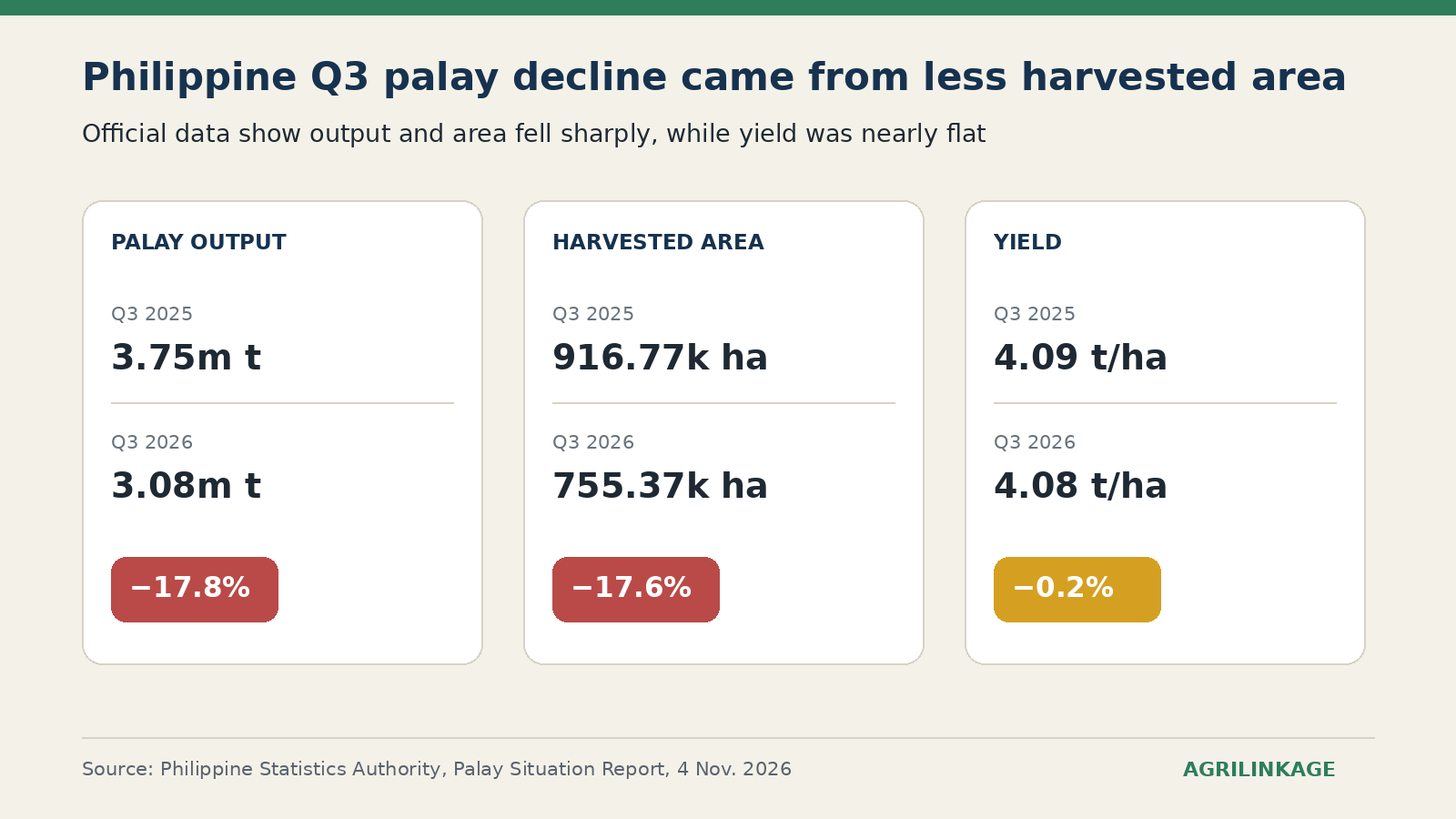
Agrilinkage chart based on Philippine Statistics Authority data published 4 November 2026.
The area decline changes the diagnosis
A production change can come from two basic sources: how much land is harvested and how much grain each hectare produces. Here, those two components moved very differently. Harvested area dropped by about 161,400 hectares, while yield decreased by only 0.01 tonne per hectare. In practical terms, the missing crop came overwhelmingly from hectares that did not reach harvest during the quarter.
That does not make the decline benign. A sharp reduction in harvested area can reflect delayed planting, water constraints, storm damage, weak farm economics or farmers choosing to reduce exposure when input prices and weather risks are high. It also means that improving seed performance alone would not recover the lost volume if farmers cannot plant, irrigate or finance the same area.
The Department of Agriculture’s 4 November assessment linked the weaker outlook to high fertilizer and fuel costs, delayed planting, irrigation constraints and farmer caution as El Niño intensified. Those pressures can shrink area before they show up as a large national yield loss: a farmer may postpone or skip planting rather than plant an expensive crop with uncertain water.
El Niño is a growing risk, not the whole explanation
It would be misleading to describe the third-quarter decline as a simple El Niño yield shock. The official quarter-on-quarter decomposition does not support that claim, because yield was nearly unchanged. Cost, timing and water-access effects can interact, and local conditions differ across producing regions.
The weather risk is nevertheless becoming more important. PAGASA’s El Niño monitoring said strong to very strong conditions were likely to persist into the first quarter of 2027, with impacts possible through the first half of the year. That timeline matters because damage to irrigation supplies and planting decisions may affect later harvests rather than appearing fully in the latest quarter.
The fourth quarter may not close the gap
The PSA estimated the standing palay crop for the fourth quarter at 6.47 million tonnes as of 1 October, 5.5% below the 6.85 million tonnes estimated a year earlier. The Agriculture Department said full-year 2026 production could finish roughly one million tonnes below 2025. Both figures are estimates rather than completed harvest results, so they should be read as an early warning, not a final tally.
For the rice market, lower domestic output raises the value of inventories, imports and precise timing. The Philippines is already a major rice importer, but a weaker harvest does not translate mechanically into a one-for-one increase in imports: stock levels, consumption, import arrivals, prices, exchange rates and government policy all affect the final balance. Buyers should watch those indicators rather than infer a fixed import number from the production loss alone.
What to watch next
Three signals will test whether the area problem becomes a deeper 2027 supply problem. First is the irrigated area actually planted for the dry-season crop. Second is reservoir and irrigation availability as El Niño strengthens. Third is whether fertilizer, fuel and credit costs allow farmers to maintain input use. A later fall in yield alongside another area contraction would be more damaging than the third-quarter pattern reported now.
For policymakers, the data argue for measures that keep viable hectares in production—reliable irrigation schedules, timely seed and input delivery, workable credit and transparent import planning—rather than treating the episode only as a seed-yield problem. For households, the immediate question is not the farm statistic by itself but whether the combination of lower output, stocks and import costs pushes retail prices higher.
Methodology: Agrilinkage compared the PSA’s published third-quarter 2025 and 2026 production, harvested-area and yield figures and reviewed the Agriculture Department and PAGASA assessments. No interviews or field observations were conducted. Cover image: original Agrilinkage conceptual editorial illustration; it does not depict a specific farm or event.


Comments