
More Wheat Roots Did Not Deliver More Grain in Three Year Field Trial

A three year winter wheat field experiment in Lithuania found that management practices that increased roots near the soil surface did not consistently increase grain yield.
The peer reviewed study, published on 11 November 2026 in Frontiers in Plant Science, compared conventional ploughing, shallow harrowing and direct drilling under traditional and integrated management from 2022 through 2024.
Integrated management increased root length density by 6 percent in 2022 and 13 percent in 2023. Direct drilling also produced more roots in the measured topsoil during those two seasons. Yet grain yield did not follow the same pattern. Integrated management lifted yield by 12 percent only in 2022, no management factor significantly affected yield in 2023, and direct drilling produced the lowest yield in 2024.
The trial separates root response from farm output
The experiment used a split plot design with three field replications at the Lithuanian Research Centre for Agriculture and Forestry in central Lithuania. The soil was a loam with 2.5 percent organic carbon. Winter wheat followed field pea.
Researchers compared conventional ploughing, shallow harrowing and direct drilling. They also compared a traditional system with an integrated system that included a cover crop and other management differences. Because more than one component changed between the two systems, the yield effect cannot be attributed to the cover crop alone.
Roots were measured in the upper 20 centimetres of soil at flowering. Grain was harvested from 16.4 square metre areas and adjusted to 14 percent moisture. Soil temperature, moisture and carbon dioxide release were also measured during biologically active stages.
One positive year did not become a stable rule
In 2022, integrated management averaged 8.29 tonnes per hectare compared with 7.41 tonnes under traditional management. The difference was statistically significant and equal to about 12 percent.
That advantage disappeared in the following seasons. Integrated management averaged 5.99 tonnes per hectare in 2023 compared with 6.21 tonnes under traditional management, a difference that was not significant. In 2024 the values were 7.49 and 7.22 tonnes, again without a significant difference.
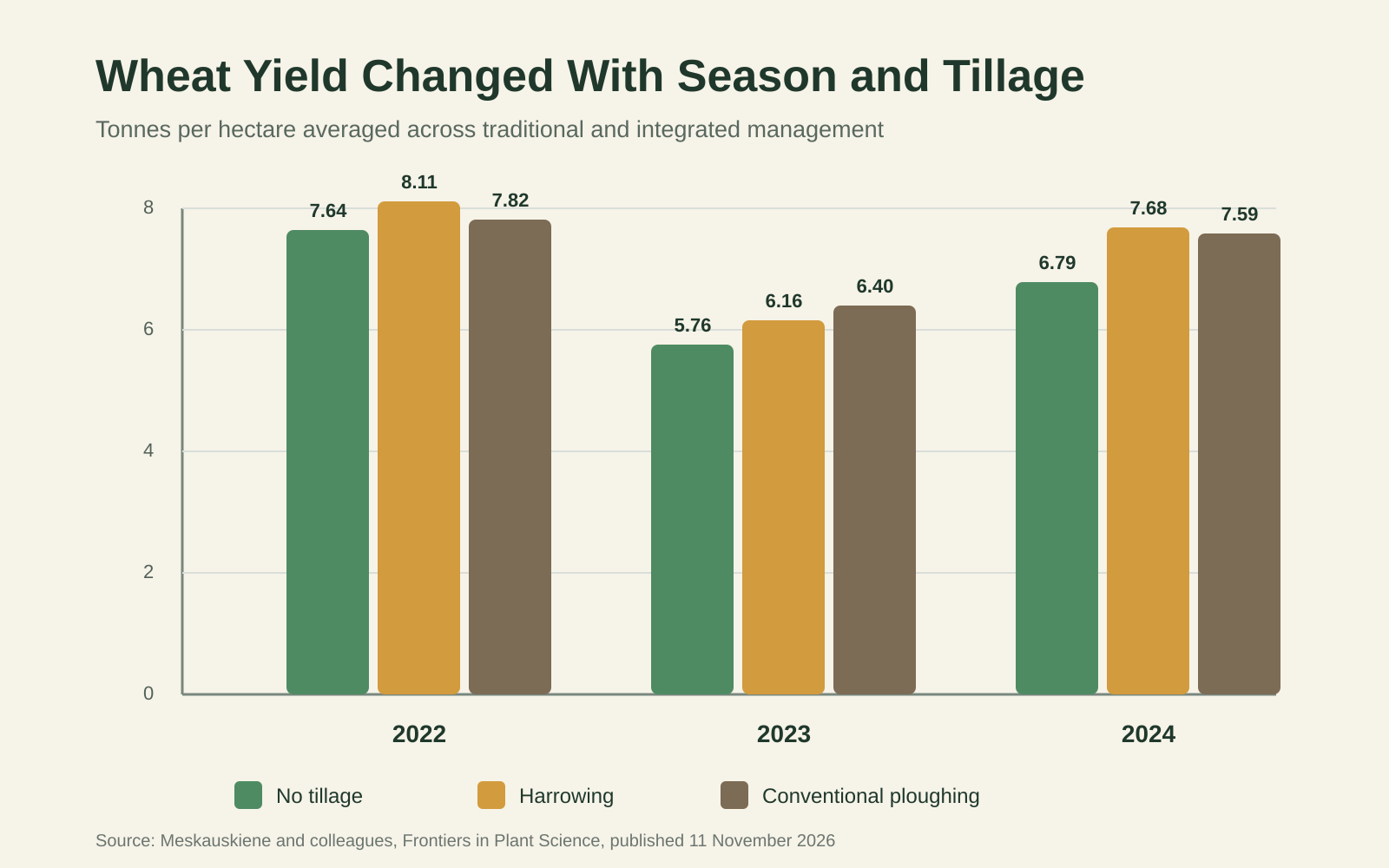
The tillage comparison also shifted with the year. Direct drilling yielded 7.64 tonnes per hectare in 2022, compared with 8.11 under harrowing and 7.82 under conventional ploughing. Those differences were not significant.
In 2023, direct drilling averaged 5.76 tonnes, harrowing 6.16 and ploughing 6.40. The declining pattern was visible but was not statistically significant.
In 2024, the difference became significant. Direct drilling produced 6.79 tonnes per hectare, while harrowing produced 7.68 and conventional ploughing 7.59. Direct drilling was about 12 percent below harrowing and about 11 percent below ploughing.
More roots near the surface were not enough
Direct drilling produced higher root length density than harrowing and ploughing in 2022 and 2023. Integrated management also increased root length density in those years. In 2024, the root differences largely disappeared.
The year with the greatest average root length density was 2023, but it also had the lowest average grain yield at 6.11 tonnes per hectare. This does not mean roots reduced yield. It means a single measurement of roots in the topsoil did not predict final grain production across very different seasons.
Deeper rooting was not measured, and root activity was not tracked through the full season. Crop establishment, nutrient access, winter recovery and later water availability could all have influenced yield. The study therefore cannot identify a single mechanism behind the weaker direct drilled result in 2024.
Weather changed the management outcome
The three seasons differed sharply. Rainfall from May through July reached 326.8 millimetres in 2022, fell to 91.8 millimetres in 2023 and recovered to 176.5 millimetres in 2024.
Average annual temperature was above the long term mean in all three years. The increase was 1.4 degrees Celsius in 2022, 2.2 degrees in 2023 and 2.8 degrees in 2024.
The study links the changing treatment response to seasonal conditions but does not prove that rainfall alone caused the yield differences. Soil carbon dioxide release fell across the three years even though rainfall recovered in 2024, showing that several environmental and biological factors were operating together.
What farmers can and cannot take from the trial
The result does not show that direct drilling is inherently inferior. It shows that benefits observed in roots or soil do not guarantee a yield advantage every year. Conservation systems may need local adjustment for establishment, residue, weeds, nutrients and seasonal stress.
The trial also cautions against judging an integrated system from one favourable season. The 12 percent yield gain in 2022 was real within the experiment, but it was not repeated in 2023 or 2024.
For growers and advisers, the practical measure is not root density alone. Yield, establishment, soil condition, fuel use, weed pressure and performance across several contrasting seasons must be evaluated together.
The evidence boundary
This was a rigorous multiyear field experiment, but it was conducted at one site. The soil, rotation, climate and equipment may differ from other wheat regions.
The integrated and traditional systems differed in more than one management component. The paper therefore cannot isolate the contribution of the cover crop, herbicide use or any single input.
Root measurements covered only the upper 20 centimetres at flowering. They do not describe the full root system or its activity at depth. The study is strongest as evidence that management outcomes changed by season and that more measured roots did not reliably translate into more grain.
Methodology: Agrilinkage reviewed the full peer reviewed study, recalculated the 2024 direct drilling yield gap against harrowing and ploughing, and reproduced the reported mean yields in an original comparison graphic. The cover is an original conceptual illustration and does not depict the trial site.



Comments