
Lynas Offers A$968 Million for Meteoric and Brazil’s Caldeira Rare-Earth Project
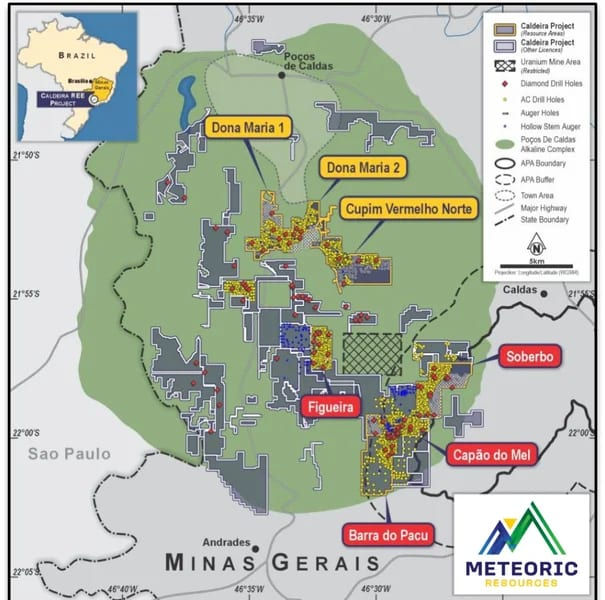
Lynas Rare Earths has agreed to pursue an all-share acquisition of Meteoric Resources that values the Brazilian developer at A$968 million on the companies’ stated fully diluted, 60-day volume-weighted basis. The proposal would give Lynas control of the Caldeira project in Minas Gerais, one of the largest advanced ionic-clay rare-earth developments outside China.
This is not a completed takeover. The transaction is structured as an Australian scheme of arrangement, remains subject to shareholder, court and regulatory steps, and is expected to be implemented in March 2027 if those conditions are met. Neither the ownership change nor Caldeira’s planned production is assured.
What Lynas is offering
Meteoric shareholders would receive 0.0207 new Lynas shares for each Meteoric share. On implementation, existing Lynas investors would own about 94.1% of the combined company and Meteoric investors about 5.9%. The exchange ratio represented A$0.286 per Meteoric share and a 68.4% premium to Meteoric’s A$0.170 closing price on September 30, according to the transaction presentation.
The A$968 million headline value is based on Lynas’s 60-day volume-weighted average price and a fully diluted Meteoric share count. At Lynas’s September 30 closing price, the companies calculated an implied Meteoric equity value of about A$876 million. An all-share structure preserves more cash for development, but the consideration will move with Lynas’s share price.
The asset behind the deal
Caldeira sits in Minas Gerais, roughly 350 kilometres from the Port of Santos and 254 kilometres from São Paulo. Meteoric’s July 2026 definitive feasibility study describes a shallow ionic-clay operation with a 23-year mine life underpinned by probable ore reserves.
The stated mineral resource is 1.631 billion tonnes grading 2,317 parts per million total rare-earth oxides. The probable reserve is 151.1 million tonnes at 3,524 parts per million. Resource size is not the same as saleable production: recovery, product quality, permitting, commissioning and operating performance will determine how much material ultimately reaches customers.
Planned capacity and capital
The feasibility case targets average annual output of 12,500 tonnes of total rare-earth oxides. Within that basket, Meteoric forecasts 3,862 tonnes a year of neodymium-praseodymium and 127 tonnes a year of dysprosium-terbium, elements used in permanent magnets for electric motors, wind turbines and other high-performance applications.
Development capital is estimated at US$498 million, including a 10% contingency, and the study gives a life-of-mine average C1 cash cost of US$11.68 per kilogram of total rare-earth oxides. These are company feasibility estimates, not guarantees. Inflation, construction execution, metallurgy and downstream commercial terms could alter the economics.
Why Lynas wants Caldeira
Lynas is the largest producer of separated rare-earth materials outside China. Caldeira would add a different ore type and a large Brazilian resource base to its Australian and Malaysian operating chain. It would also increase Lynas’s exposure to heavy rare earths such as dysprosium and terbium, which help permanent magnets retain performance at high temperatures.
The acquisition therefore looks less like a purchase of immediate production and more like an attempt to secure a long-duration feedstock option. Lynas would still have to convert a feasibility design into a permitted, financed and operating mine, then establish a reliable downstream route for the mixed rare-earth product.
Funding and development route
Lynas has offered Meteoric an interim funding facility of up to A$110 million so work can continue before the scheme is completed. The companies say Lynas’s balance sheet and operating expertise should reduce Caldeira’s funding and execution risks. The facility does not remove those risks and is governed by the scheme implementation deed.
Meteoric had received a preliminary environmental licence and was targeting an installation licence during 2026 when the deal was announced. The project layout anticipates renewable power, nearby road access and water supplied from a dam around 800 metres away. Those advantages still have to be translated into final permits, contracts and operating systems.
Approval path and timetable
Meteoric’s board unanimously recommended the scheme in the absence of a superior proposal and subject to an independent expert continuing to conclude that it is in shareholders’ best interests. Directors holding about 2.6% of Meteoric shares and the largest disclosed shareholder, Tolga Kumova and associated entities with 6.7%, gave similarly qualified voting intentions.
The indicative timetable points to a first Australian court hearing in mid-November 2026, distribution of the scheme booklet in mid-December, a shareholder meeting in late January 2027 and implementation in early March. The companies warned that Brazil’s critical and strategic minerals regime may affect timing because it can require approval for changes of control involving relevant mining rights.
What changes if the deal closes
For Lynas, the transaction would place an advanced Brazilian project beside its established production and separation network without an immediate cash purchase price. Meteoric investors would exchange a single-project developer for a minority holding in a larger producer while retaining exposure to Caldeira’s potential upside.
For the supply chain, the most important number is the proposed output mix rather than the transaction value. If Caldeira is built and performs to the study assumptions, it could add material volumes of both light and heavy rare earths outside China. Until permits, financing, construction and commissioning are completed, that contribution remains a development case rather than available supply.



Comments