
KitchenAid Luminaire adds a bowl light to the $699.99 Artisan Plus

Updated: Oct 7
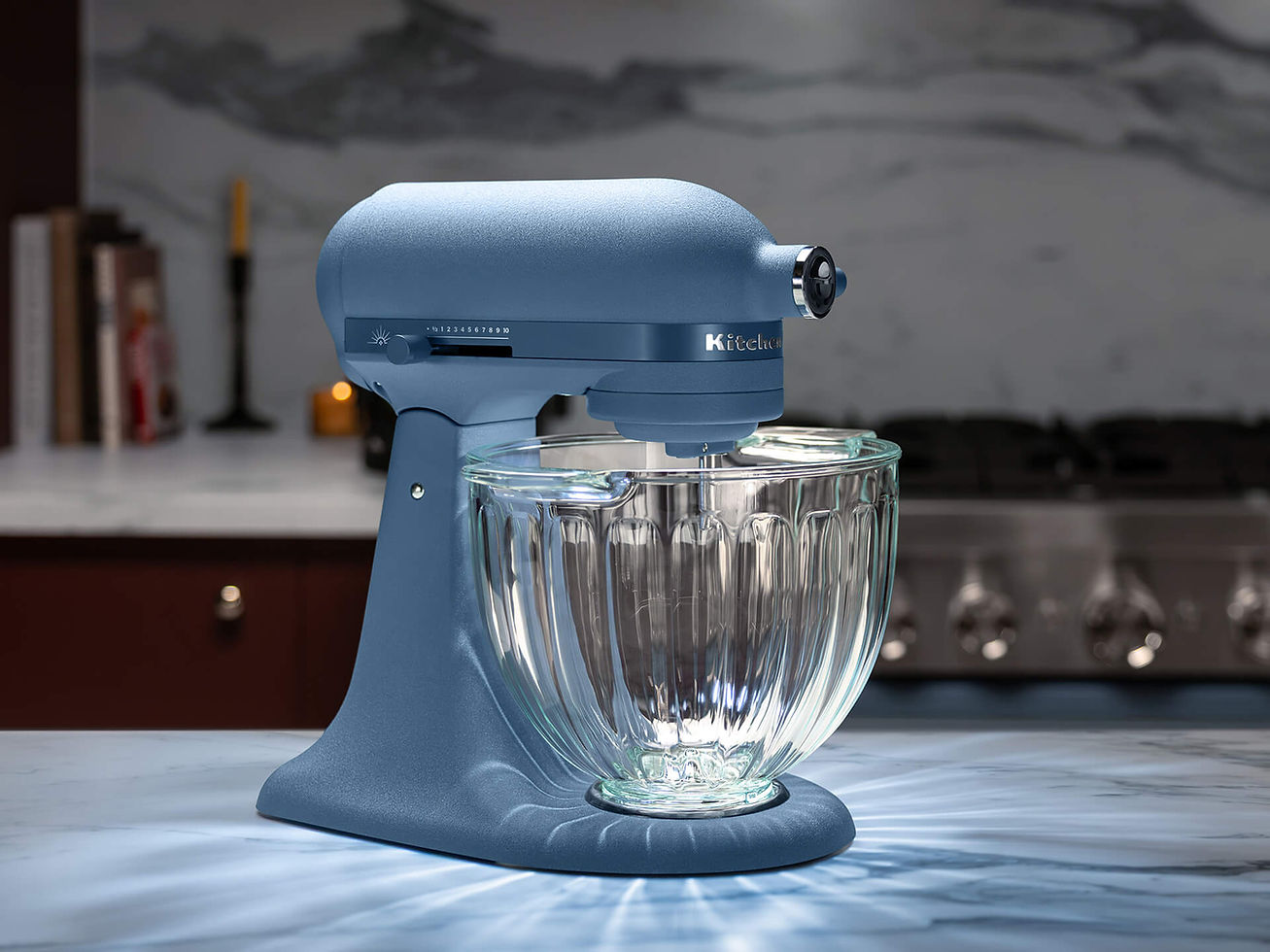
KitchenAid has put a new kind of visibility into its flagship countertop format. The 2026 Design Series Luminaire is a five-quart Artisan Plus tilt-head stand mixer with an integrated bowl light, a fluted hardened-glass bowl and a Blue Peppercorn textured finish. The U.S. product page lists model KSM50GSVXBP at $699.99. That makes Luminaire less a reinvention of planetary mixing than a premium configuration built around seeing the mixture and controlling speed more precisely.
The practical distinction begins with the Artisan Plus platform. KitchenAid specifies 11 preset speeds, a dedicated half-speed fold setting, Soft Start and a separate Precision Speed Control mode that lets the user turn the dial between presets. The combination matters for tasks at opposite ends of the mixing range: gently incorporating whipped ingredients at the low end and making smaller corrections to texture without jumping a full detent at the other. These are manufacturer-stated capabilities; Agrilinkage has not independently bench-tested the machine.
The bowl is both the product's visual signature and its most unusual working component. It holds five U.S. quarts, or 4.7 litres, and is made in Italy from fluted hardened glass. KitchenAid says it is scratch resistant and safe in the freezer, microwave, dishwasher and oven up to 475°F, equivalent to 240°C. Those limits give the bowl uses beyond mixing—softening butter, tempering chocolate, chilling dough or moving a preparation into an oven—while its pot-style handles address the extra care and weight associated with glass.
KitchenAid mounts a light above that transparent bowl so the user can see the bottom and sides while ingredients combine. That should be most useful where visual cues decide when to stop: watching flour disappear into batter, checking whether butter and sugar have creamed evenly, or spotting unmixed material that a beater has left against the glass. The light is a visibility aid, not a sensor; it does not measure doneness, temperature or gluten development.
The included tool set is unusually complete. The box contains a stainless-steel double flex-edge beater, flat beater, six-wire whip and C-style dough hook. KitchenAid says all four are dishwasher safe, and the double flex-edge design scrapes two sides of the bowl rather than one. The standard attachment hub remains available for separately sold tools used for jobs such as slicing, grinding, spiralizing and pasta making, so the design edition does not trade away the broader KitchenAid accessory ecosystem.
Price is the central buying question. At $699.99, Luminaire sits above KitchenAid's comparison-page prices for the conventional five-quart Artisan and the Artisan package configurations shown alongside it. The surcharge buys the glass bowl, light, finish, polished detailing, the Artisan Plus control system and the bundled stainless accessories. Buyers who care mainly about mixing capacity can spend less within the same brand; the premium is easier to justify for someone who will use the extra low-speed control, wants a multipurpose glass bowl and keeps the mixer permanently on display.
The product also clarifies what it is not. Five-quart capacity is suitable for ordinary household batches but is not the largest option in the KitchenAid range, and a tilt-head machine is not the same proposition as a heavier bowl-lift model for repeated dense dough work. Glass provides visibility and thermal versatility but requires more careful handling than stainless steel. The illuminated bowl may reduce guesswork at the sides and base, yet it cannot substitute for recipe judgment or for stopping to check a dough or emulsion directly.
For the right kitchen, Luminaire is a coherent specification rather than decoration alone. Its most defensible functional upgrades are the half-speed fold, continuously adjustable Precision Speed Control, integrated light and temperature-tolerant glass bowl. Its most obvious compromise is value: much of the $699.99 price is tied to materials, finish and presentation. The decision therefore turns on whether those visibility and control features will be used often enough to matter, not on an expectation that the machine will automatically outperform every less expensive KitchenAid in routine mixing.


Comments