
French Lettuce Prices Jump 57% as Heat Cuts Output 8%

France expects to harvest 389.7 million lettuce heads in the 2026-27 campaign, 35 million fewer than in the previous campaign, while producer prices in September stood 57% above a year earlier. The combination points to a sharp weather-driven supply squeeze rather than a routine seasonal fluctuation.
The figures come from Agreste's vegetable outlook published on 28 October 2026. The French agriculture ministry's statistics service classifies the production figure as a forecast as of 1 October, for a campaign running from May 2026 through April 2027. It is not a final harvest total.
Agreste also reported that September producer prices were 54% above the 2021-25 average. That measure tracks prices received by producers, not the final price paid by shoppers. Retail prices can move differently because packaging, transport, contracts, promotions, imports and store margins sit between the farm and the shelf.
More land did not prevent a smaller crop
The planted lettuce area was estimated to be 2% larger than in the previous campaign, yet full-campaign output was forecast to fall 8%. Taken together, those aggregate changes imply roughly 9.8% less output per planted hectare than the previous campaign. This is an Agrilinkage calculation, obtained by dividing the production index of 0.92 by the area index of 1.02. It is an indicator, not an official yield statistic, because regional and lettuce-type shares can change.
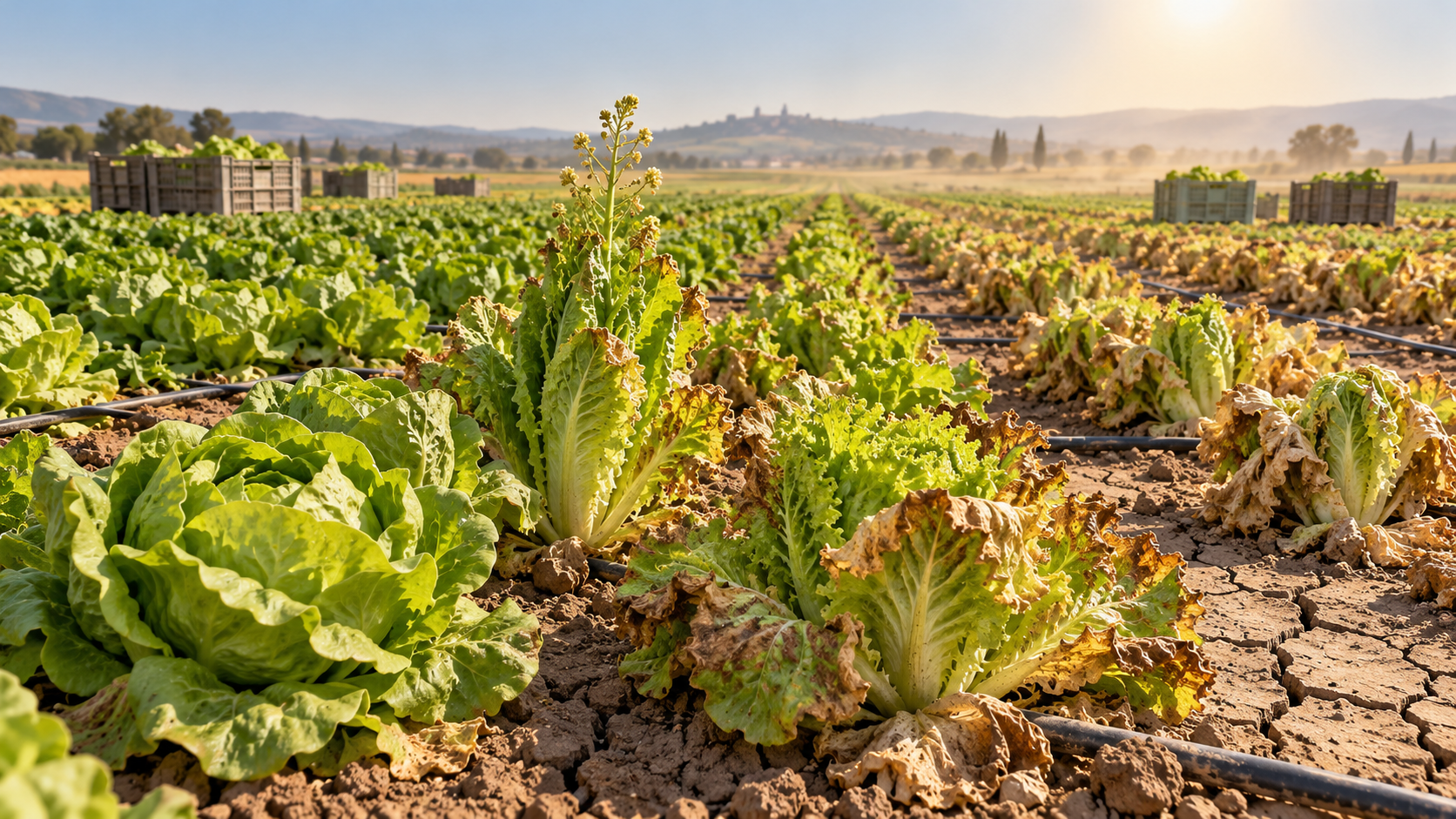
The summer was the central production shock. Agreste estimated summer output at 25% below the previous year. Heat in June reduced volumes and complicated harvesting. Further hot weather in July and August caused leaf burn and accelerated bolting, the rapid move from leaf growth to flowering that can make a lettuce unmarketable.
The result is commercially important because lettuce is sold on appearance, weight and freshness as well as total volume. A field can therefore lose marketable output even when plants remain alive. Heat damage also compresses harvest windows, increasing the risk that several growers need labor and cooling capacity at the same time.
The price signal arrived before the annual total
Producer prices were already exceptionally high in August, 58% above August 2025 and 69% above the five-year average. In September they remained 57% above a year earlier and 54% above the five-year average. Those readings show that the market had reacted to reduced availability well before the campaign's final months.
High prices do not automatically mean higher farm income. Growers may have fewer saleable heads, lower pack-out rates, additional irrigation and labor costs, and losses from quality defects. Whether the price increase offsets those costs will vary by farm, contract, region and production system.
Why the comparison base needs care
The current Agreste release says production will fall by 35 million heads to 389.7 million. That statement implies a comparison base of about 424.7 million heads. Agrilinkage uses the comparison stated in the latest release because official campaign estimates are revised as more information arrives. Mixing figures from different publication vintages can create a false change that reflects revisions rather than new field conditions.
The forecast is also uneven across the year. A 25% summer decline does not mean every region or every lettuce type lost one quarter of its crop. Winter and early spring production still have time to alter the full-campaign result, while weather, planting decisions and imports can change availability.
A wider French vegetable shock
The lettuce figures fit a broader weather pattern. Insee recorded 53 heatwave days from mid-June through August 2026 and estimated that French vegetable production overall would decline. Agreste's latest update also pointed to lower carrot and leek production, showing that the pressure was not confined to a single crop.
The transmission into the food chain will depend on substitution. Buyers can switch between lettuce types, draw on imports, alter pack sizes or promote other salads. Those responses can soften shortages, but they also move demand into neighboring crops and can raise logistics and cooling requirements.
What growers, buyers and retailers should watch
The first indicator is the next Agreste production revision, particularly whether winter output narrows or widens the current 8% campaign decline. The second is the producer-price index: a rapid fall would suggest supply is normalizing, while persistent premiums would point to continued tightness.
Buyers should also watch quality specifications, not only headline tonnage. Heat can reduce the share of harvested heads that meet retail or processing standards. Import volumes and origins matter as well, because a domestic shortfall can be offset only if alternative production is available at the right time and can reach French distribution networks without excessive delay.
For growers, the 2026 season reinforces the value of heat-tolerant varieties, planting-date diversification, irrigation scheduling, shade or cooling options where practical, and harvest plans that account for faster crop development. The official data do not prove that any one measure would have prevented the losses, but they define the production risk that adaptation must address.
Methodology and image disclosure
Agrilinkage reviewed Agreste bulletin 2026-137 and the official Insee assessment of France's 2026 heat and drought effects. Percentage comparisons and the implied output-per-area change are Agrilinkage calculations from the published aggregate figures. Forecasts may be revised and should not be read as completed harvest totals.
Cover image: original Agrilinkage conceptual editorial illustration of heat and drought stress in a lettuce field. It does not depict a specific French farm or the documented condition of any named producer.


Comments