
China Raises Sugar Output Forecast 5% as Domestic Shortfall Narrows

China has raised its sugar production forecast for the 2026 to 2027 marketing year by 670,000 tonnes, improving the outlook for domestic supply even as consumption is also expected to rise.
The November update from the Ministry of Agriculture and Rural Affairs puts production at 13.60 million tonnes, up 5.2% from the 12.93 million tonnes forecast in October. The change is large enough to alter the balance for refiners and importers, but it does not remove China from the global sugar market.
The increase is driven by cane
Cane sugar production is now forecast at 12.29 million tonnes, 860,000 tonnes above the October estimate. The ministry said planted area expanded and conditions improved in Guangxi, the main cane producing region, where rainfall and soil moisture supported crop development.
The estimated sugar crop area rose from 1.461 million hectares to 1.514 million hectares, an increase of 3.6%. Average yield was revised from 60.92 tonnes a hectare to 66.02 tonnes, an increase of 8.4%. Higher expected output per hectare is therefore doing most of the work.
Beet sugar moves in the opposite direction. Its production forecast was cut from 1.50 million tonnes to 1.31 million tonnes. The national increase depends on a much larger cane crop outweighing a smaller beet contribution.
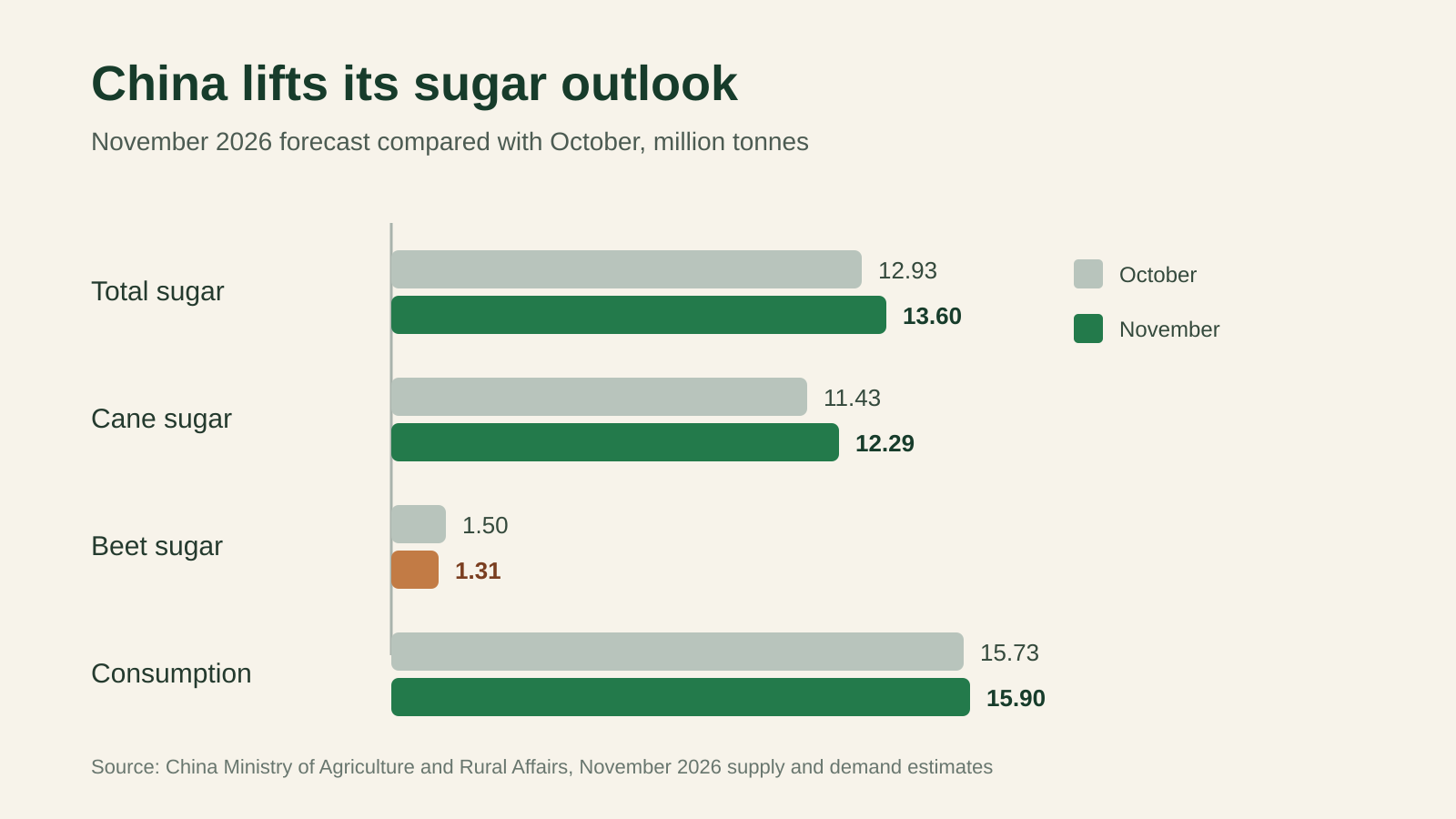
Agrilinkage chart based on official Chinese supply and demand estimates.
A smaller domestic gap, not self sufficiency
The consumption forecast was also raised, from 15.73 million tonnes to 15.90 million tonnes. Domestic output would fall 2.30 million tonnes short of consumption before imports, exports and stock changes are considered. The ministry says that shortfall is 640,000 tonnes smaller than in the prior marketing year.
That distinction matters. A narrower domestic production gap does not mean China has no import requirement. The ministry kept its 2026 to 2027 import forecast at 4.80 million tonnes and its export forecast at 180,000 tonnes. Trade timing, refining demand, stock management, quality and regional prices all influence buying.
For the global market, the signal is moderation rather than withdrawal. A stronger cane crop reduces the volume China may need merely to cover weak domestic production, but the unchanged import forecast indicates that officials still expect substantial foreign supply to enter the market.
International supply still matters
The Chinese revision arrives while the ministry has become less optimistic about output in Brazil, India and Thailand. China can therefore face a better crop at home and a tighter or more expensive import environment at the same time.
If domestic crushing performs as forecast, local raw material availability should improve. If international prices remain firm, imported sugar may still be costly, limiting the benefit for users that depend on foreign raw sugar.
The ministry retained a domestic sugar price range of 5,500 to 6,000 yuan a tonne and an international range of 16.5 to 21.5 United States cents a pound. These are forecast ranges, not guaranteed prices.
What to watch next
The first test is the Guangxi crush. Actual cane deliveries, sugar recovery rates and mill output will show whether the higher yield assumption survives the harvest. A second test is the timing of import licences and arrivals.
A third indicator is the relationship between domestic and international prices after freight and tariffs. If the import margin improves, buyers may rebuild purchases even with better domestic production. If it remains unattractive, stocks and local output could carry more of the burden.
The November forecast is a meaningful improvement in Chinese supply, but it is not a signal that the country is leaving the import market. The main change is that a larger cane crop gives buyers and policymakers more room to manage when and how they source foreign sugar.
Primary sources and method
Agrilinkage compared the ministry's October and November estimates and calculated the percentage changes. The domestic shortfall refers to consumption minus domestic production before trade and stock changes.
Cover image: original contextual editorial illustration created for Agrilinkage. It represents sugar processing and does not depict a named Chinese facility.


Comments