
China Cuts Edible Oil Import Estimate 9% as Palm Oil Costs Bite

China has cut its estimate of edible oil imports for the completed 2025 to 2026 marketing year by 700,000 tonnes, citing expensive palm oil, weak import margins and reduced sunflower oil flows from the Black Sea region.
The November update from the Ministry of Agriculture and Rural Affairs puts imports at 7.03 million tonnes, down 9.1% from the previous estimate of 7.73 million tonnes. The revision ties a large change in Chinese buying directly to international prices and logistics, not simply to weaker food demand.
Palm oil prices and logistics changed the estimate
The ministry said international palm oil prices remained high and the margin on imports stayed poor. Palm oil is a major part of China's imported edible oil supply, so an unfavourable gap between foreign costs and domestic prices can quickly reduce buying or delay cargoes.
Sunflower oil added a separate constraint. The ministry said Black Sea logistics had not fully recovered, limiting imports from a region that is central to global sunflower oil trade. One pressure is a price and margin problem, while the other is a transport and availability problem.
Domestic edible oil production for 2025 to 2026 was revised slightly higher to 32.45 million tonnes. Exports were raised to 1.33 million tonnes, while total domestic consumption was estimated at 38.00 million tonnes. The 700,000 tonne import cut equals about 1.8% of that consumption estimate.
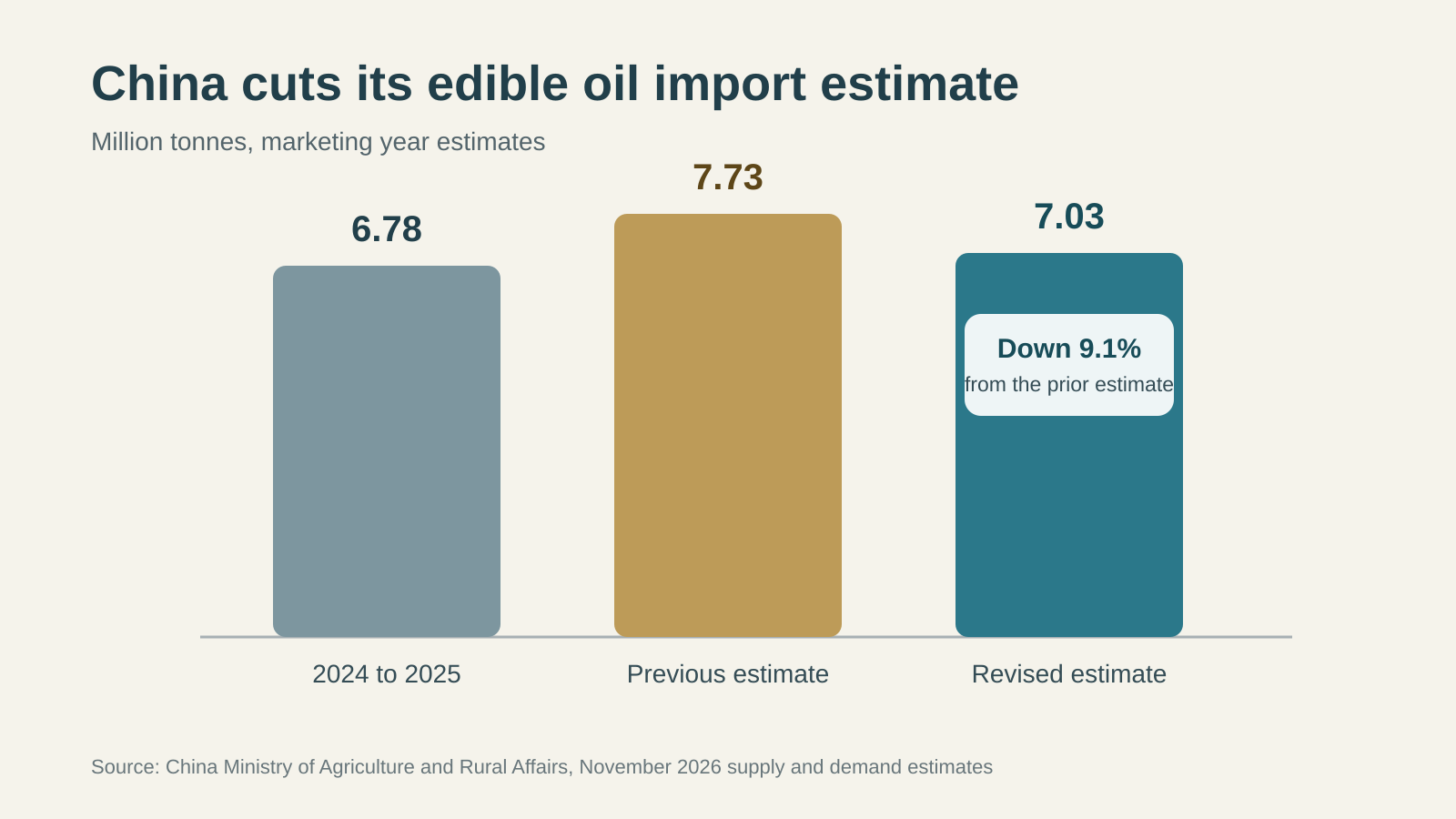
Agrilinkage chart based on official Chinese supply and demand estimates.
The cut is large, but imports did not collapse
The revised figure remains above the 6.78 million tonnes imported in 2024 to 2025, an increase of about 3.7%. The ministry is correcting an estimate that had been too strong, not reporting a fall below the previous season.
Imports at 7.03 million tonnes equal roughly 18.5% of estimated domestic consumption. Foreign prices, exchange rates, freight and logistics therefore remain important to Chinese food processors even when local production covers most demand.
The revision also represents about 10% of the new import estimate. For exporters, that is a meaningful volume. It can affect cargo demand from Indonesia and Malaysia for palm oil and from Black Sea suppliers for sunflower oil, while influencing substitution among soybean, rapeseed, palm and sunflower oils inside China.
This is a historical estimate, not a new collapse forecast
The largest caution is timing. The 7.03 million tonne figure applies to the completed 2025 to 2026 marketing year and reflects a reassessment of what occurred. The ministry left its 2026 to 2027 import forecast unchanged at 7.70 million tonnes.
The report does not yet predict another sharp fall in the current season. It says the previous season ended with fewer imports than officials had estimated. Future buying will depend on whether palm oil margins improve and whether Black Sea sunflower oil logistics recover.
The distinction is commercially important. A historical revision reveals the sensitivity of Chinese demand, but traders should not automatically apply the 9.1% cut to the current season. The forward estimate remains higher than the revised result for the year just ended.
Implications for suppliers and buyers
For palm oil exporters, China has shown that high international prices can meet resistance even in a large market. Buyers can delay cargoes, draw on stocks or shift toward other oils when the delivered cost becomes unattractive.
For sunflower oil, freight routes, insurance, port operations and vessel availability matter alongside crop size. Chinese refiners may change the mix of oils they buy rather than replace every missing sunflower cargo like for like.
Substitution is not frictionless for food manufacturers. Oils have different flavour, melting, stability and processing characteristics. A price advantage does not always translate into an immediate recipe change.
The ministry's current price ranges are 7,500 to 10,000 yuan a tonne for imported palm oil, 8,000 to 10,000 yuan for domestic soybean oil and 9,000 to 11,000 yuan for domestic rapeseed oil. Relative prices inside those broad ranges will shape substitution.
What to watch next
The clearest indicator is the import margin for palm oil after freight, currency and domestic prices. A sustained improvement would support cargo bookings. The second is the pace of sunflower oil shipments from Black Sea ports. The third is whether the ministry changes its 7.70 million tonne forecast in later reports.
China's revision shows that headline demand figures can conceal sharp changes in the composition and timing of trade. The country still imported more edible oil than a year earlier, but high costs and disrupted routes prevented purchases from reaching the level officials previously expected.
Primary sources and method
Agrilinkage compared the ministry's published estimates and calculated the percentage change, the year on year comparison and the share of consumption. Figures are rounded.
Cover image: original contextual editorial illustration created for Agrilinkage. It represents an edible oil import terminal and does not depict a named Chinese port.


Comments