

World Rice Output Set to Fall for First Time in Four Seasons

By Agrilinkage Research Desk
World rice production is set to fall for the first time in four seasons as weak farm margins and El Niño related weather reduce output, according to the Food and Agriculture Organization Food Outlook published on 19 November 2026.
The decline does not point to an immediate global shortage. Large stocks built during previous seasons should absorb part of the production gap. It does mean that the rice market is moving from record output toward a tighter balance at the same time that fuel, fertilizer and freight costs are testing producers and importers.

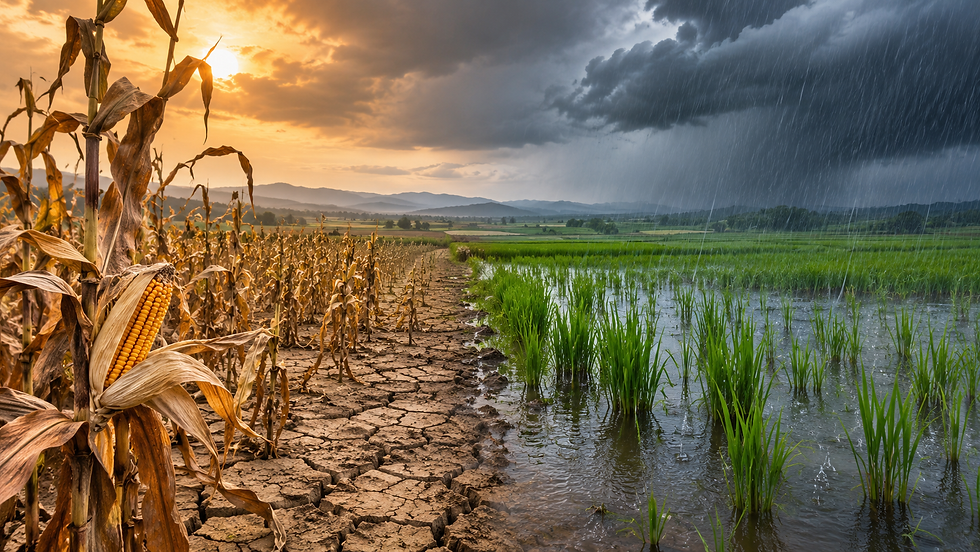
Original Agrilinkage editorial illustration. It represents rice production and water stress and does not depict a specific farm or event.
Production falls below use
FAO quantified the change in its 6 November cereal supply brief. It forecast milled rice production at 552.0 million tonnes, down 2.5 percent from the previous season. Rice utilization is expected to reach 558.8 million tonnes, an increase of 0.6 percent.
The difference is 6.8 million tonnes. That gap can be supplied from inventories, so it is not the same as a physical deficit in which consumers cannot obtain rice. It does show that stocks are expected to fall rather than continue accumulating.
FAO expects global rice reserves to end the season at 216.5 million tonnes. That would still be the second highest level on record because the season began with unusually large inventories.
This distinction matters for buyers and policymakers. A falling crop can be manageable when stocks are abundant, trade remains open and reserves are held where they can reach the market. The same production decline becomes more serious if weather losses deepen, exporters restrict sales or inventories are concentrated in countries that do not release them.
The global cushion is concentrated
The United States Department of Agriculture uses a different balance and arrives at a different absolute stock estimate, so its total should not be compared directly with the FAO figure. Its November data are still useful for showing where inventories sit.
USDA estimates China will hold 106.5 million tonnes of rice at the end of 2026 to 2027 and India 58.0 million tonnes. Together they account for about 82 percent of the USDA world stock estimate of 199.8 million tonnes.
That concentration means the headline global reserve is not equally available to every importer. China holds stocks primarily for its domestic market. India is both a major stockholder and the largest exporter, so its crop, domestic price policy and export decisions have disproportionate influence on internationally traded supply.
Weather is only part of the problem
FAO attributes the production decline to adverse El Niño related weather and falling producer margins. The Agricultural Market Information System reached the same conclusion in November, noting that high fuel and fertilizer costs and thin returns also reduced planting incentives.
This is an important correction to a purely weather driven explanation. A farmer may plant less rice because water is scarce, but also because the expected selling price does not cover fertilizer, pumping, labour and credit. The two pressures can reinforce each other when irrigation becomes more expensive during a dry season.
AMIS said crop conditions remained favourable in several producing regions, while risks were increasing as El Niño strengthened. The global outcome therefore depends on the location and timing of weather damage rather than on the climate label alone.
Agrilinkage previously examined the broader crop risks from the strengthening El Niño event across Asia, Africa and the Americas.
Trade is expected to grow despite the smaller crop
FAO forecasts world rice trade to rise 2.9 percent in 2027 to 61.6 million tonnes, supported by firmer import demand and larger shipments from India and Pakistan.
Growing trade can help redistribute supply from surplus producers to countries with weaker harvests. It can also make the market more sensitive to policy decisions by a small group of exporters. If India and Pakistan deliver the expected volumes, the production decline may remain a controlled drawdown in stocks. If shipments are restricted or weather damages exportable crops, importers could compete for a smaller accessible pool.
Rice prices were already rising in October even as wheat, maize and soybean prices declined, according to the November AMIS Market Monitor. That divergence is consistent with a rice balance that is tightening while other major crops remain more comfortable.
Why an immediate price surge is not certain
The high starting stock level is the strongest buffer against a sharp global price increase. India and Pakistan are expected to ship more rice, and the forecast decline in production is small relative to total supply.
Local retail prices can still move differently from the global benchmark. Currency weakness, import duties, transport costs, milling capacity and domestic stock releases determine what households pay. An importing country can face expensive rice even when world reserves appear large if its currency falls or freight and financing costs rise.
Producer prices also send mixed signals. Low farm prices can protect consumers in the short term but discourage planting and input use. Higher prices can restore farm margins but raise food costs for households that depend heavily on rice.
What would turn a drawdown into a larger risk
The first indicator is production in South and Southeast Asia as El Niño develops. Revised estimates from India, Indonesia, Thailand, Vietnam, the Philippines and Pakistan will show whether the global decline remains close to the current forecast.
The second is export policy. Open sales from India and Pakistan would support the expected trade expansion. New restrictions, minimum prices or licensing delays would reduce the amount of rice available to importers even if national stocks remain high.
The third is fertilizer and fuel affordability. Continued pressure could reduce application rates or irrigated planting for the next crop, extending the tightening beyond one season.
The fourth is the pace of stock releases. A gradual fall from record inventories would confirm that the buffer is working. A faster drawdown combined with rising import demand would leave the market more exposed to a second weather or policy shock.
The central conclusion
The world has enough rice to manage the forecast production decline, but the margin is becoming less comfortable. Output is falling below use, reserves are expected to decline and the largest stocks are concentrated in two countries.
The base case is therefore a controlled tightening rather than a global shortage. That conclusion depends on large inventories remaining usable, exporters keeping trade open and El Niño damage not spreading beyond present assumptions.
Sources and methodology
Agrilinkage reviewed the FAO Food Outlook released on 19 November, the FAO Cereal Supply and Demand Brief released on 6 November, the November AMIS Market Monitor and the USDA November Grain report. The calculation of the 6.8 million tonne production gap is the difference between FAO production and utilization forecasts. The concentration estimate uses USDA figures and is presented separately because FAO and USDA balances use different methodologies.


Comments