
Sweden’s Food VAT Cut Drives 6.8% Price Drop as Axfood Trails Online

Sweden’s lower food tax has produced a dramatic supermarket price headline, but Axfood’s third-quarter accounts show why the underlying business story is more complicated. Food-retail prices were 6.8% lower than a year earlier in the July-to-September quarter when measured including VAT. Excluding VAT, the estimated fall was only 1.5%.
That gap matters. Sweden cut VAT on food from 12% to 6% on 1 April 2026. In percentage-point terms, the tax-inclusive decline was 5.3 points larger than the underlying ex-tax decline. This is not a formal decomposition of the price index, but it indicates that roughly four-fifths of the observed headline fall was associated with tax arithmetic rather than a comparable collapse in supplier or retailer prices.
A volume recovery hidden by falling shelf prices
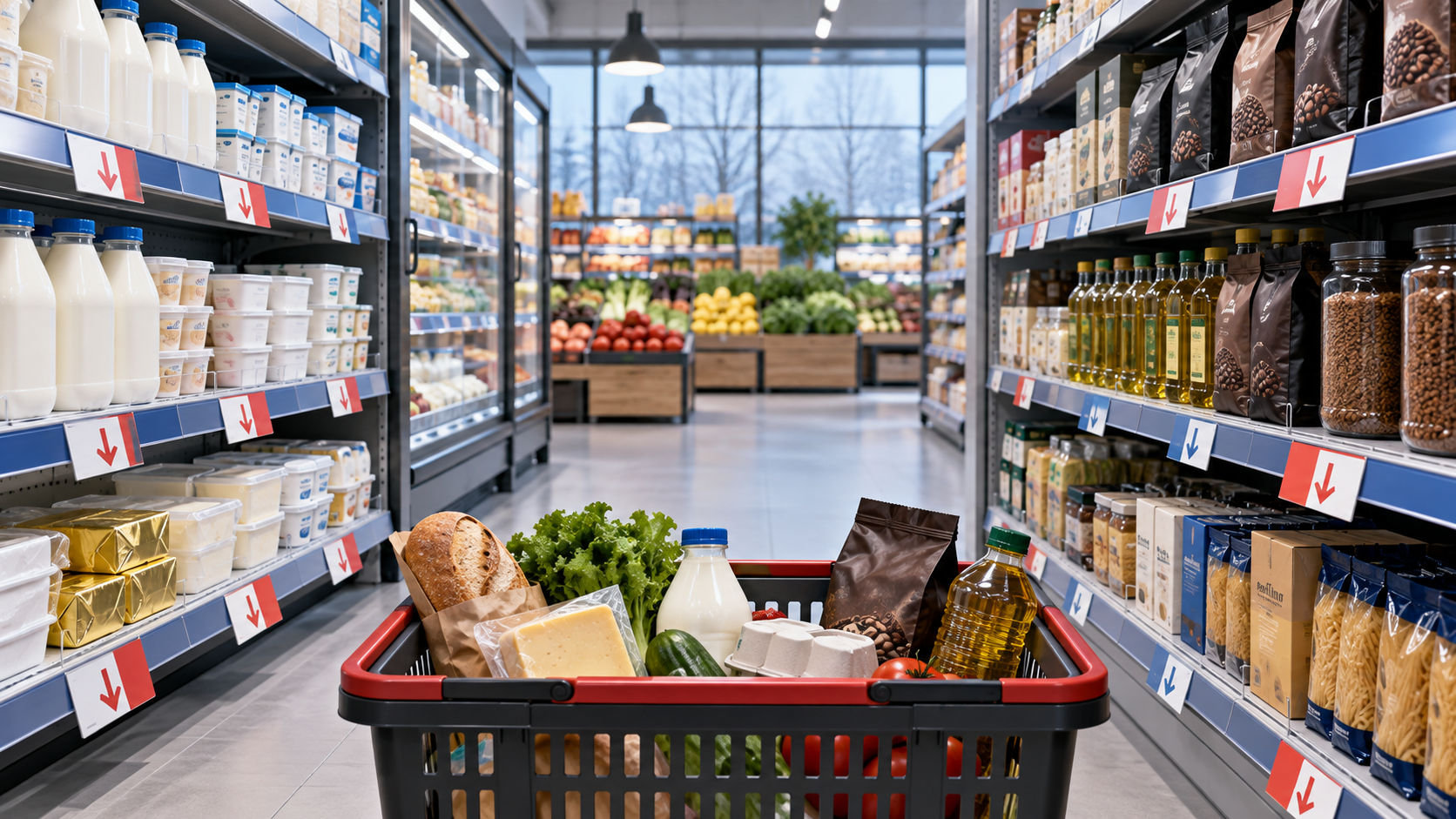
Swedish food-retail sales increased 4.0% in the quarter even though the price index fell sharply. Axfood said the market’s growth was entirely volume-driven. For processors, distributors and packaging suppliers, that combination is more important than the nominal sales number: more physical goods moved through stores even as tax-inclusive prices fell.
The biggest price declines were in dairy products, coffee, and oils and fats. Those categories are also useful tests of the difference between consumer prices and upstream economics. A lower VAT rate directly reduces the price paid at checkout, but it does not automatically lower milk collection costs, green-coffee prices, edible-oil costs, energy bills or packaging expenses. The more modest 1.5% ex-VAT decline is therefore the better starting point for judging commercial price pressure.
Axfood grew, but lost ground to the market
Axfood’s consolidated net sales increased 1.9% to SEK 22.711 billion. Retail sales rose 2.9% to SEK 20.2 billion, 1.1 percentage points below the Swedish market’s 4.0% growth. Like-for-like retail sales increased 1.6%. The company is still expanding, but not at the market’s pace.
The online gap was wider. Swedish grocery e-commerce grew 7.7%, while Axfood’s online sales increased 2.5% to SEK 909 million. That is a 5.2-percentage-point growth shortfall. Axfood’s online share of its retail sales was nevertheless 4.5%, above the market-wide 4.0% share, so the result is not evidence that its digital operation is insignificant. It shows that a retailer with an above-market online mix can still underperform when rivals grow faster.
For comparison, Agrilinkage recently examined how Sainsbury’s online grocery growth outpaced store sales in Britain. The Swedish result underlines that online grocery is not moving uniformly even among established chains.
Margins held as price deflation raised the execution bar
Axfood’s reported operating profit rose 5.6% to SEK 1.118 billion, lifting the margin to 4.9% from 4.8%. Adjusted operating profit increased 1.9% to SEK 1.119 billion, with the adjusted margin unchanged at 4.9%. Higher volume, a stable gross margin and cost control supported earnings, while food-price deflation and higher fuel costs pulled in the opposite direction.
This is the central commercial lesson from the quarter. Deflation does not automatically destroy grocery profit, but it forces retailers to earn the result through unit growth, mix, purchasing, logistics and operating discipline. A stable gross margin during a tax-driven price reset also means suppliers should not assume that the full headline price decline is flowing backward into procurement prices.
Hemköp, Willys and City Gross tell different stories
Hemköp was the strongest growth engine. Retail sales rose 7.1%, like-for-like sales increased 4.8%, and adjusted operating profit climbed 21.9% to SEK 125 million. Its adjusted operating margin improved to 5.8% from 5.1%.
Willys produced a more subdued result: sales increased 2.1% and like-for-like sales only 0.3%. Adjusted operating profit fell 1.8%, while the margin eased to 4.7% from 4.9%. In a volume-led market, that weak like-for-like figure suggests that price positioning alone is not enough to guarantee share gains.
City Gross provides the clearest turnaround signal. Retail sales declined 2.9%, although like-for-like sales increased 0.6%. Yet adjusted operating profit swung to a positive SEK 24 million from a SEK 4 million loss, producing a 1.1% margin instead of minus 0.2%. Axfood described it as City Gross’s first positive quarterly result less than two years after the acquisition.
That is progress, but not the same as a completed recovery. Profitability improved while total sales contracted, which can reflect cost and portfolio actions before a durable demand recovery. The next test is whether City Gross can maintain positive earnings while returning to total sales growth.
What food suppliers and competitors should watch
First, monitor ex-VAT prices rather than the headline consumer index. The 6.8% decline is real for households, but the 1.5% ex-tax measure is closer to the commercial pressure moving through retailer and supplier negotiations.
Second, watch unit volumes after the initial VAT reset. The quarter’s market growth was entirely volume-driven, but some of that improvement may reflect timing, promotional changes or shoppers responding to lower checkout prices. Sustained volume growth would be more meaningful for food factories, logistics providers and packaging demand than a one-quarter rebound.
Third, Axfood’s e-commerce shortfall deserves attention. Its penetration remains above the market average, but the chain grew far more slowly online. If that gap persists, it could affect picking capacity, fulfilment investment, last-mile partnerships and the balance between store-based and centralised distribution.
Finally, fuel and logistics costs remain a counterweight. Tax policy can reduce shelf prices quickly, but distribution expenses still move with diesel, wages and network efficiency. Axfood’s result shows how those physical-economy costs can absorb part of the benefit from higher volumes.
Sources and methodology
This analysis is based on Axfood’s official third-quarter results announcement dated 22 October 2026 and the company’s
full Q3 2026 interim report. Market, price, sales and profit figures are company-reported. Agrilinkage calculated the 5.3-percentage-point gap between tax-inclusive and ex-VAT price changes, the 1.1-point retail growth gap and the 5.2-point online growth gap from those figures. The calculations are descriptive and do not establish causation.


Comments