
SSR Mining Offers US$464 Million for Roxmore's Converse Gold Project

By Agrilinkage Research Desk | Published 14 October 2026
SSR Mining has agreed to acquire Roxmore Resources in a cash transaction that values Roxmore's equity at about US$464 million. The strategic prize is not simply another Nevada deposit: Roxmore's Converse Gold Project sits about six kilometres west of SSR Mining's operating Marigold complex, creating a possible route to shared technical expertise, infrastructure and district-scale planning.
The transaction is proposed, not completed. Roxmore securityholders, a court and other customary conditions must still approve it. Nor is Converse an approved mine: federal permitting, including a Bureau of Land Management environmental review, would precede construction. SSR Mining says initial production is targeted for 2033, so the immediate significance lies in control of a large development option rather than near-term gold supply.
What SSR Mining would buy
Under the definitive arrangement announced on 13 October 2026, Roxmore shareholders would receive C$6.75 in cash for each share plus 0.33 shares in a new exploration company. SSR Mining put the cash consideration at US$464 million on an equity-value basis and US$392 million on an enterprise-value basis.
Roxmore would place its Rattlesnake Hills, Shabu River and Newton exploration assets, together with US$10 million in cash, into the spinout. Former Roxmore holders would own 85.01% of that company and SSR Mining 14.99%. That structure separates Converse—the asset SSR wants beside Marigold—from Roxmore's earlier-stage exploration portfolio.
The disclosed cash price represents a 27% premium to Roxmore's 9 October closing price and a 47% premium to its 20-day volume-weighted average price. Those figures are based on the company's transaction announcement; they do not measure the value that future permitting, engineering, gold prices or dilution may add or remove.
Why six kilometres matters
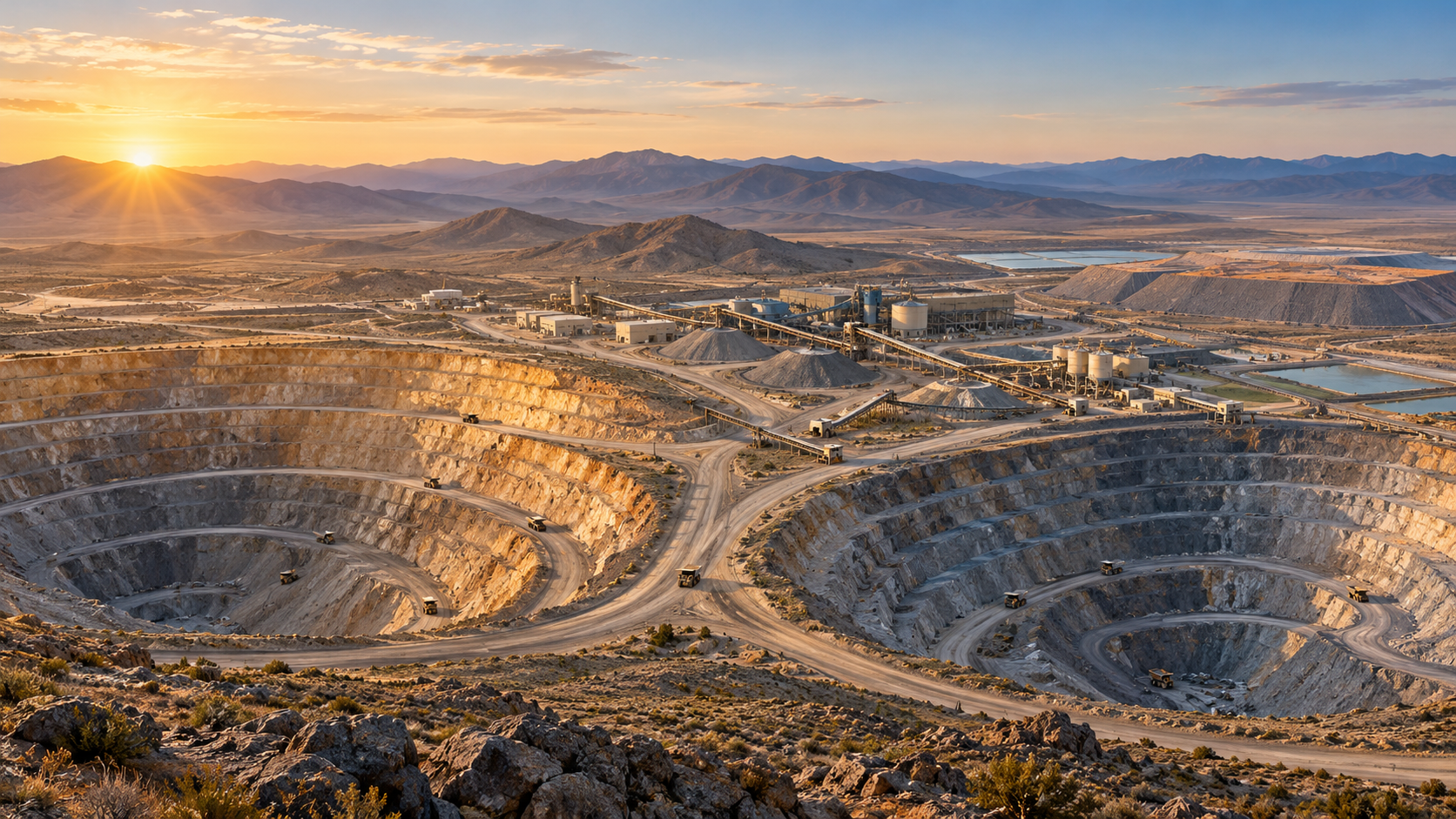
Converse is planned as a conventional open-pit, truck-and-shovel operation with three-stage crushing and heap-leach processing. Marigold is already a large open-pit gold operation in Nevada. Proximity does not automatically make the two projects one mine, but it can change the development question from building an isolated asset to extending an established operating district.
SSR Mining estimates Converse could produce 150,000 to 170,000 ounces of gold annually for more than ten years. At the midpoint, that implies roughly 1.6 million ounces across a decade before considering ramp-up, variability or any mine-life extension. This is an Agrilinkage calculation from the company's stated annual range and is not a production forecast.
The company also estimates at least US$200 million of undiscounted synergies. That claim has not been independently verified and should not be treated like cash already captured. The value will depend on the final mine design, infrastructure choices, permitting conditions, construction costs and the extent to which Marigold can actually support Converse.
A large resource, but not yet a reserve
The March 31, 2026 mineral-resource estimate cited for Converse reports 103 million tonnes of indicated material grading 0.65 grams of gold per tonne, containing 2.2 million ounces, plus 218 million tonnes of inferred material grading 0.43 grams per tonne, containing 3.0 million ounces. Together that is 5.2 million reported ounces, but indicated and inferred resources are not mineral reserves and do not by themselves establish that all of the metal can be mined economically.
The estimate used a US$3,000-per-ounce gold resource shell. Readers should therefore separate the scale of the geological inventory from the more conservative assumptions normally required in a reserve statement or final investment decision. Inferred material also carries greater geological uncertainty than indicated material and cannot be treated as if it were proven production.
Capital and timing keep this a long-dated project
SSR Mining's preliminary development concept puts initial capital at US$800 million to US$900 million. The midpoint, US$850 million, is about 1.8 times the announced equity purchase price. That comparison is useful because it shows that buying Roxmore is only the first major capital step; building Converse, if approved, could require substantially more cash than the acquisition itself.
SSR Mining says it does not expect material project spending until the early 2030s and targets initial production in 2033. Inflation, labor availability, equipment lead times, water management, power, reclamation requirements and the final permitting outcome can all move the cost and schedule. The company has not yet made a construction decision.
What must happen before closing
The arrangement requires approval by at least two-thirds of votes cast by Roxmore securityholders, plus any minority approval required under Canadian securities rules. Holders representing about 26.8% of Roxmore on a fully diluted basis have entered voting-support agreements. The deal also requires court approval and customary closing conditions, with completion targeted for the fourth quarter of 2026.
The agreement includes a C$18 million termination fee in certain circumstances. Until the conditions are satisfied and the transaction closes, Roxmore remains separate and SSR Mining does not control Converse.
What to watch next
Three milestones will determine whether the strategic logic becomes operating value. First is shareholder and court approval of the acquisition. Second is publication of more detailed engineering that tests the proposed production rate, capital budget and claimed synergies. Third is the federal permitting record, including alternatives and mitigation developed through the environmental review.
For mining and physical-economy investors, the case is a reminder that location can be as important as headline resource size. Converse's value to SSR Mining rests on adjacency to an established Nevada operation—but the distance between a resource estimate and a producing mine is still measured in permits, engineering, capital and years.
Sources and methodology
Agrilinkage reviewed the companies' transaction terms, resource figures, development assumptions and approval timetable. Dollar figures are reported in the currencies used by the companies; operational projections and synergy estimates are identified as company estimates rather than independently verified outcomes.
Primary source: SSR Mining transaction announcement.
Company source: Roxmore Resources news and transaction materials.
Cover image: original Agrilinkage editorial illustration. It is contextual and does not depict the actual Converse or Marigold sites.





Comments