

Sonoco Takes $829 Million Impairment as Drought Hits Food-Can Demand

Sonoco’s third-quarter accounts show how a weak harvest can travel beyond the farm gate. Drought across parts of Europe and the United States reduced crop yields and demand for food cans, while higher input, freight and energy costs squeezed the packaging group’s margins. At the same time, Sonoco recorded an $829 million goodwill impairment—an accounting reassessment that puts a large number on weaker expectations for parts of the business.
The company’s 21 October 2026 results reported third-quarter net sales of $2.042 billion, down 4.2% from $2.131 billion a year earlier. Adjusted EBITDA fell 9.0% to $352 million, and adjusted operating profit declined 13.1% to $268 million. Sonoco posted a GAAP net loss of $732 million, compared with net income of $123 million in the year-earlier quarter, mainly because of the noncash impairment.
The result matters well beyond one packaging company. Metal food-can demand depends on the volume of vegetables, fruit, fish and other products entering preservation lines. When crops are not harvested, canners need fewer containers. That makes packaging orders a downstream signal of agricultural production—and shows why the commercial effects of drought can appear in factories after the weather damage is recorded in fields.
The quarter in five numbers
Group net sales: $2.042 billion, down $89.5 million or 4.2% year on year.
Adjusted EBITDA: $352 million, down $34.8 million or 9.0%.
Consumer Packaging sales: $1.396 billion, down $42.2 million or 2.9%.
Consumer Packaging operating profit: $178.6 million, down $30.4 million or 14.6%.
Consumer Packaging operating margin: 12.8%, down from 14.5%—a contraction of about 1.7 percentage points calculated from Sonoco’s reported segment figures.
Those comparisons make the central point clearer than the sales change alone. Consumer Packaging revenue declined by less than 3%, but its operating profit fell almost 15%. The group’s gross margin also narrowed to 19.9% from 21.9%, based on reported gross profit and sales. Price increases therefore did not fully offset the mix of weaker volumes and higher costs during the quarter.
What the $829 million impairment means
Goodwill is the portion of an acquisition price that cannot be assigned to identifiable net assets such as plants, inventory or customer relationships. An impairment reduces that accounting asset when expected future cash flows no longer support its carrying value. It is noncash in the quarter: Sonoco did not pay $829 million in October. But it is still economically important because it records a lower assessment of the earnings power attached to acquired or reorganized businesses.
Sonoco assigned $802 million of the charge to Consumer Packaging in Europe, the Middle East and Africa and Asia-Pacific, and $27 million to Industrial Paper Packaging in Asia-Pacific. The consumer charge is especially notable because Sonoco completed its acquisition of Eviosys in December 2024. Eviosys brought a large European metal-food-can footprint into the Consumer Packaging segment.
The company’s first-quarter 2025 SEC filing put the net cash consideration for Eviosys at about $3.790 billion. A later second-quarter 2026 filing said $1.415 billion of goodwill in Consumer Packaging EMEA/APAC was at risk of near-term impairment if operations failed to meet expectations or the long-term outlook weakened. The new $802 million consumer charge is roughly 57% of that previously disclosed at-risk balance, a scale comparison rather than a statement that the two accounting measures are identical.
That sequence is significant: the June filing disclosed the sensitivity, and the September-quarter assessment converted much of the warning into a recorded charge. The impairment does not by itself prove that the Eviosys assets are unprofitable, nor does it determine their resale value. It does indicate that management’s updated assumptions no longer support the earlier goodwill valuation.
How drought reaches a can factory
The physical chain is straightforward. Drought or heat reduces marketable crop output; processors run fewer or shorter canning campaigns; and packaging suppliers receive fewer orders for cans and ends. The timing can vary by crop, country and customer inventory. Sonoco did not quantify how many tonnes of food output or how many cans were lost, so the drought explanation should be read as the company’s attribution—not as an independently measured estimate of agricultural damage.
Sonoco said Consumer Packaging volume and mix declined 3%. It linked that result partly to weaker food-can demand caused by drought across portions of Europe and the United States. Lower seasonal pack volumes can be particularly consequential for a fixed-cost manufacturing network because machinery, labor and overhead are spread across fewer units.
The commercial pressure was not only agricultural. Sonoco said inflation in input, freight and energy costs exceeded its expectations. Higher selling prices helped, but the price-cost gap was still unfavorable. For food processors and buyers, the combination illustrates a two-sided squeeze: fewer crops can reduce packaging throughput even while energy and transport raise the cost of each manufacturing and delivery step.
Demand was uneven, not universally weak
The quarter did not point to a broad collapse in packaged-food demand. Sonoco reported double-digit volume growth in international paper cans, which it attributed to strong snack demand in emerging markets. The Industrial Paper Packaging segment also recorded positive volume and mix, including a 10% increase in external sales of uncoated recycled paperboard and 94% paper-mill capacity utilization.
This divergence is useful for operators and investors. Food cans tied to seasonal agricultural packs can weaken when harvests disappoint, while paper packaging for snacks and other categories follows different consumer, geographic and inventory cycles. The mix of product formats therefore matters almost as much as aggregate packaging demand.
Cash flow improved, but investment slowed
For the first nine months of 2026, Sonoco reported $218 million of cash from operations, down from $277 million a year earlier. Free cash flow rose to $43 million from $29 million because net capital expenditure fell to $175 million from $248 million. That is a reduction of about $73 million, or 29.5%, based on the company’s figures.
At quarter-end, Sonoco reported $4.3 billion of total debt, $4.1 billion of net debt and about $1.3 billion of available liquidity. It maintained full-year guidance of $7.2 billion to $7.4 billion in sales, $1.20 billion to $1.25 billion in adjusted EBITDA, adjusted earnings of $5.30 to $5.50 per diluted share, and $600 million to $650 million in operating cash flow.
Lower capital spending helped free cash flow in the short term, but it is not automatically a sign of stronger operations. The decision-useful question is whether reduced spending reflects project timing and disciplined allocation, or whether it limits future efficiency and capacity improvements. The quarter’s disclosures do not settle that question.
What to watch next
Four indicators will show whether the setback is temporary or structural. First is the recovery of European and US crop volumes feeding seasonal canning lines. Second is Sonoco’s food-can volume and mix as customers reset inventories. Third is whether price actions catch up with energy, freight and material costs. Fourth is the performance of the Consumer Packaging EMEA/APAC unit after the impairment, including any further revisions to expected cash flows.
The broader lesson is that harvest risk does not end at commodity prices. It changes factory utilization, packaging orders, logistics and the value investors place on industrial assets built around food throughput. Sonoco’s quarter offers a rare quantified view of that downstream transmission, even though the company did not disclose the crop-by-crop or country-by-country contribution.
Methodology and sources
Agrilinkage calculated percentage and margin changes from Sonoco’s reported third-quarter 2026 and 2025 figures. The primary sources are Sonoco’s third-quarter results release, the company’s June 2026 SEC filing, and its March 2025 SEC filing describing the Eviosys acquisition. Non-GAAP measures are presented as defined by Sonoco and should be read with the company’s reconciliations.
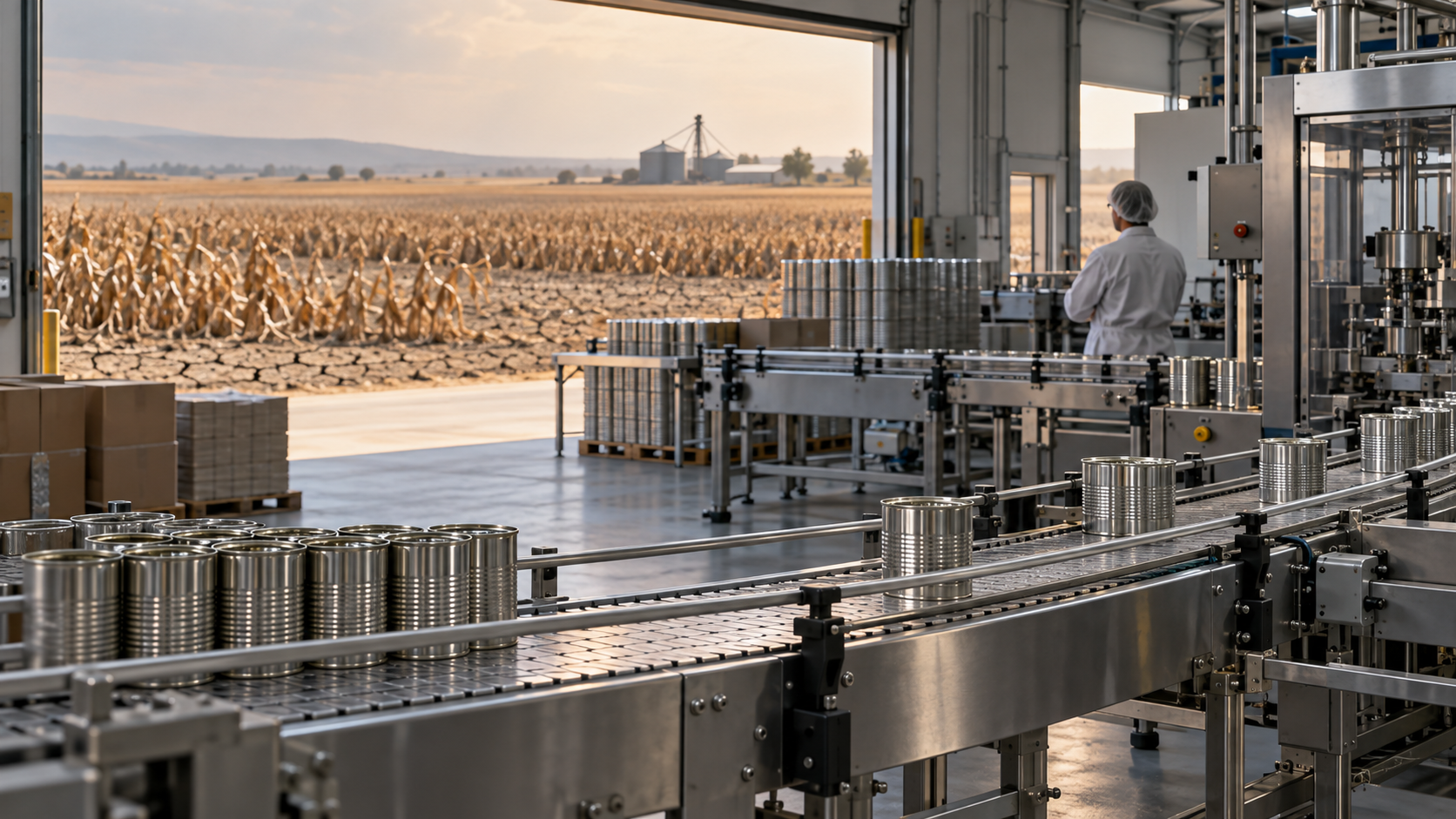
Image note: The cover is an original Agrilinkage editorial illustration connecting drought-stressed crop supply with food-can manufacturing. It does not depict a Sonoco facility or an actual affected farm.


Comments