

Silk Microneedles Carry Vaccines to Trout Too Small for Standard Shots

A food-grade silk microneedle system has delivered vaccine material underwater to juvenile rainbow trout weighing only 1 to 2 grams—far below the roughly 30-gram size at which conventional needle vaccination becomes practical. The peer-reviewed result addresses a real aquaculture bottleneck, but it is a delivery pilot, not evidence that the device prevents disease on farms.
Researchers from MIT and the U.S. Department of Agriculture reported the platform in ACS Nano on 2 November 2026. The tiny devices were designed to pierce wet fish skin, remain attached while fish swim and then release bacterin or DNA-vaccine cargo over a controlled period.
The ACS Nano paper describes three microneedle formats—shell, solid-tip and hollow—engineered for different combinations of mechanical strength, water resistance, cargo compatibility and release speed. MIT’s research release provides the institutional account of the animal pilots and intended aquaculture use.
Why vaccinating small fish is difficult
Disease prevention is a major operating problem in intensive aquaculture. Vaccines delivered in feed or through immersion reduce handling, but the amount reaching each fish can vary. Metal-needle injection gives a more controlled individual dose, yet it requires sedation, removal from water and rapid handling—work that adds labor, stresses fish and exposes workers to accidental needle injuries.
Size compounds the problem. USDA researcher Gregory Wiens said standard injection does not work well until rainbow trout reach about 30 grams, leaving smaller juveniles exposed during an important growth stage. The silk devices were tested on trout of only 1 to 2 grams as well as zebrafish.
Shellac makes silk survive long enough underwater
Silk fibroin is attractive because it can carry biological materials and is already used in food-related applications, but untreated silk softens quickly in water. The researchers added a thin shellac barrier. Shellac is a resin used in food coatings and pharmaceuticals; here it delayed water entry so the microneedle could retain enough strength to penetrate wet skin.
By changing the device geometry and coating, the team produced water resistance lasting from minutes to hours. Release could be designed for a short interval of about 15 minutes or extended to 10 or even 24 hours, according to the MIT account. That flexibility could allow different vaccines or therapeutic materials to use different delivery profiles.
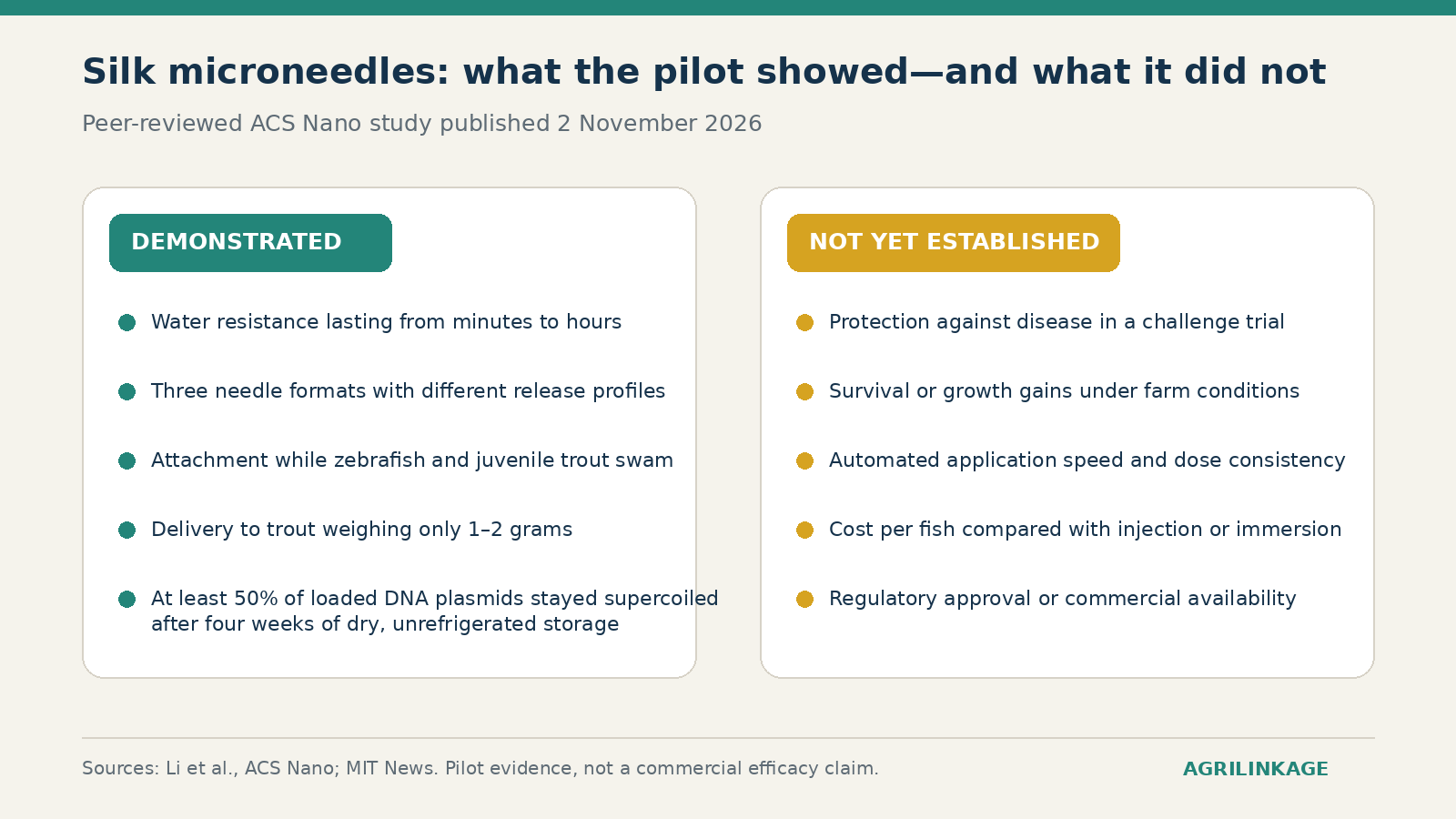
Agrilinkage evidence check based on the ACS Nano paper abstract and MIT’s 2 November research release.
Dry storage result needs careful interpretation
The platform also preserved the supercoiled form of at least 50% of loaded pIHNVw-G DNA plasmids after four weeks in dry conditions outside refrigeration. That plasmid was developed for protection against infectious hematopoietic necrosis virus, an important salmonid disease.
The result is potentially useful for hatcheries and farms where refrigerated transport is expensive or unreliable. But supercoiled DNA retention is a measure of physical molecular structure. It does not prove that the stored material produced an adequate immune response, prevented infection or maintained protection for a commercially useful period.
What the animal pilot did—and did not—show
In pilot animal work, inserted microneedles remained attached while zebrafish and juvenile rainbow trout swam. The study therefore demonstrates that a food-based device can overcome the immediate mechanical problem of wet-skin penetration and underwater retention.
The published claims do not establish disease-challenge protection, survival improvement, faster growth or reduced antimicrobial use. The work also does not yet show how thousands of fish would be processed per hour, whether each fish would receive a consistent dose, how often devices would detach prematurely or what the cost would be relative to injection and immersion systems.
Those omissions are not flaws in a materials-development pilot; they define its stage. The study answers whether a silk microneedle can be engineered to function underwater and carry relevant vaccine materials. It does not yet answer whether a fish farm should buy the system.
The commercial test is throughput plus protection
For the technology to matter commercially, two evidence streams must converge. First, controlled disease-challenge studies must show immune response and protection at relevant doses, with safety and tissue-quality monitoring. Second, an application system must process fish quickly and consistently enough to compete with established vaccination workflows.
A successful platform could expand the vaccination window to smaller fish, reduce reliance on metal needles and potentially simplify cold-chain logistics. It could also support cargos beyond vaccines. Yet every one of those benefits depends on results that remain to be demonstrated at scale.
What to watch next
The next meaningful milestones are challenge-trial efficacy, dose-response data, attachment and release consistency across large groups, worker and animal safety, manufacturing cost and an automated or semi-automated method of application. Regulatory review would also need to address the device, its materials and each biological cargo.
For aquaculture operators, the most useful interpretation is therefore neither dismissal nor premature adoption. The study provides a credible new delivery mechanism for a difficult production stage. Whether it becomes a farm tool will depend on proof that it protects fish reliably and can be applied at industrial speed.
Methodology: Agrilinkage reviewed the ACS Nano article metadata and abstract and MIT’s institutional research release. Claims about disease protection and commercial performance were limited to what the published evidence supports. No interviews or farm tests were conducted. Cover image: original Agrilinkage conceptual editorial illustration; it does not depict the study animals or a commercial product.


Comments