
Japan’s Rice Gene Database Now Links 2,000 Varieties With AI-Assisted Curation

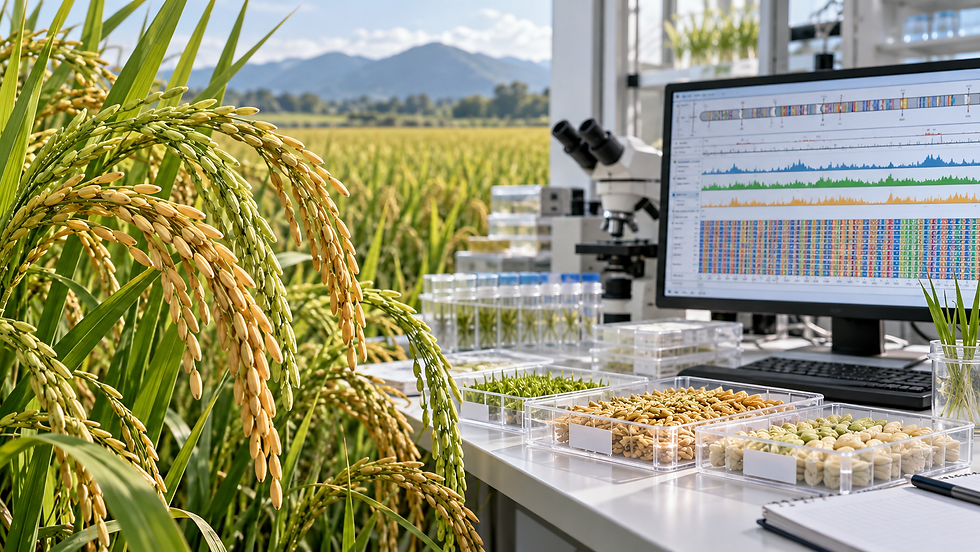
Japan’s National Agriculture and Food Research Organization (NARO) has rebuilt its long-running rice genetics database into a single search layer linking gene function, expression, varietal DNA differences and agriculturally important alleles. The October 13 release is infrastructure rather than a new seed: it does not prove higher yields or heat tolerance in farmers’ fields. Its significance is that breeders can now examine several kinds of evidence in one place before deciding which genes and parent lines deserve expensive laboratory, greenhouse and field testing.
The renewed Rice Annotation Project Database, or RAP-DB, brings together information from 4,904 scientific papers covering 6,747 genes that specialists had reviewed and updated by February 2026. NARO says the new version also integrates gene-expression results from 746 samples, genomic variation across about 2,000 varieties and lines, 1,085 genes linked to important agricultural traits and 1,129 functional alleles.
Those figures matter because rice improvement rarely depends on discovering one attractive gene in isolation. A breeder needs to know what the gene does, when and in which tissue it is active, whether useful versions already occur in accessible germplasm, and what evidence connects a DNA difference to a field-relevant trait. RAP-DB now places those questions on the same record rather than forcing researchers to reconcile separate literature, expression and variation resources.
What changed in the database
RAP-DB has operated since 2006, after the complete rice genome sequence became available in 2004. Its distinguishing feature is human literature curation: specialists read research papers and record experimentally supported gene functions, related traits and functional alleles. NARO describes that continuing curation as unusual among biological databases, many of which rely more heavily on automated predictions from sequence similarity.
The rebuilt service adds large-scale public sequencing data that NARO reanalysed using consistent methods. Researchers can now compare expression patterns across tissues and growing conditions, inspect sequence variation among varieties and lines, and connect those differences with known functional alleles. The practical gain is not that every entry becomes a breeding recommendation; it is that the evidence needed to form and reject hypotheses is easier to assemble.
AI narrows the reading list; experts keep the final decision
The most consequential workflow change is an AI-supported literature-screening system. NARO trained a model on the body of papers previously selected for RAP-DB curation. The system evaluates new publications and points curators toward material likely to contain useful rice-gene evidence. It does not automatically rewrite database records or decide that a reported function is true.
That division of labour is important. Automated screening can reduce the time experts spend finding relevant papers as the literature expands, while human review remains responsible for interpreting experiments, resolving inconsistent terminology and deciding what is sufficiently supported to enter the resource. The approach is therefore better understood as triage for scientific curation than as autonomous plant breeding.
Why the 2,000-variety layer matters
A reference genome describes one sequence, but breeding depends on variation. Two rice lines may carry different versions of the same gene, and those variants can change flowering time, grain quality, disease response or tolerance of environmental stress. By integrating polymorphism data across about 2,000 varieties and lines, RAP-DB lets researchers ask whether a candidate allele exists in germplasm that could be crossed into a breeding programme.
The 1,129 functional alleles form a smaller, more decision-useful subset: variants for which published evidence links sequence differences to biological or agronomic effects. They can inform marker design, parent selection and genome-editing target assessment. They do not remove the need to test interactions with genetic background, local climate, management and consumer-quality requirements.
The likely value is faster candidate selection, not instant yield
The immediate beneficiaries are public institutes, universities and seed developers working on molecular breeding, genomic selection or genome editing. Consolidated evidence can shorten the first stage of a project: identifying plausible targets and avoiding genes or alleles already shown to have undesirable trade-offs. It can also make published work easier to reuse because expression and variation data have been reprocessed consistently.
For heat tolerance, for example, a team can examine whether a candidate stress-response gene is active in relevant tissues at sensitive growth stages, which alleles occur across the collection, and what experiments have already been reported. That still leaves years of validation, crossing, multi-location trials, seed multiplication and regulatory or variety-release work. Database scale should not be confused with commercial deployment.
Disease-resistance work faces the same constraint. A resistance allele may be effective against some pathogen populations but not others, while resistance can break down as pathogens evolve. RAP-DB can improve target discovery and comparison; it cannot predict durable field performance without epidemiology and location-specific testing.
An open research asset with global relevance
Rice is a model crop as well as a staple, so well-curated rice gene information can influence both applied breeding and broader plant biology. The database is publicly accessible, which gives smaller research groups a common starting point without requiring each team to build its own literature and sequence-integration pipeline.
NARO has also opened a community feedback channel for new gene information, relevant papers and proposed corrections. That can improve coverage, but the value of the system will depend on how transparently submissions are reviewed, how quickly records are updated and how clearly the database separates experimental evidence from computational inference.
What to watch next
The first test is adoption: whether breeding teams use the integrated records to define targets, design markers or select germplasm. The second is update performance—how much the AI triage increases the flow of expert-reviewed records without weakening quality control. The third is traceable output, such as published breeding studies that cite RAP-DB in target selection and later report greenhouse or field validation.
For producers and seed buyers, the relevant milestone is not the database launch itself but the arrival of independently tested varieties with measurable advantages under heat, disease or quality stress. Until those results exist, the defensible conclusion is narrower: Japan has made a large body of rice-genetics evidence substantially easier to search and combine.
Sources and methodology
This article is based on NARO’s October 13, 2026 technical release, including its reported database counts and description of the AI-assisted, human-reviewed curation workflow. Agrilinkage also reviewed the live RAP-DB research resource and NARO’s earlier NARO Open Rice Collection announcement for context on the institute’s public rice-genomics assets. The analysis distinguishes database contents and expected research uses from demonstrated field or commercial outcomes.


Comments