
Japan Moves to Cull 200,000 Hens as Egg Prices Hit Record High

Japan confirmed its first domestic poultry outbreak of highly pathogenic avian influenza of the 2026 season on 12 November, ordering the destruction of about 200,000 laying hens at a farm in Kameoka, Kyoto Prefecture. The timing raises the commercial stakes because the agriculture ministry says the national retail price of eggs reached a record in October.
The case is small beside the multi million bird outbreaks of recent seasons and does not by itself prove that prices will rise further. It does, however, remove production from a market that was already carrying less spare capacity into the year end demand period.
The first confirmed farm case of the season
According to the Japan Ministry of Agriculture, Forestry and Fisheries notice, the farm reported an increase in dead birds on 11 November. Rapid tests were positive, and genetic testing completed at 08:30 on 12 November confirmed a suspected case of highly pathogenic avian influenza.
Authorities began culling and disposal at the site and established a movement restriction zone within three kilometres. Farms between three and ten kilometres face shipment restrictions. The response also includes testing at nearby poultry holdings, disinfection and an epidemiological investigation.
The ministry stressed that chicken meat and eggs are not considered a route of human infection in Japan under normal consumption conditions. The immediate issue is animal disease control and the possible loss of egg production, not a warning against eating properly handled eggs.
Why the egg market has less room for another shock
The agriculture minister said on 10 November that the national retail price of eggs averaged 312 yen in October. That was the highest level since the ministry began the series in August 2003. The ministry attributed the pressure to a slower recovery in supply after avian influenza losses and firmer demand ahead of the year end season.
Eggs are unusually important to food manufacturers because they are both a household staple and a functional ingredient in bakery, prepared food, noodles, sauces and confectionery. When shell egg availability tightens, processors can face allocation, reformulation or higher contract costs before the full effect becomes obvious on supermarket shelves.
Japan also produces most of the eggs it consumes. In its review of the severe 2022 season, the ministry estimated domestic self sufficiency near 97 percent and reported that shortages were especially visible in industrial and processing channels. That makes domestic flock health more important than import substitution for short term supply.
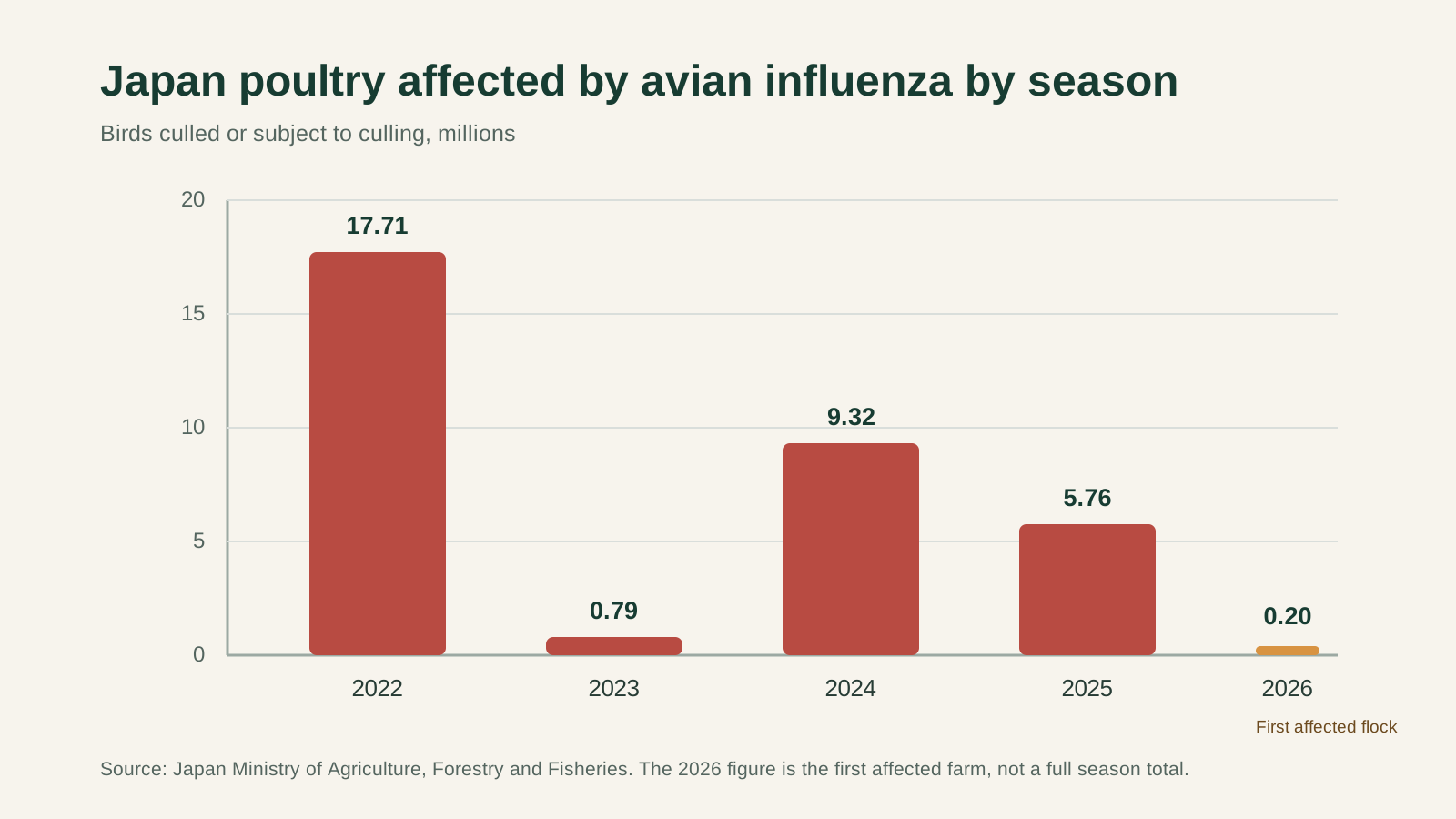
Past seasons show why one case is an early signal, not a forecast
The ministry recorded about 17.71 million birds affected in the exceptional 2022 season, followed by about 793,000 in 2023, 9.32 million in 2024 and 5.76 million in 2025. Those totals show how widely outcomes can diverge after the first detection.
The 200,000 hens at the Kyoto farm are therefore best treated as the opening observation of the new season. If control measures contain the virus to one holding, the national production effect should be limited. If detections spread across major layer regions, the cumulative supply loss could become commercially significant.
What happens next
The most useful indicators are the number of additional farm detections, the share of cases in large layer operations, the speed at which movement zones are lifted and whether wholesale and retail egg prices keep rising after seasonal demand passes. Wild bird detections also matter because they can reveal continued environmental pressure even when farm outbreaks are contained.
For retailers and processors, the distinction between a temporary precaution and a broader supply event will become clearer through weekly outbreak reports and the ministry price series. Buyers should avoid assuming that the first case guarantees a repeat of 2022, but the combination of a new cull and a record October price justifies closer monitoring.
Methodology and image disclosure
This report uses official Japanese agriculture ministry outbreak notices, ministerial statements and historical season summaries. Seasonal figures refer to birds culled or subject to culling and are not estimates of egg production. The cover is an original contextual editorial illustration of a layer farm biosecurity checkpoint. It does not depict the affected Kyoto farm. The chart was produced by Agrilinkage from ministry data.



Comments