
Iran Sugar Beet Model Raises Profit 23% Without Using More Water

Iran could raise the modeled net profit of its sugar beet system by 23% without increasing national water use if cultivation shifted toward more efficient provinces and factories recovered more value from crop residues.
That is the central result of a peer reviewed optimization study published on 11 November 2026. It is a model result rather than a measured farm outcome, but it offers a concrete test of how water scarcity, processing capacity and residue markets could be considered together in crop planning.
The researchers combined provincial data on yield, irrigation demand, cultivation costs and processing capacity. They then used an optimization algorithm to redistribute cultivation while keeping total national water consumption fixed.
The model moves production toward stronger water returns
The optimized result prioritizes provinces including Khuzestan and Golestan, where the model identifies a more favourable combination of water productivity and processing potential. Less efficient regions are reduced rather than expanding the crop everywhere.
This is important because a national average can hide major differences in yield per unit of water, factory access and cultivation cost. Moving hectares between provinces can increase modeled value even when the country uses the same total volume of irrigation water.
The result does not mean that every hectare should immediately move. Land suitability, crop rotations, water rights, transport, labour, local incomes and factory contracts can make a mathematically attractive shift difficult or undesirable in practice.
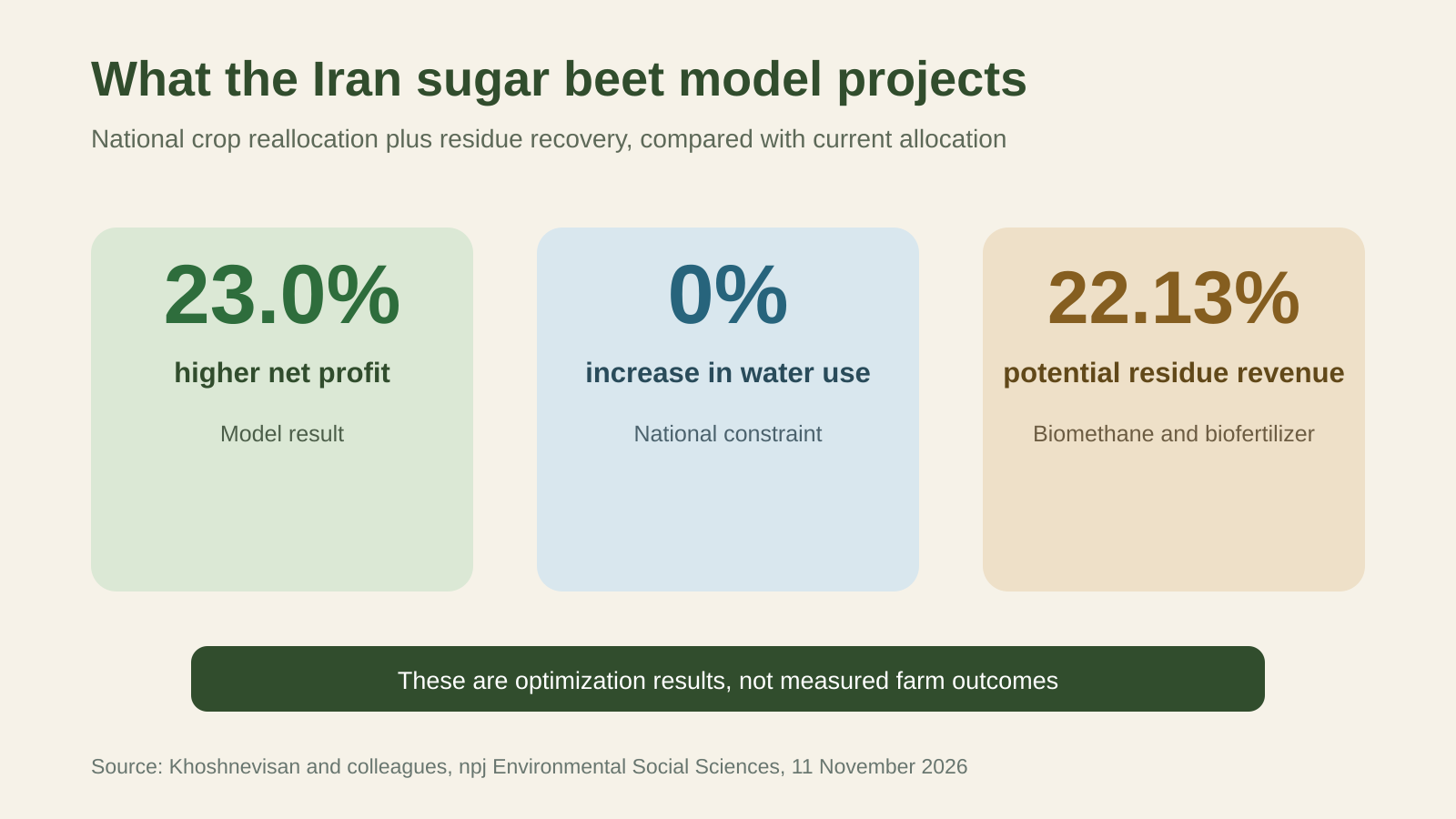
Agrilinkage chart based on the published model results. These values are projections, not observed outcomes.
Residues change the economics
The study does not value sugar beet only as a source of sugar. It also includes potential biomethane and biofertilizer production from post harvest residues through anaerobic digestion.
The authors estimate that residue recovery could contribute potential revenue equal to as much as 22.13% of the integrated system value. That additional stream helps explain why the optimized result differs from a model focused only on crop yield and sugar processing.
Residue value is not free income. Collection, transport, storage, digestion equipment, plant utilization and markets for biomethane and digestate all carry costs and operational risks. The study incorporates economic assumptions, but actual returns would depend on projects being built and operated at scale.
Biofertilizer value also depends on nutrient content, contamination control, transport distance and farmer acceptance. Digestate can replace part of mineral fertilizer demand in some systems, but it is bulky and its nutrient release pattern may not match every crop or soil.
A fixed national water total is useful but incomplete
Holding national water use constant makes the comparison clear: the modeled gain comes from allocation and residue value, not from consuming more water. Yet a fixed national total does not guarantee that local aquifers, rivers or irrigation districts remain within sustainable limits.
Water scarcity is spatial and seasonal. A shift toward a province with higher modeled water productivity could still worsen a local groundwater deficit if the available water budget is overstated or poorly enforced.
Implementation would therefore require basin level limits, measurement of actual withdrawals and attention to return flows. Water saved in one place is not automatically available to another farm or ecosystem.
Processing capacity is a hidden constraint
Sugar beet is bulky and time sensitive. Long transport distances raise costs and can reduce recoverable sugar. The model includes processing capacity, which is essential because reallocating hectares without matching factory throughput could create queues, losses or stranded production.
Factories also determine whether residue recovery is practical. Anaerobic digestion works best when feedstock supply, energy use and product markets are coordinated. A plant that cannot use or sell biomethane and digestate may capture far less value than the model suggests.
The most credible implementation path would begin with provincial pilot plans around factories that have reliable beet supply, measured water performance and realistic residue logistics.
What policymakers should test before reallocating land
First, planners should validate provincial yield and irrigation data over several seasons. A single high yield period can make a region look efficient even if drought performance is unstable.
Second, the model should be stress tested against fertilizer prices, sugar prices, energy prices, transport costs and lower residue collection rates. The 23% profit result should be treated as a scenario, not a guaranteed return.
Third, decision makers should examine who gains and loses. Reducing cultivation in a less efficient province can improve national profit while harming local farmers or underused factories. Transition costs and alternative crops belong in the policy calculation.
Fourth, environmental claims need more evidence. The authors use proxy indicators for carbon reduction and fertilizer substitution rather than a full life cycle assessment. Methane leakage, construction impacts, digestate handling and changes in land use could materially change the result.
A decision framework, not a production forecast
The study is valuable because it joins crop allocation, water limits, processing and residue value in one national model. It shows how a country might obtain more economic value from a crop without simply expanding water use.
It does not demonstrate that Iran has already achieved the projected profit, water performance or residue revenue. Nor does it prove that the same provincial allocation will remain optimal as prices, climate and infrastructure change.
The next step is not nationwide implementation based on one model. It is transparent validation with current water accounts, factory data and regional pilot results. If those tests confirm the assumptions, the approach could become a practical planning tool for other water constrained crop systems.
Primary source and methodology
Agrilinkage reviewed the full open access study and separated calculated optimization results from observed production outcomes. Percentages are reported as published by the authors.
Cover image: original conceptual editorial illustration created for Agrilinkage. It represents sugar beet cultivation, irrigation and residue recovery and does not depict a specific Iranian farm or factory.


Comments