

Indonesia Cuts Palm Oil Benchmark 6% but Keeps Export Levy at 12.5%

Indonesia has lowered its official crude palm oil reference price for November by 6.07%, but exporters still face a fixed duty plus a 12.5% levy. The combination means a lower benchmark does not translate into an equally large improvement in the price competitiveness of shipments.
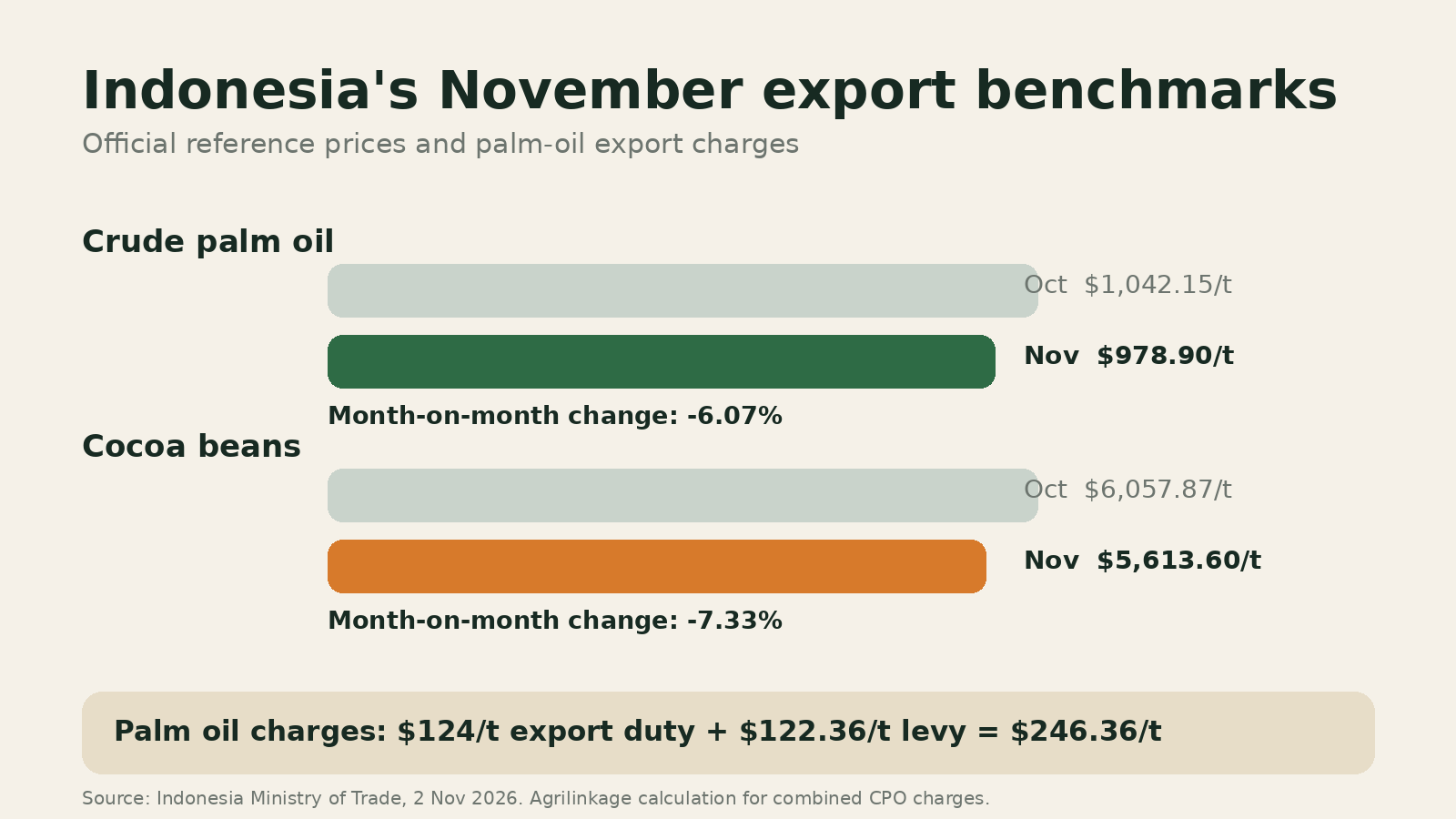
The Ministry of Trade set the November crude palm oil reference price at $978.90 per metric tonne, down $63.25 from October's $1,042.15. The government notice was published on 2 November and applies to shipments during 1–30 November 2026.
The change matters beyond Indonesia. USDA data put the country at 57.3% of world palm-oil production in 2025/26. A shift in its export pricing framework can influence refiners, food manufacturers and rival vegetable-oil markets across Asia, Africa and Europe.
The benchmark fell, but the export burden remains substantial
For November, the crude palm oil export duty is $124 per tonne. The separate export levy is $122.36 per tonne, calculated as 12.5% of the official reference price. Together they amount to $246.36 per tonne.
Agrilinkage calculates that those two charges equal about 25.2% of the November reference value. That is not a forecast of an exporter's final margin: actual proceeds also depend on contract prices, product grade, freight, insurance, refining costs and the point at which a sale was booked. It does show why the reference-price decline cannot be read as a simple 6% reduction in the cost of Indonesian supply.
Because one component is a fixed $124 duty, its weight rises slightly as the benchmark falls. In October, the same fixed amount would have represented 11.9% of the reference price; in November it represents 12.7%. The variable levy declines with the benchmark, but the fixed duty does not.
Why the reference price is not a spot-price quotation
Indonesia's reference price is an administrative benchmark used to determine export charges. It is not the price received by every seller and should not be described as a live global palm-oil quotation.
The ministry said the calculation used observations from 20 September through 19 October. The Indonesian exchange averaged $869.07 per tonne, the Malaysian exchange $1,088.73 and Rotterdam port quotations $1,443.90. Under the applicable methodology, a wide gap among the three sources leads the government to use the two prices closest to the median. For November, those were the Indonesian and Malaysian values.
That time window is important for buyers. The benchmark can lag current physical-market conditions because it averages an earlier period, while contracts and freight markets continue moving. A falling administrative reference therefore signals softer conditions during the calculation window, not necessarily a further fall after 1 November.
Cocoa's benchmark also dropped
Indonesia also lowered its cocoa-bean reference price by 7.33% to $5,613.60 per tonne. The export benchmark used for cocoa duties fell 7.81% to $5,242 per tonne. The ministry attributed the decline to rising stocks as the West African main crop entered the market.
The cocoa export duty and levy were each set at 7.5%. These charges sit alongside the lower benchmark, so processors and traders must separate three questions: whether the underlying commodity price is falling, how the government calculates the taxable reference and how much of the change is passed through to farmgate or factory-gate prices.
For chocolate and ingredient companies, the Indonesian figure is more a confirmation of improved availability than a decisive global price signal. West Africa remains the central driver of traded cocoa supply, and quality, bean differentials and delivery timing can diverge materially from a national administrative benchmark.
What the change means for vegetable-oil buyers
A lower Indonesian benchmark can support export demand at the margin, but the combined charges limit the pass-through. Buyers comparing palm oil with soybean, sunflower or rapeseed oil should focus on delivered prices rather than the headline benchmark alone.
The policy also affects domestic allocation. Export charges reduce the net value of overseas sales relative to domestic sales and can help keep more feedstock available for local refining and biodiesel. The exact effect will depend on domestic mandates, refinery demand and the spread between Indonesian and competing export offers.
For refiners outside Indonesia, the key market indicators are therefore the actual free-on-board offer, the Malaysia–Indonesia price spread, freight to the destination market and changes in inventories. The November reference price is one input in that calculation, not the calculation itself.
What to watch next
Three developments will determine whether the November reduction becomes a lasting shift. First is the next reference-price calculation and whether international quotations remain below October levels. Second is Indonesia's monthly export volume, which will show whether lower benchmarks overcome the export-charge burden. Third is production and stock data as El Niño-related weather risks compete with the arrival of mature plantings.
A sustained decline in delivered palm-oil prices would ease costs for food processors and import-dependent markets. A benchmark decline without stronger shipment volumes, however, would indicate that taxes, domestic demand, logistics or supply constraints are limiting the response.
Sources and methodology
This article uses the Indonesian Ministry of Trade's 2 November notice for the reference prices, calculation window and applicable duties and levies. Agrilinkage added the fixed duty and variable levy and divided the result by the official crude palm oil reference price to show their combined scale. The calculation is illustrative and does not represent a trader's realised margin.





Comments