
India’s 11-Billion-Litre Ethanol Tender Cuts Sugar Diversion to Zero

India’s latest ethanol tender makes a sharp feedstock choice: protect sugar availability by excluding sugarcane juice, sugar syrup and B-heavy molasses, while asking fuel suppliers to meet the country’s blending programme with grain and C-heavy molasses instead.
The oil marketing companies’ first tender for the 2026–27 ethanol supply year seeks about 11 billion litres for delivery from 1 November 2026 through 31 October 2027. The volume is large—equivalent to roughly 30.1 million litres a day if spread evenly across the year—but it is a procurement request, not proof that the full amount will be contracted or delivered.
The immediate effect is to remove the biofuel market’s claim on primary sugar streams for this tender cycle. The less visible consequence is a transfer of demand pressure toward maize, surplus rice, damaged foodgrains and C-heavy molasses. India is therefore not stepping back from petrol blending; it is changing which agricultural markets carry more of the feedstock burden.
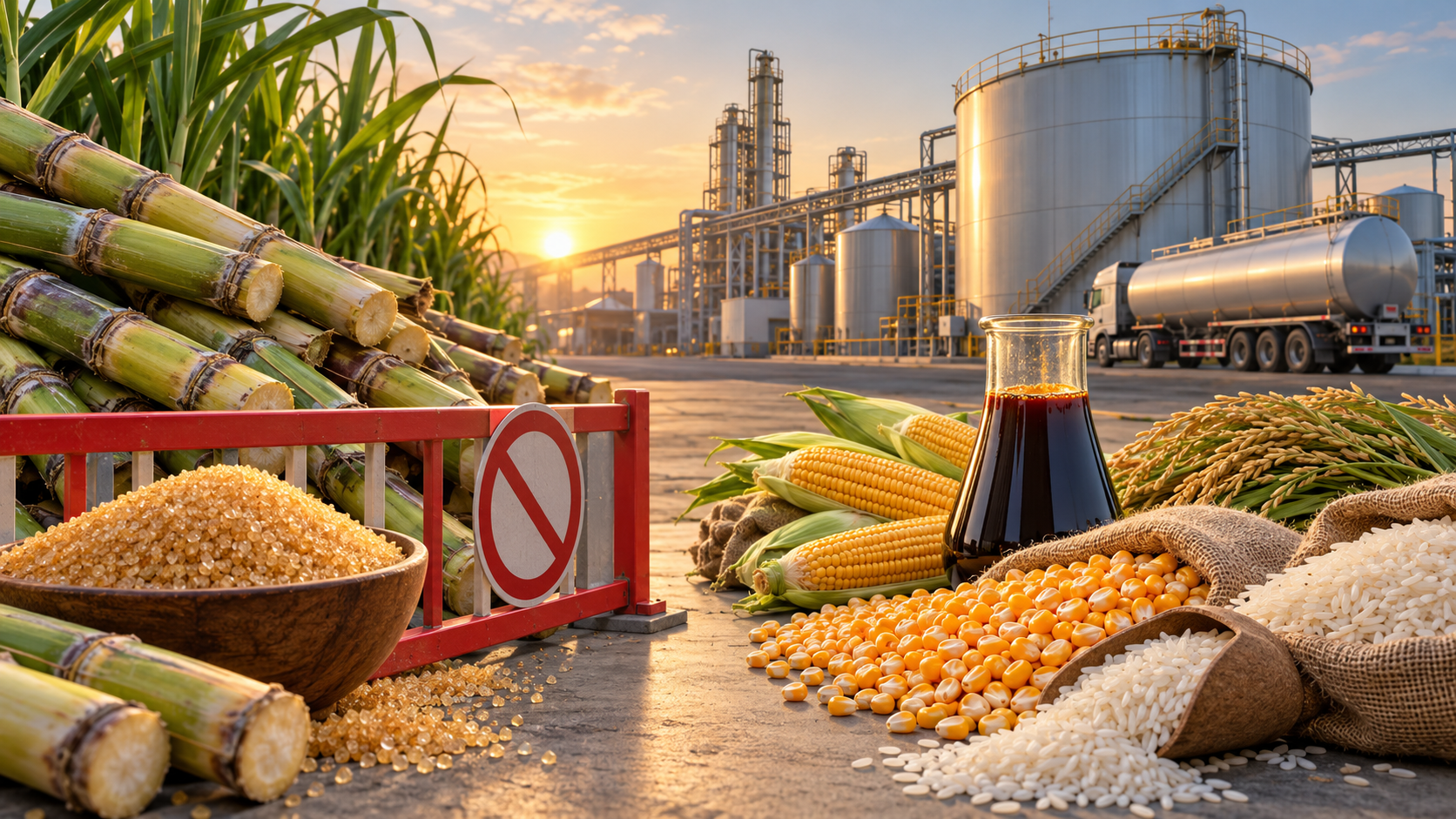
Original Agrilinkage editorial illustration. It is a conceptual graphic and does not depict a real tender, refinery or facility.
What the tender changes
The tender excludes ethanol made directly from sugarcane juice or sugar syrup and from B-heavy molasses. Both routes divert fermentable material before the maximum recoverable sugar has been crystallised. By contrast, C-heavy molasses remains eligible because it is the residue left after more sugar has already been extracted.
Eligible routes listed in the tender include maize, broken or damaged foodgrains, surplus rice supplied through the Food Corporation of India, and C-heavy molasses. That distinction matters: calling the decision a ban on all sugarcane ethanol would be inaccurate. The measure targets the two cane routes that compete most directly with crystal-sugar output.
The tender also reduces the incentive for maize-based ethanol. The procurement price falls from ₹71.86 to ₹68.86 per litre, a ₹3 cut or about 4.2%. The separate maize incentive declines from ₹5.79 to ₹2.79 per litre. Suppliers must therefore weigh a wider potential market against weaker per-litre economics.
Why sugar was given priority
India entered this decision with unusually tight sugar inventories and uncertain production prospects in its two largest producing states, Maharashtra and Karnataka. Earlier industry estimates put opening stocks at roughly 3.5–3.6 million tonnes, near a decade low, while annual domestic consumption was expected around 28.5–29 million tonnes.
Roughly 3 million tonnes of sugar had been diverted to ethanol in the preceding season. That is equivalent to just over 10% of expected annual domestic consumption. It does not follow that the new tender will automatically add the same 3 million tonnes to market supply: cane output, recovery rates, mill decisions and later government changes will determine the actual gain. But the comparison shows why removing high-diversion feedstocks can materially change the sugar balance.
The policy also reduces the risk that fuel demand amplifies a weather-driven sugar shortfall. When stocks are thin, even a moderate production miss can lift wholesale prices, narrow export room and raise the probability of further intervention. Reserving more cane sucrose for food use creates a buffer before the season’s final crop and recovery numbers are known.
The pressure does not disappear—it moves to grain
A zero allocation for cane juice, syrup and B-heavy molasses leaves ethanol producers with a narrower feedstock portfolio. Grain distilleries may receive more orders, but they will need reliable supplies of maize or government-released rice at prices that still cover conversion, energy and finance costs.
That creates three separate markets to watch. First is maize: additional distillery demand may support farm prices and investment in storage, but it can also raise costs for poultry, dairy and starch users if crop supply does not expand. Second is rice: the programme depends partly on the government’s willingness and ability to release eligible surplus stocks without tightening food-security buffers. Third is C-heavy molasses: mills can still monetise this residue, but its ethanol yield is lower than the more sugar-rich routes.
The reduced maize incentive complicates the shift. At ₹3 less per litre, producers face a 4.2% lower procurement price before accounting for changes in maize, energy, enzyme and borrowing costs. A tender can invite 11 billion litres, but offers will depend on whether those economics work plant by plant.
Sugar mills face a different trade-off
For integrated sugar-ethanol groups, the decision removes some of the flexibility that has helped them respond to sugar prices, cane availability and fuel demand. Mills using juice or B-heavy molasses cannot simply redirect those streams into the tender. More cane should therefore move through the sugar crystallisation route, increasing exposure to sugar-market prices and working-capital needs.
The policy is likely to favour operators with grain capacity, flexible multi-feedstock plants or access to C-heavy molasses. It may disadvantage distilleries designed around juice or B-heavy molasses, especially where retrofitting is costly or grain logistics are weak. The tender rules thus alter not only commodity demand but also capacity utilisation across India’s ethanol industry.
What consumers and markets should expect
For consumers, the first-order objective is straightforward: reduce the chance that ethanol demand worsens a sugar shortage. The decision may help contain sugar-price pressure, but it cannot eliminate it. Monsoon performance, cane area, sucrose recovery and mill payments to growers remain decisive.
For fuel markets, the key question is whether eligible feedstocks can replace excluded cane volumes fast enough. India’s blending target requires both physical ethanol and timely logistics to depots. A shortfall in awarded or delivered volumes could make blending harder even if the headline tender remains large.
For farmers, effects will differ. Cane growers benefit when mills remain liquid and able to pay on time, but mills may lose some ethanol-margin flexibility. Maize growers could see stronger demand, yet livestock and feed users may face higher input costs. Rice releases can moderate grain-market pressure, but only while public stocks remain comfortably above policy needs.
Four indicators that will test the policy
1. Tender awards versus the 11-billion-litre request. The gap will show whether suppliers found the revised prices and feedstock rules commercially workable.
2. India’s final sugar production and recovery rates in Maharashtra and Karnataka. A larger crop could ease the rationale for restrictions; a weak crop would reinforce it.
3. Maize prices and poultry-feed margins. Rising distillery demand alongside lower ethanol incentives would squeeze one or both sides of that chain.
4. Government rice allocations and ethanol deliveries. These will reveal how much of the replacement burden falls on public grain stocks rather than the open maize market.
A balancing measure, not a retreat from ethanol
The central point is that India is reallocating agricultural risk. Sugar availability receives protection now, while grain supply, public rice stocks and distillery economics take on more of the burden of sustaining the blending programme. That may be rational under tight sugar inventories, but its success cannot be judged from the tender volume alone.
The outcome will depend on contracted volumes, actual deliveries, crop size and the relative prices of sugar, maize and rice. If grain supply proves adequate and tender awards are strong, India can preserve blending momentum while rebuilding its sugar buffer. If not, the pressure will reappear as higher feed costs, weaker ethanol supply or another policy adjustment.
Sources and methodology
This analysis uses the 16 October reporting by Reuters on the 2026–27 tender and excluded sugar feedstocks, together with the tender terms and supply window reproduced by AgriInsite.
Tender details and eligible feedstocks: AgriInsite transcript of the oil-marketing-company invitation. Agrilinkage converted 11 billion litres to an even daily rate and calculated the maize-price percentage change from the stated old and new rates. Comparisons are scale indicators, not forecasts.


Comments