
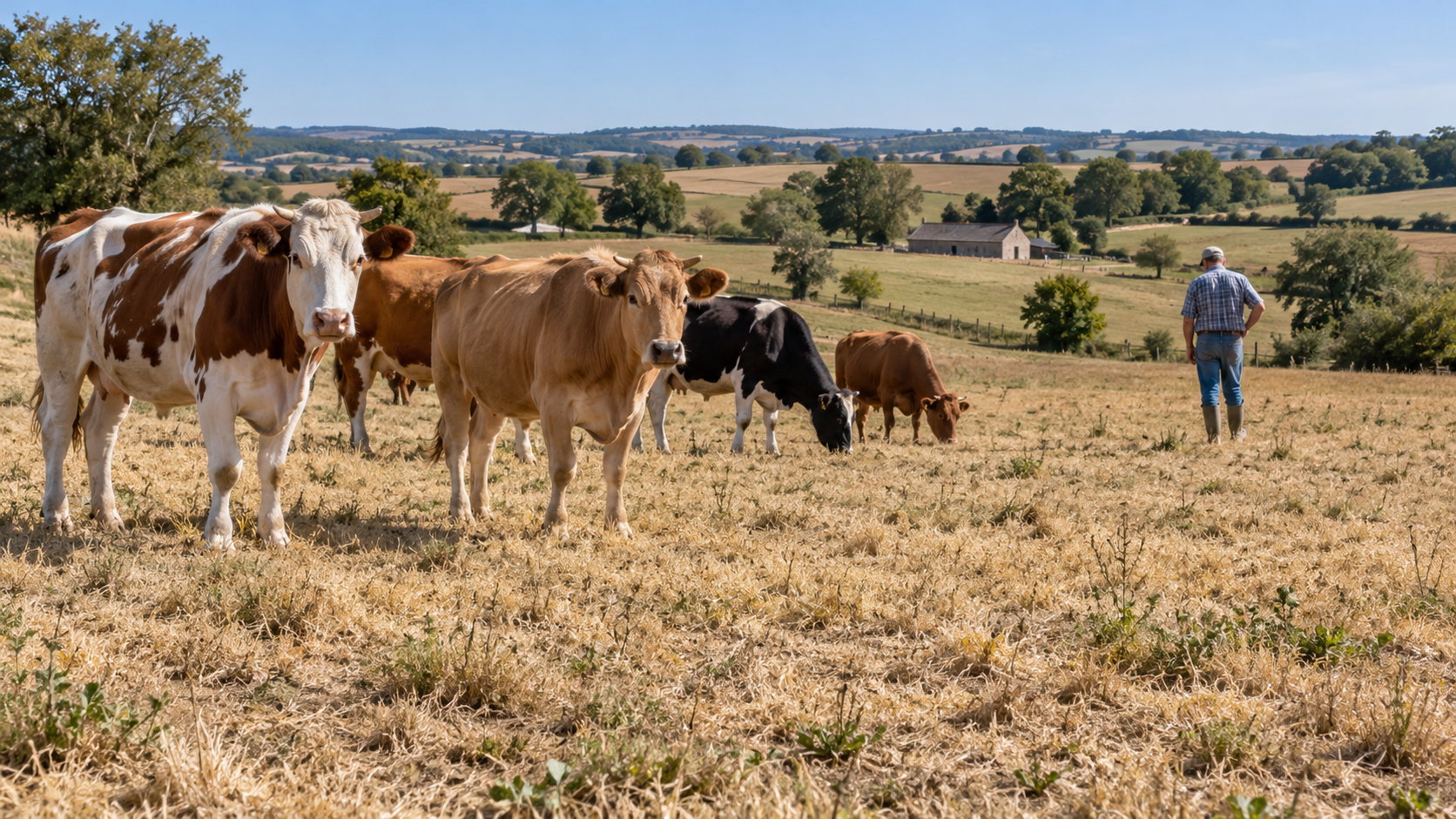
France’s Pasture Grass Growth Runs 42% Below Normal After Three-Month Stall

Grass growth on France’s permanent pastures was 42% below its historical benchmark by September 30, after heat and drought kept national forage production almost flat for more than three months, according to the French Agriculture Ministry’s Agreste statistical service.
The October 7 update shows a deterioration that began rapidly in early summer and continued through the start of autumn. For livestock farms that depend on grazing or cut grass for hay and silage, the shortage means less home-grown feed and greater pressure on winter forage reserves.
A deficit that kept getting worse
At the end of June, cumulative pasture growth was already 15% below the 1989–2018 reference for the same point in the season. The gap widened to 20% by July 10, 30% by July 31 and roughly one-third by August 10.
Agreste put the deficit at 37% on August 31, 39% on September 10 and 40% on September 20. By September 30 it had reached 42%. The ministry said recurring high temperatures and drought since the late-June heatwave prevented a meaningful recovery, leaving cumulative growth stalled for more than three months.
That sequence matters more than a single bad reading. Pastures normally add feed through summer and early autumn, although the pace varies greatly by region and weather. When growth remains weak for months, livestock producers lose both immediate grazing and opportunities to replenish conserved forage.
What the 42% figure means
The result compares cumulative growth on permanent grassland with average growth observed by the same date during the 1989–2018 reference period. Permanent pastures are fields kept in grass for several years and used for grazing or cutting.
The indicator is not the same as saying every French farm has 42% less feed. Individual conditions depend on location, soil, rainfall, stocking rate, pasture management and the reserves carried into the season. It also does not directly measure hay already stored in barns or feed that farmers may buy.
It does show that the national biological production base for grass-fed livestock is far below its usual level. Agreste reported that the deficit had spread across nearly all regions by September, making it harder for better conditions in one area to offset losses elsewhere.
Why livestock producers feel the pressure
Grass is the lowest-cost feed on many cattle and sheep farms. When animals cannot obtain enough from pasture, farmers may open silage or hay stocks earlier than planned, buy supplementary feed, reduce grazing time or move animals between fields.
Each option has a cost. Using winter reserves in summer shortens the buffer available for cold months. Purchased forage and concentrates add cash expense. Moving animals requires labour and transport, while reducing stocking pressure can mean selling animals earlier than intended.
Dairy farms can also face production pressure if cows receive less energy or lower-quality forage. Beef and sheep operations may see slower weight gain. These outcomes are not measured in the Agreste grass-growth figure, but they are the practical channels through which a pasture deficit can affect farm income and eventually meat or milk supply.
Why late rain may not erase the damage
Rain can restart grass growth when soil temperatures and plant conditions remain favourable, but timing matters. A late-autumn recovery does not automatically replace the volume lost during the main growing season, and shorter days limit the amount of biomass that can be produced before winter.
Pastures stressed by repeated heat and moisture shortages may also recover unevenly. Farmers must balance the need for extra grazing against the risk of overusing weakened fields, which can reduce plant cover and make future production less resilient.
The official series therefore points to an accumulated production loss rather than a temporary dry spell. Even if rainfall improves, many farms will enter winter with a smaller forage margin than they expected at the start of the year.
What to watch next
The next national pasture update is scheduled for late October. The key question is whether cooler weather and rainfall produce a measurable recovery or whether cumulative output remains close to its September level.
Feed markets will also matter. A pasture shortage becomes more expensive when hay, straw, cereals or protein feed are scarce or costly at the same time. Livestock prices can partly offset higher costs, but only if farms have enough feed and cash flow to maintain production.
For policymakers, the data provide an early warning about where drought support, water management and forage availability may become urgent. For producers, the 42% deficit is a signal to recalculate winter feed balances now rather than assume autumn growth will close the gap.
Primary source
Agreste, French Ministry of Agriculture and Food Sovereignty, “Pousse de l’herbe : nouvelle dégradation au 30 septembre 2026,” published October 7, 2026: https://agreste.agriculture.gouv.fr/agreste-web/disaron/%21searchurl/e2606dbb-73e6-4148-8ffc-0facf0e52155/search/
Related Agrilinkage coverage
France’s 2026 wine harvest forecast: https://www.agrilinkage.com/post/france-2026-wine-harvest-34-9-million-hectolitres-lowest-century
France corn crop seen at its lowest since 1980: https://www.agrilinkage.com/post/france-corn-crop-8-1-million-tonnes-lowest-since-1980
Cover image: OpenAI-generated editorial visualization created for Agrilinkage. It represents drought-stressed French pasture conditions and does not depict a named farm.


Comments