
Food Crises Remain Severe Across 39 Countries as Risks Build for 2027

Acute food insecurity remained very high across 39 countries and territories with available data through August 2026, according to a new midyear assessment released by the World Food Programme, the Food and Agriculture Organization and the Global Network Against Food Crises on 17 November.
The assessment says conflict, insecurity and weather extremes remained the main drivers. Rising food and fertilizer prices added pressure, while reduced humanitarian funding weakened the ability to respond. The central finding is not that every crisis worsened at the same rate, but that broad improvement failed to take hold.
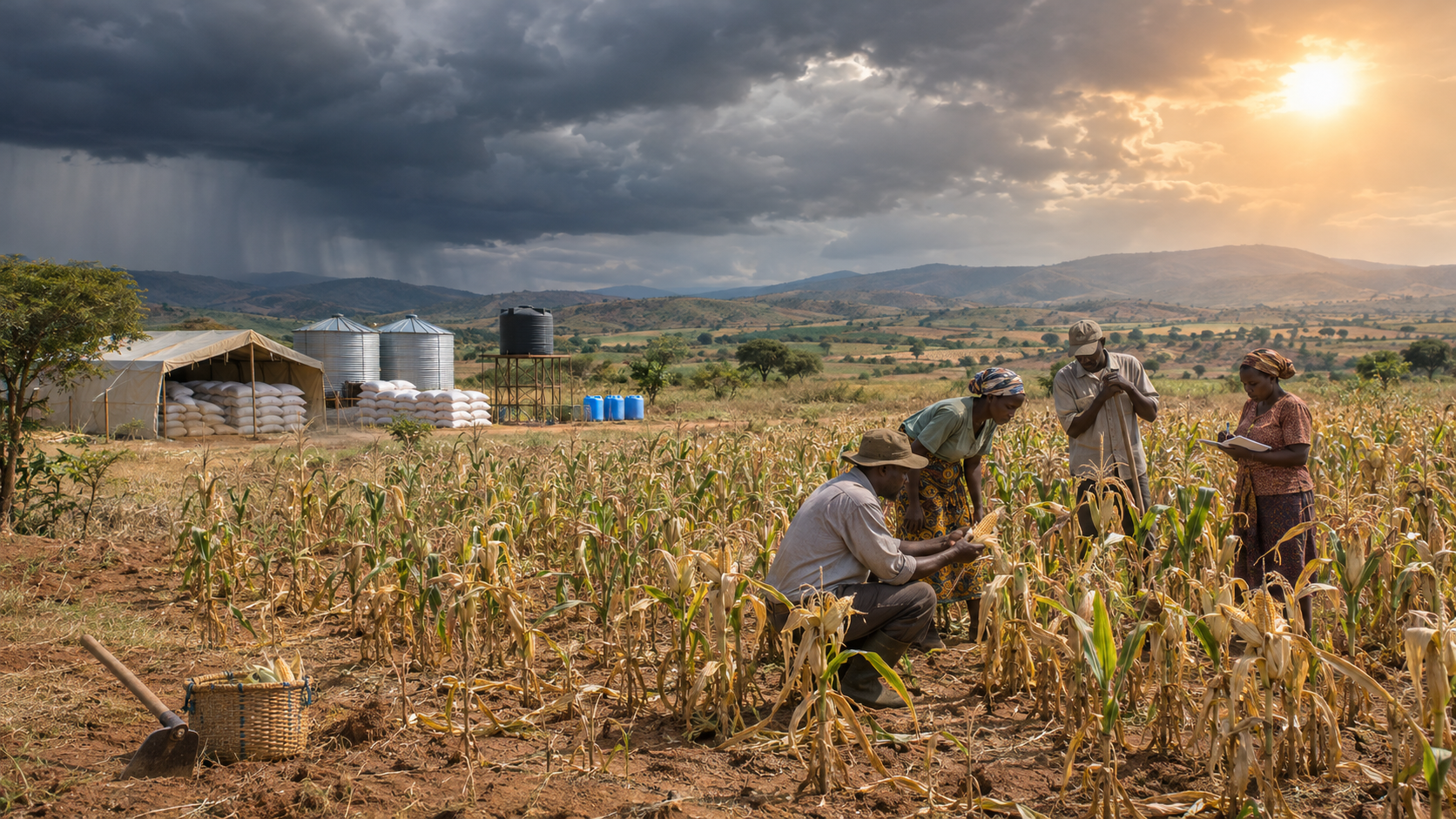
Image note: This is an original Agrilinkage editorial illustration created with artificial intelligence to represent agricultural and supply risks. It does not depict a named country, community or crisis.
Limited improvements remain fragile
The report notes improved conditions in the Gaza Strip and parts of Sudan during the first part of 2026. It also warns that those gains were limited, uneven and fragile.
That distinction is essential. A movement away from the most extreme classification in one area does not mean households have recovered their livelihoods, rebuilt market access or regained reliable supplies of food, fuel, water and agricultural inputs. It can instead reflect a temporary improvement in access or assistance that may reverse.
Food security analysis measures severity and access, not only crop output. A country can produce food while conflict, damaged transport, high prices or lost income prevent vulnerable households from obtaining it. The report therefore treats violence, weather and economic pressure as interacting drivers rather than isolated causes.
New risks extend into 2027
The midyear update expects additional setbacks that are not yet captured in the available data. It identifies the continuing conflict in the Middle East, El Niño conditions and reduced humanitarian funding as major risks for late 2026 and 2027.
El Niño can affect regions in different ways. Drought can reduce rainfed crop yields and pasture, while excessive rain can damage fields, roads and storage. The market effect depends on which producing regions are hit, whether stocks are available and whether trade remains open.
The funding constraint creates a second channel of risk. When assistance budgets fall, agencies may reduce the size, frequency or geographic reach of support. That can lower food access even before a harvest shock appears in national production statistics.
Food and fertilizer prices can amplify local shocks
The report identifies rising food and fertilizer prices as compounding pressures. Fertilizer affects future production because farmers may cut application rates, switch crops or plant less when cash and credit cannot cover input costs.
Food prices operate more immediately. Households that spend a large share of income on staples have little room to absorb an increase. Traders and millers may also face higher transport, energy and finance costs, which can move through local supply chains even when international benchmark prices are stable.
These channels do not guarantee a global price spike. Well supplied world markets and open trade can buffer regional shortfalls. The danger is greatest where conflict, weak currencies, import dependence and limited public finances already restrict access.
The 39 country update is not a simple global headcount
The midyear assessment covers 39 countries and territories for which current data were available. That coverage is narrower than the annual 2026 report, which assessed 47 food crisis countries and territories using 2025 data.
The annual report estimated that 266 million people, or 22.9 percent of the analysed population, faced high levels of acute food insecurity in 2025. That figure should not be treated as a direct midyear total for 2026. Coverage, reference periods and available assessments differ.
The comparison problem is especially important when access and funding constraints reduce data collection. A smaller reported total can reflect fewer assessed places rather than genuine improvement. Agrilinkage therefore uses the new report's qualitative conclusion for 2026 and keeps the earlier 266 million estimate clearly tied to 2025.
What would confirm improvement
A durable improvement would require more than a temporary fall in emergency classifications. Useful indicators include sustained market access, lower staple prices relative to incomes, restored planting and livestock activity, safer transport routes, adequate humanitarian funding and repeated assessments showing households moving out of crisis conditions.
The opposite signals would be widening conflict, new displacement, crop losses linked to El Niño, rising fertilizer costs and further reductions in assistance. Those indicators can affect food access on different timelines, so a quiet market month should not be mistaken for a resolved crisis.
Sources and methodology
Agrilinkage treated the 17 November publication as a midyear status update rather than a replacement for the annual report. Observed conditions through August are separated from the report's outlook for late 2026 and 2027. Figures from the annual edition are labelled with their 2025 reference year.


Comments