
Market and Trust Barriers Hold Back Farm Biotechnology More Than Lab Readiness

Agricultural biotechnology often stalls after scientists have shown that a tool can work. A new assessment of 77 technologies argues that the hardest barriers are more often commercial viability and public acceptance than laboratory readiness.
The perspective, published in Nature Biotechnology on 10 November 2026, compares technologies across crops, soils, livestock, watersheds, aquaculture, health and security, food loss and waste, and longer term research frontiers. It uses a Balanced Readiness Level framework that scores five dimensions: technology, market, regulation, acceptance and organization.
The authors conclude that market viability and social acceptance are the leading constraints across the portfolio. That finding matters because it shifts the question from whether a biological tool can produce an effect to whether it can be manufactured, approved, delivered, trusted and paid for at agricultural scale.
Laboratory success is only one gate
A field technology must survive several tests at once. It needs reliable performance outside controlled conditions, a cost structure that fits farm margins, a regulatory pathway, acceptance from growers and food buyers, and organizations capable of production, distribution and support.
The study finds that higher readiness tends to be associated with technologies that can enter existing operations without major system changes, remain contained, act temporarily and are perceived as natural. Those traits reduce the number of changes required from farmers, regulators and consumers.
This does not mean that natural products are automatically effective or safe. It means that tools fitting familiar practices face fewer deployment barriers than technologies requiring new infrastructure, permanent environmental release or contentious genetic changes.
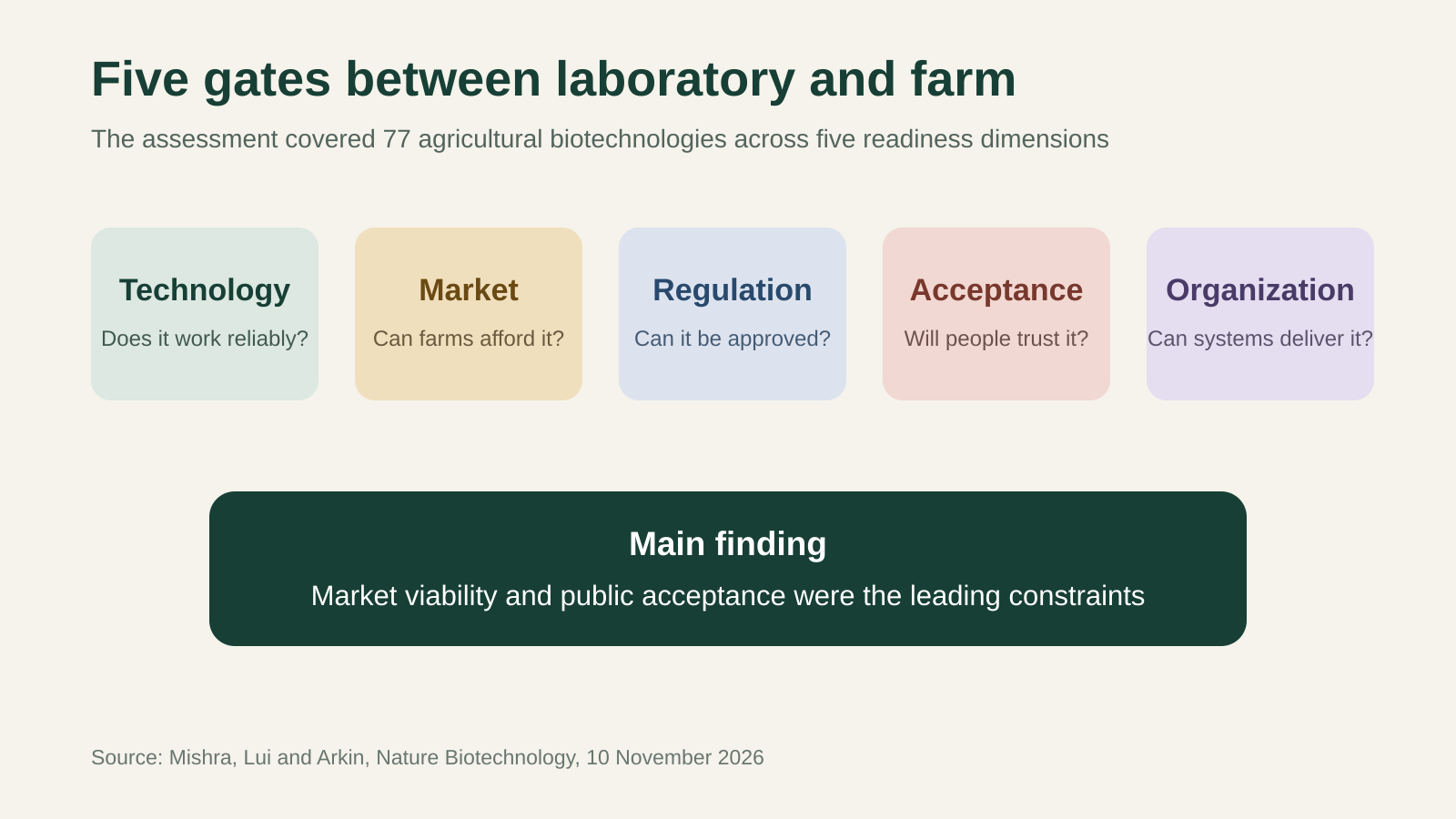
Agrilinkage framework based on the five dimensions used in the Nature Biotechnology assessment.
Why nitrogen fixing microbes are a useful test
The same journal issue includes a peer reviewed comment on engineered nitrogen fixing bacteria for cereal crops. The concept is attractive because maize and wheat cannot form the same natural nitrogen fixing partnerships as legumes. Microbes that deliver more usable nitrogen near roots could reduce part of the synthetic fertilizer requirement and the losses associated with broad fertilizer application.
The technology is also a clear example of the deployment gap. Engineered strains must compete with native soil organisms, colonize roots across different soils and climates, produce nitrogen when crops need it, avoid unacceptable environmental persistence and deliver enough value to justify their price.
Some products based on gene edited microbes are already used commercially, while more extensively engineered strains have entered confined field testing in the United States and received approval for testing in Brazil. These tests establish a regulatory and experimental path. They do not yet prove a reliable fertilizer replacement rate across farms.
The comment itself requires careful reading because several authors work for Switch Bioworks or hold equity in the company, while other authors advise Pivot Bio. The journal discloses those interests. The work is useful for identifying technical directions, but performance and substitution claims still need independent field evidence.
The business question is cost per dependable unit of nitrogen
Farmers do not buy scientific potential in isolation. They compare the delivered cost and risk of a biological product with fertilizer prices, expected yield response, application requirements and the consequences of under supplying nitrogen.
A microbial product can be valuable even if it replaces only part of a fertilizer program, but the commercially relevant measure is dependable nitrogen delivery per hectare across environments. Average trial performance is insufficient if results vary widely with soil type, weather, storage conditions or application timing.
Manufacturing and shelf life also matter. A living product must remain viable during production, transport and farm storage. Distribution systems need quality control, agronomic guidance and a process for handling failed establishment. These organizational requirements can become the binding constraint even when the biology is promising.
Acceptance is not a public relations problem alone
Public acceptance is often treated as a communications issue, but the assessment suggests it is a core deployment dimension. Acceptance can depend on the type of genetic change, environmental containment, transparency, food chain exposure, farmer experience and the distribution of benefits and risks.
Regulators need evidence about persistence, gene transfer and effects on non target organisms. Food companies may need traceability and assurance for buyers. Farmers need clarity about stewardship and liability. Communities need credible answers about who monitors the technology after release.
Technologies perceived as natural may move faster, but perception should not replace evidence. A robust approval system should assess actual exposure and risk rather than relying only on whether a product sounds familiar.
What investors and policymakers should measure
The assessment offers a useful screening tool, not a forecast of which company or product will win. A strong development plan should report performance across locations and seasons, manufacturing yield, shelf life, application cost, regulatory milestones, farmer retention and independent safety evidence.
For engineered nitrogen microbes, the decisive evidence would include replicated yield and nitrogen use results under reduced fertilizer rates, the proportion of fields meeting a defined performance threshold, and the full cost of product delivery and stewardship.
For public funders, the main lesson is that supporting discovery alone may leave valuable tools stranded. Field networks, regulatory science, manufacturing research and independent adoption studies can be as important as another laboratory improvement.
What the study does not prove
The 77 technology assessment is a structured perspective, not a set of randomized farm trials. Its readiness scores organize expert judgment across domains, but they do not establish commercial returns or environmental benefits for individual products.
The framework also cannot remove uncertainty about future regulation, consumer response or production costs. A technology rated as deployable can still fail in the market, while a difficult technology can advance if it solves a sufficiently valuable problem.
The strongest conclusion is therefore practical rather than predictive. Agricultural biotechnology succeeds only when biological performance, economics, regulation, acceptance and delivery systems mature together.
Primary sources and methodology
Agrilinkage reviewed the published abstracts, methods framing, disclosed conflicts and regulatory context. The article separates the readiness assessment from company claims and does not treat field trial authorization as proof of commercial performance.
Cover image: original conceptual editorial illustration created for Agrilinkage. It does not depict a specific company, field trial or research team.


Comments