

Dairy Compost Cut Almond Orchard Nitrous Oxide 35 Percent Without Reducing Yield

By Agrilinkage Research Desk | Published 18 November 2026 | Source review and field trial analysis
A four year commercial almond orchard study led by University of California Davis researchers found that dairy manure compost cut nitrous oxide emissions by about 35 percent compared with fertilizer delivered through irrigation alone, while maintaining or increasing almond yield.
The result challenges a simple assumption that adding manure based compost must increase this potent greenhouse gas. It also points to a practical nutrient loop between California dairies and almond orchards. But the findings remain preliminary. UC Davis said the work has not yet completed peer review and will be submitted to scientific journals.
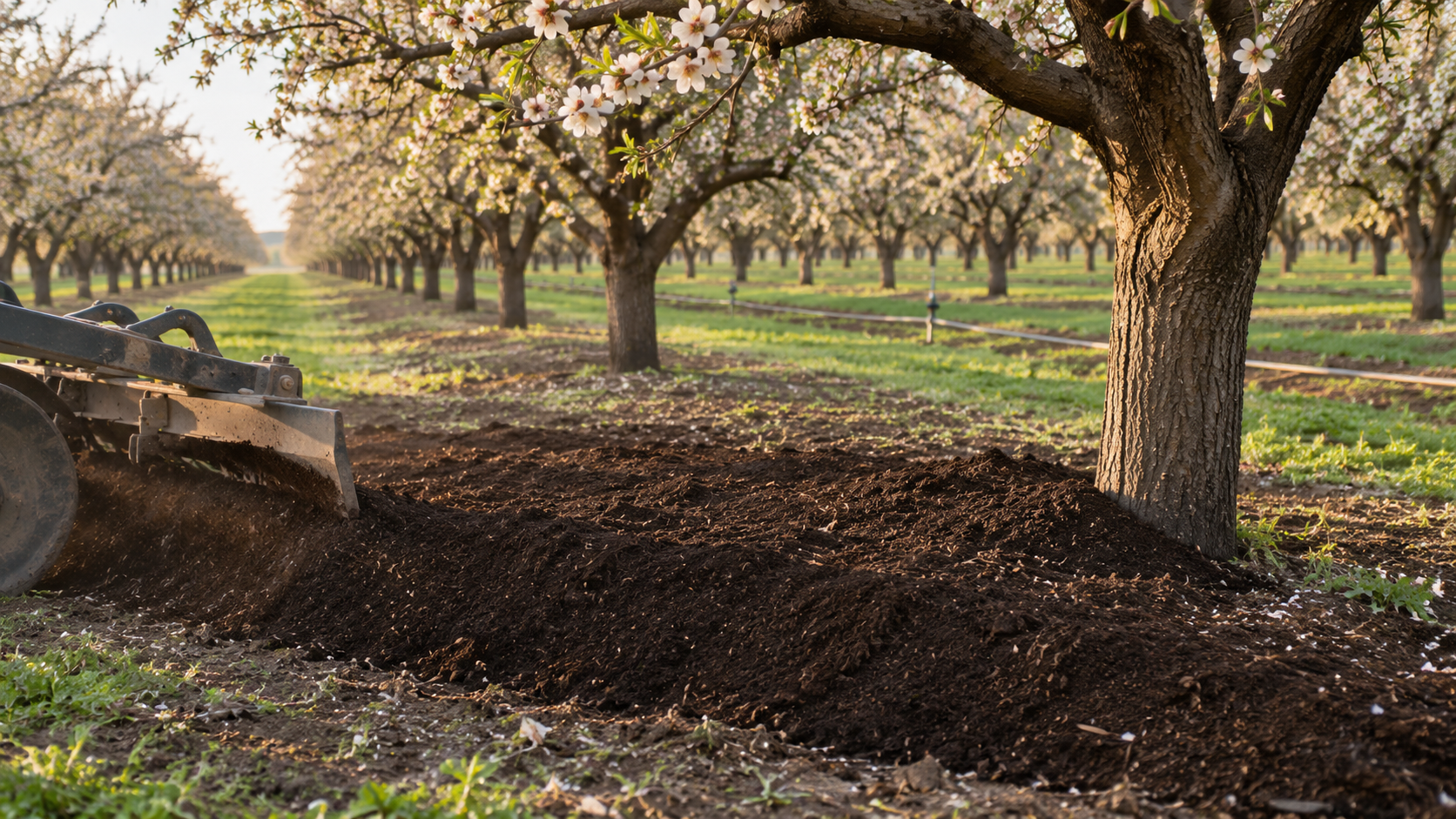
Original editorial illustration by Agrilinkage. It does not depict the reported UC Davis orchard.
What the orchard trial tested
Researchers followed 480 trees across 40 acres of a commercial almond orchard for four years. The experiment compared four nutrient strategies: no added nutrient control, compost alone, fertilizer supplied through irrigation, and compost combined with that irrigation fertilizer.
According to the UC Davis report published on 17 November, trees receiving compost grew faster. The combination of compost and irrigation fertilizer was also more resilient as the study years became progressively hotter and drier.
The central emissions result was measured against the irrigation fertilizer treatment. Compost amended soil produced roughly 35 percent less nitrous oxide, while yields were maintained or improved. That combination matters because emissions reductions that reduce crop output can simply shift production pressure elsewhere. Here, the researchers reported no such yield penalty.
Why the result is plausible but not yet settled
Nitrous oxide is commonly produced when soil microbes transform available nitrogen under suitable moisture and oxygen conditions. More organic material can sometimes increase emissions because it supplies both nitrogen and carbon. The UC Davis team instead suggested that carbon in the compost may have helped soil microbes retain nitrogen in the soil system rather than release it as gas.
That explanation is a proposed mechanism, not a confirmed causal result. The public report does not provide a complete nitrogen budget, detailed soil process measurements, or a peer reviewed statistical appendix. Growers should distinguish the observed field outcome from the mechanism offered to explain it.
The weather sequence also matters. Compost can improve soil structure and water holding capacity, so its agronomic value may become more visible during hot and dry seasons. The reported resilience in the combined treatment is consistent with that possibility, but one orchard cannot establish how large the effect would be across different soils, irrigation systems, compost specifications, and climates.
A circular nutrient link between dairies and almonds
California almond hulls are widely used as dairy feed. Returning finished dairy manure compost to orchards closes part of that material cycle. Orchards receive organic matter and nutrients, while dairies gain another managed outlet for manure nutrients. The climate value depends on the full chain, including compost production, transport distance, application rate, displaced fertilizer, soil emissions, and any change in long term soil carbon.
That whole system view is commercially important. A lower field emission does not by itself prove a lower total footprint. Transporting bulky compost over long distances can be costly, and compost nutrient content varies. Excess application can create nutrient imbalance or salinity concerns. A responsible decision requires laboratory analysis, a crop nutrient plan, local soil knowledge, and realistic hauling and spreading costs.
What growers should watch next
The strongest next evidence would be a peer reviewed paper with full treatment rates, seasonal emissions data, yield statistics, soil measurements, and uncertainty ranges. Replication across orchards would show whether the result survives changes in soil, cultivar, irrigation, and compost source. Economic analysis should compare material, transport, application, fertilizer savings, yield response, and any value assigned to emissions reductions.
For now, the study provides a credible field signal rather than a universal recommendation. It suggests that well managed dairy compost can support almond production without the nitrous oxide increase some growers may expect. It does not yet establish the best rate, the best timing, or the net climate benefit for every orchard.
Sources and methodology
Agrilinkage reviewed the official UC Davis Agriculture and Natural Resources report and treated all numerical findings as preliminary because the underlying study has not yet been peer reviewed. No interviews or firsthand field observations were conducted for this article.


Comments