
Clarios Moves to Buy U.S. Ecobat Plants Processing 40 Million Batteries a Year

Clarios has agreed to acquire Ecobat's three U.S. critical-mineral recovery plants, a proposed transaction that would move facilities processing more than 40 million vehicle batteries a year into the battery maker's closed-loop supply network.
The companies announced the deal on October 27, 2026. It covers plants in City of Industry, California; Indianapolis, Indiana; and Middletown, New York, as well as Ecobat's Dallas office. The price was not disclosed. Closing is expected by early 2027 and remains subject to regulatory approval and other customary conditions.
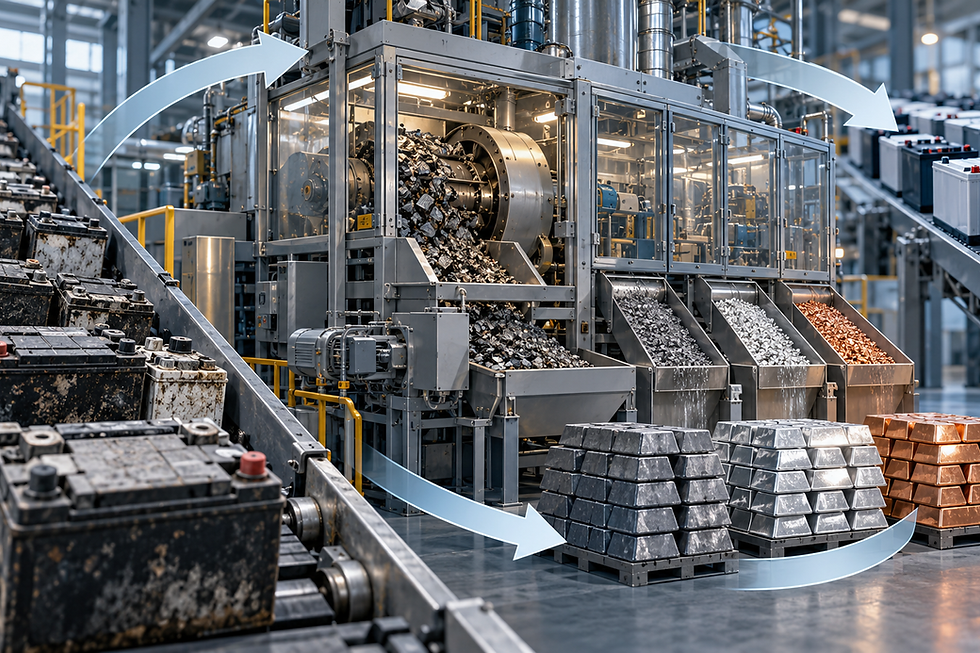
Why the 40 million figure matters
The acquired plants recover lead, tin, antimony and other materials from used batteries. Their stated annual throughput is equivalent to more than 109,000 batteries a day, or roughly 4,560 an hour, if spread evenly across a full year. That is Agrilinkage arithmetic based on the company figure, not a description of actual shift patterns or daily production.
The scale matters because vehicle batteries are both a waste stream and a source of industrial feedstock. Recovered lead can return to battery manufacturing, while antimony is used to harden lead in storage batteries. That gives the plants a role beyond disposal: they shorten the chain between end-of-life products and new manufacturing.
Clarios said in its October 27 announcement that the facilities process more than 40 million batteries annually and that it intends to maintain continuity of operations, environmental compliance and workforce stability during the transition.
A critical-minerals deal, but not a lithium deal
The transaction is easy to misread as part of the lithium-ion investment boom. It is primarily about the established lead-battery loop and the associated recovery of lead, tin and antimony. Ecobat separately exited its lithium-recycling business, according to its corporate news archive.
The strategic case is reinforced by U.S. import exposure. The U.S. Geological Survey's 2026 mineral report says China was a major source for 14 of the 33 critical minerals on which the United States was most dependent on imports. The report also identifies antimony among the minerals subject to Chinese export restrictions to the United States.
Domestic recycling does not eliminate import dependence by itself. It can, however, turn material already present in the U.S. vehicle fleet into a repeat source of industrial supply. The commercial value will depend on recovery yields, operating costs, environmental performance and the ability to return recovered material to qualified manufacturing customers.
Clarios is consolidating both ends of the loop
Clarios says its batteries are installed in one in three vehicles worldwide and that its existing network recycles about 8,000 batteries an hour. Buying the Ecobat plants would add recovery assets to a company that also sells new low-voltage batteries to vehicle manufacturers and the replacement market.
The transaction also continues Clarios' expansion into assets previously owned by Ecobat. Ecobat's news archive records an earlier sale of German and Austrian battery-recycling and specialty-lead operations to Clarios. Ecobat said the U.S. sale would complete a portfolio transformation involving ten divestitures across 17 sites in six countries over roughly 16 months.
That sequence can be checked against Ecobat's corporate news archive, which distinguishes the completed European disposals from the newly proposed U.S. transaction.
What remains unknown
Neither company disclosed the purchase price, individual plant capacity, current utilization or the capital expenditure Clarios may commit after closing. Those omissions prevent a reliable valuation of the acquired throughput or a comparison with replacement cost.
Regulatory approval is another real condition, not a formality that can be assumed complete. The deal would combine major parts of the battery manufacturing and recycling chain, and the companies have only stated an expected closing window.
Environmental performance will be central. Lead recovery is valuable precisely because it keeps a hazardous material in a controlled industrial loop, but the benefit depends on emissions control, worker safety, transport practices and regulatory compliance at each site. Clarios has promised to build on Ecobat's environmental, health and safety practices; that is a forward commitment rather than an independently verified outcome.
What to watch next
The most useful next disclosures would be the purchase price, the reviewing regulators, any required remedies, plant-level investment plans and post-closing recovery targets. Customers and suppliers should also watch whether Clarios changes procurement arrangements for spent batteries or the sale of recovered lead, tin and antimony.
For the wider industrial economy, the transaction is a test of whether circular supply chains can be scaled through consolidation without weakening competition or environmental accountability. The plants already exist and process material at volume. The unanswered question is what a vertically integrated owner will do with that base.
Reporting method: Agrilinkage reviewed the October 27 Clarios announcement, Ecobat's corporate transaction archive and the U.S. Geological Survey's 2026 mineral reporting. No interviews were claimed or conducted for this article. Calculations are simple conversions of disclosed company figures.


Comments