
Brazil Farm Exports Reach US$16 Billion as Soy Leads October Sales

Brazilian agribusiness exports reached US$16 billion in October 2026, an increase of 4.1 percent from the same month a year earlier, according to figures released by the Brazilian government on 18 November.
The result matters beyond a single monthly total. Farm and food products generated 42.3 percent of all Brazilian export revenue during the month and produced an estimated trade surplus of US$14.1 billion. That scale makes the sector a central source of foreign currency for Brazil and a major supply channel for feed, food, fibre and industrial raw materials across the world.
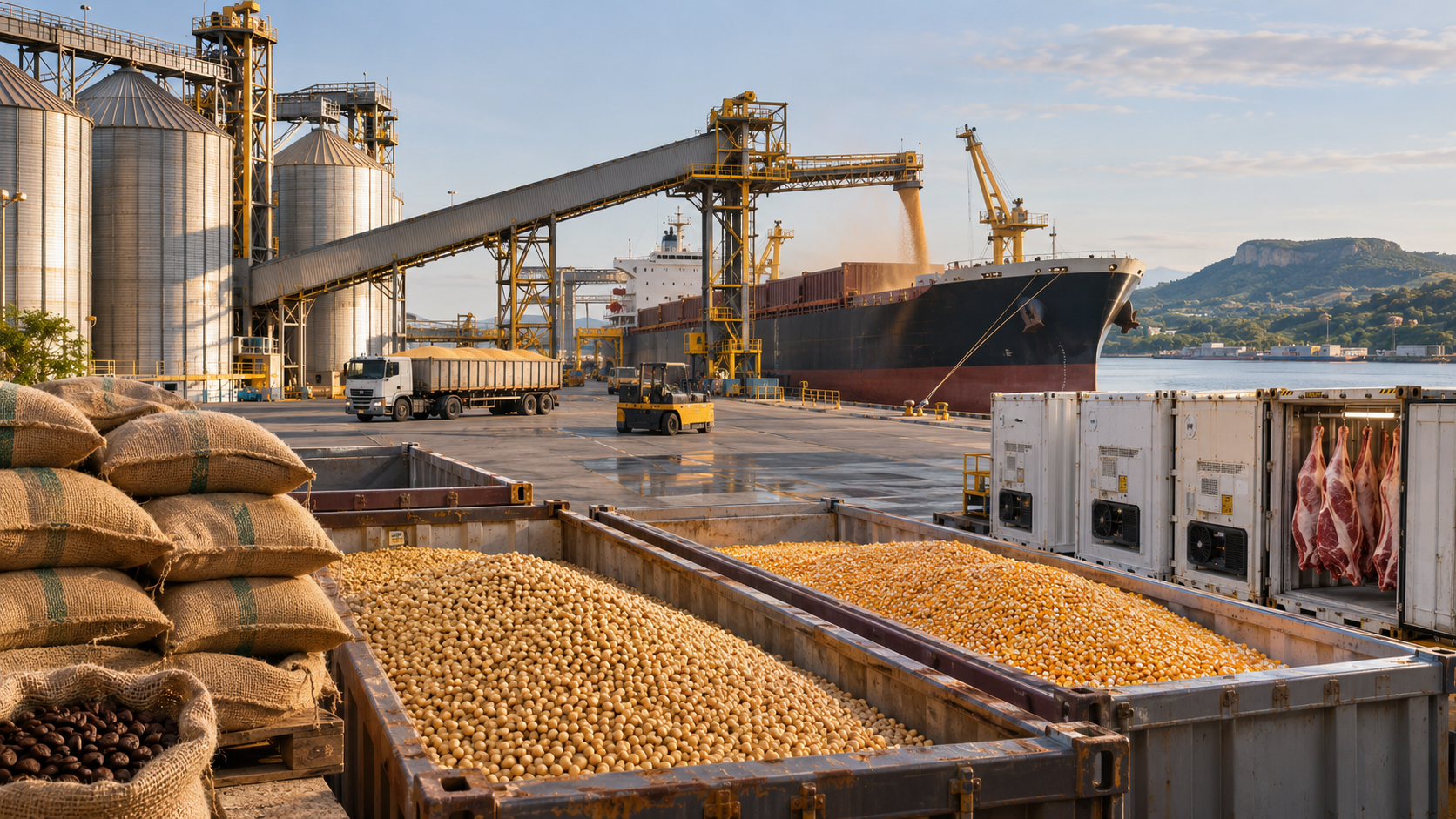
Image note: This is an original Agrilinkage editorial illustration created with artificial intelligence to represent Brazil's agricultural export mix. It does not depict a specific port or shipment.
Soy still leads a broader export basket
Soybeans were the largest export product in October at US$3.1 billion. Green coffee followed at US$1.6 billion, corn at US$1.3 billion, fresh beef at US$1.2 billion and pulp at US$1 billion.
Those five lines together accounted for US$8.2 billion, just over half of the monthly agribusiness export total. The concentration shows how strongly Brazil's trade position still depends on a limited group of commodities, even though the list spans crops, livestock and forestry.
Soybean meal exports rose 40.3 percent from a year earlier, while fresh chicken meat exports increased 13.5 percent. Those gains are commercially important because they point to strength in processed feed and animal protein as well as in raw grain shipments.
China remains first, while Europe and the United States grow
China remained the largest buyer with US$3.9 billion of purchases. The European Union was second at US$2.6 billion, while the United States bought US$952.1 million.
Sales to the European Union increased 15 percent from October 2025, led by corn, soybean meal and soybeans. That mix suggests the increase was closely tied to feed and commodity demand rather than to one premium consumer category.
Exports to the United States rose 35.7 percent, with fresh beef, green coffee and pulp making the largest contributions. The beef comparison requires care. The government said sales benefited from a temporary expansion of the United States tariff quota for lean beef trimmings from September through November, as well as a low comparison base in October 2025 when an additional tariff applied.
In other words, the United States increase is real, but part of it reflects policy timing and the prior year's unusually restrictive conditions. Buyers and exporters should not assume that the October growth rate will continue once the temporary quota period ends.
The annual total is rising faster than the month
From January through October, Brazilian agribusiness exports reached US$149.4 billion. That was 5.2 percent higher than in the same period of 2025 and represented an increase of US$7.4 billion.
The annual pace is slightly stronger than the October growth rate. This indicates that the sector entered the final months of 2026 with a sizeable accumulated gain, even though commodity prices, crop availability, trade rules and exchange rates can change the value of shipments quickly.
What the figures do and do not show
Export value combines the effect of shipment volume and price. The government summary identifies the leading products and destinations, but it does not by itself establish how much of every increase came from larger physical volumes, stronger prices or currency movements.
The data also measure exports rather than farm profitability. Higher export receipts can support processors, traders and producers, but margins still depend on freight, credit, fertilizer, fuel, labour and the price paid at the farm gate.
What to watch next
The first test is whether United States beef demand holds after the temporary quota expansion ends. The second is whether China's US$3.9 billion monthly intake remains firm as new South American crops approach the market. The third is whether European demand for corn and soybean products continues after the October surge.
Freight conditions and harvest timing will also matter. Brazil can have ample exportable supply while still facing inland transport or port bottlenecks that affect delivery schedules and basis levels. A strong dollar value does not remove those physical constraints.
Sources and methodology
Agrilinkage analysed the official figures as a trade value snapshot and calculated the combined value of the five leading product groups from the published amounts. No inference about shipment volume was made where the government release did not provide it.


Comments