

Argentina’s Wheat Milling Reaches a 12-Campaign High

Argentina milled 5.63 million tonnes of wheat from December 2025 through September 2026, the highest volume for the same period in 12 campaigns. The result is more than an industrial milestone: it shows how the country’s record wheat crop is moving through domestic processors while a much larger share is also being directed to export markets.
The Agriculture Secretariat reported the new figure on 4 November. Milling reached 5,633,125 tonnes, up 2.8% from 5,476,463 tonnes in the previous campaign and 8.2% above the 10-year average. The absolute increase was 156,662 tonnes.
The official Agriculture Secretariat release ties the milling record to abundant grain availability after Argentina produced a record 27.9 million tonnes of wheat in the 2025/26 campaign from 6.97 million hectares.
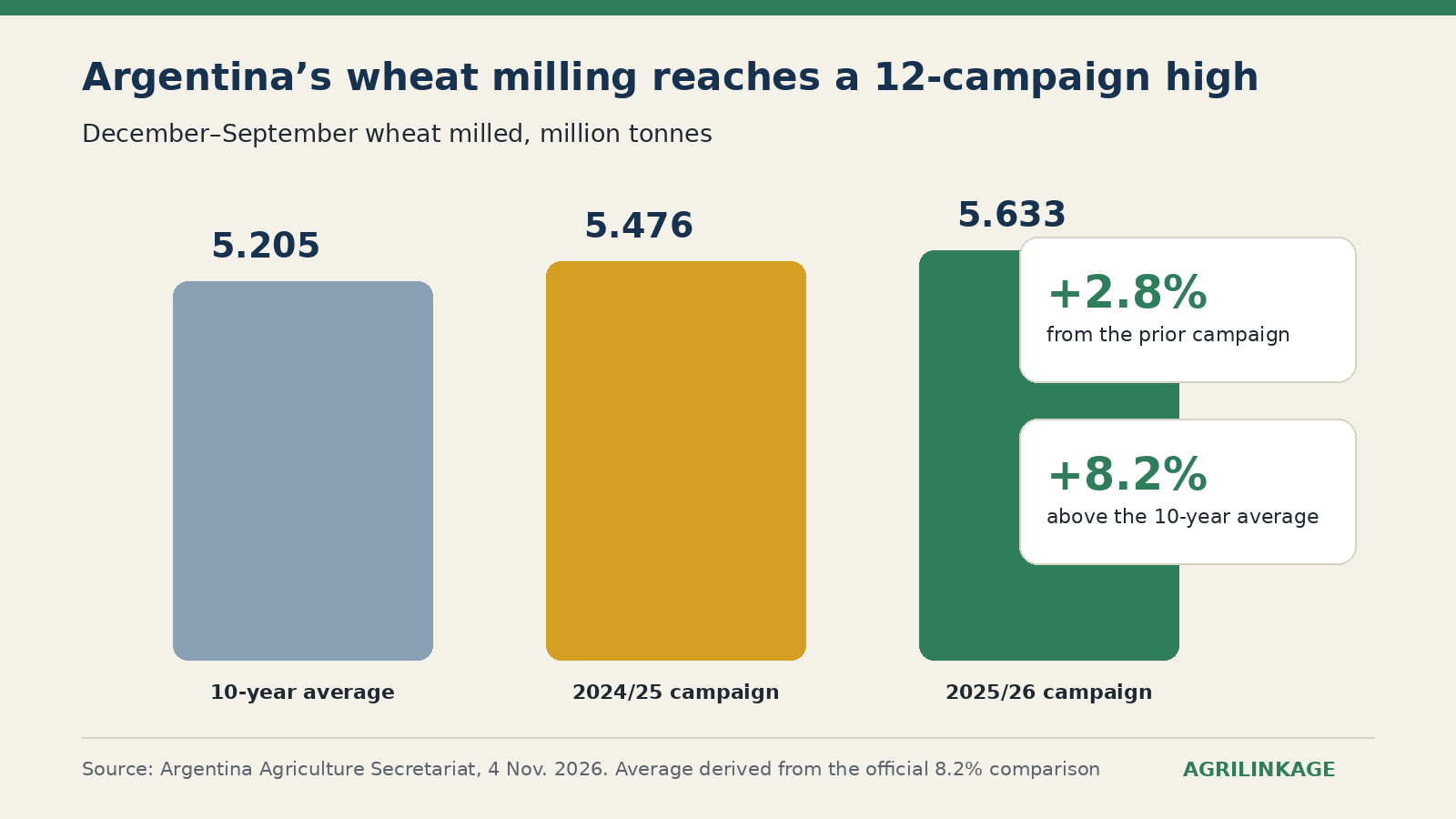
Agrilinkage chart based on Argentina Agriculture Secretariat data. The 10-year average is derived from the official statement that current milling is 8.2% above that average.
A record crop is feeding two channels
Domestic milling and grain exports are different outlets for the same crop. Milling converts wheat into flour and other products for local consumption and export, supporting processors, logistics operators and food manufacturers. Grain exports move unprocessed wheat to overseas buyers. A large crop can expand both channels without one necessarily displacing the other.
For scale, cumulative milling through September equalled about 20.2% of the 27.9-million-tonne crop. Projected wheat exports of 18.5 million tonnes equal about 66.3%. These are simple ratios, not a complete balance sheet: the periods do not align perfectly, stocks carry across campaigns, seed and feed uses remain, and some grain is still in storage. The calculation is useful only as an indication of the relative size of the two main outlets.
By September, accumulated wheat exports had reached 15.94 million tonnes, according to the Secretariat. That leaves the export projection within reach, but the final result still depends on shipment timing, international demand, port logistics and the quality mix available to buyers.
Flour exports add value but remain smaller than grain trade
The same official release put flour exports for December–September at roughly 450,000 tonnes, 14% above the prior campaign and 27% above the average of the previous four campaigns. The recovery matters because flour carries additional processing, packaging and labor before it leaves the country, even though the volume is small beside bulk wheat exports.
Higher mill utilization can spread fixed costs across more tonnes and strengthen demand for wheat suited to specific flour specifications. But processors still face margins set by grain prices, energy, freight, exchange rates and the price they can obtain for flour and by-products. Record throughput therefore does not automatically mean record profitability.
The next campaign starts from a smaller area
The production backdrop may be less expansive next season. Argentina currently estimates 6.6 million hectares planted to wheat for 2026/27, 5.3% below the record 6.97 million hectares harvested in 2025/26. Area alone does not determine output—weather and yield can offset or amplify the change—but it lowers the starting base for another record.
That makes the current milling number partly a story about unusually strong raw-material availability. If the next crop is smaller, mills and exporters may compete more directly for quality wheat, especially if external demand stays firm. If yields remain high, the area reduction could be absorbed. The decisive evidence will come from crop condition, rainfall, final harvested area and quality results, not from planted hectares by themselves.
What the record means for the market
For Argentine farmers, a strong domestic processing channel broadens the set of buyers and can support regional basis values where mills are accessible. For millers, plentiful grain improves supply security but does not eliminate cost or demand risk. For flour buyers in neighboring markets, higher Argentine output can improve availability, while grain importers watch the much larger export program.
The next useful indicators are monthly milling volume, flour export pace, the remaining wheat shipment schedule and 2026/27 crop condition. If milling remains above its recent average after the record crop is worked through, that would be stronger evidence of a durable increase in processing demand. If it falls back as grain availability tightens, the current peak will look more cyclical than structural.
Methodology: Agrilinkage used the Agriculture Secretariat’s 4 November release and calculated the crop shares and planted-area change from the official figures. Ratios are rounded and are not presented as a full supply-and-demand balance. No interviews or facility visits were conducted. Cover image: original Agrilinkage conceptual editorial illustration; it does not depict a named mill or terminal.


Comments