
How Sonia Amiri Turned a Family Olive Grove in Rural Tunisia Into an Award-Winning International Brand

Updated: 7 days ago
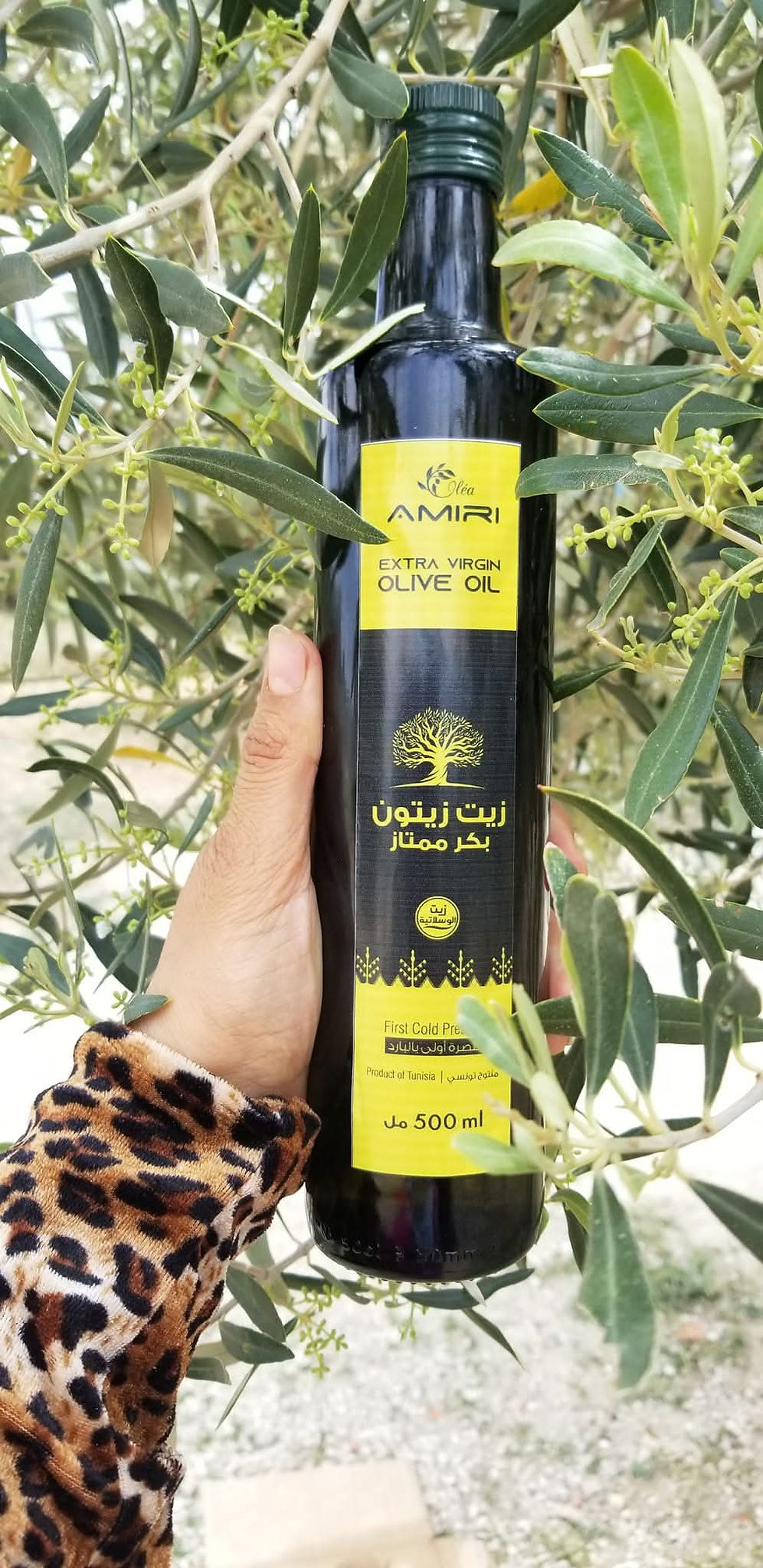
Oléa Amiri, rooted in the ancient olive-growing tradition of Oueslatia, is the story of one woman who built a premium olive oil brand from scratch, with nothing but determination, a borrowed machine, and an unshakeable promise to her father.
Oueslatia sits in the Kairouan region of central Tunisia, about 60 kilometres from the ancient medina city, in the foothills of the Djebel Oueslat mountains. Kairouan is one of Tunisia's great olive oil territories, home to some of the country's oldest groves and most prized native varieties. The landscape is rugged, dry, and scattered with olive trees that have been standing for over two thousand years. From this corner of rural Tunisia, with its deep-rooted olive-growing culture, Sonia Amiri has built Oléa Amiri, a cold-pressed, certified organic olive oil brand that now sells in Germany, Italy, Abu Dhabi, Côte d'Ivoire, and the finest restaurants and épiceries fines of Tunisia itself.
Our mission at AgriLinkage is to spotlight the people who transform agriculture, the entrepreneurs working far from the spotlight, solving real problems, and building things that matter. Sonia Amiri is exactly that kind of entrepreneur.

A Promise Made to a Father
Every great business begins with a reason. For Sonia, that reason is deeply personal.
The Amiri family has been growing olives in Oueslatia for generations. The land, the trees, the traditions: they are not just assets. They are identity. When Sonia decided she wanted to build something from this inheritance, she approached her father with a proposal. He listened. Then he did something remarkable: he gave her the land to work with, even though the family principle had always been the same, the land is never sold, never given away. He bent that rule for her.
"We never sell our land. But my father gave it to me so I could realise my project. I paid him back progressively. Today, I pray for him to rest in peace, and I hope to see Oléa Amiri expand internationally, as I promised him."
That promise became the engine of everything that followed.

Starting From Zero: The Machine Before the Business
Sonia does not romanticise her beginnings. She started with nothing.
Her first move was not to build a brand or find clients. It was to buy a machine. Before having a product, before having customers, she invested in the equipment that would let her cold-press her own oil. She ran formation after formation in olive oil tasting and quality analysis, training herself to understand the product at a sensory and technical level until she could distinguish oils the way a sommelier distinguishes wines.
"I really started from nothing. I first bought the machine, then I began testing my product while following olive oil tasting training. Today I am a member of tasting panels, and I will soon be joining the IOC."
The International Olive Council, the global intergovernmental body that sets the standards the entire industry operates by, does not hand out panel memberships easily. Sonia earned hers through years of methodical self-education.
That training fundamentally changed her relationship to the product. She stopped thinking about olives and started thinking about quality: about polyphenol content, about the timing of the harvest, about what the soil at Oueslatia gives to a fruit that grows nowhere else in the world.

The Oueslati Olive: A Variety the World Doesn't Yet Know
To understand Oléa Amiri, you have to understand the Oueslati olive. It is an endemic variety, unique to the mountains around Oueslatia and the Kairouan region. Unlike the better-known Chemlali or Chetoui varieties that dominate Tunisian bulk exports, the Oueslati produces an oil with a distinctive sensory profile: complex, fragrant, high in polyphenols and natural antioxidants.
For decades, this oil has been consumed locally or blended into anonymous tanker loads heading to Italian bottlers. Sonia saw something different: a product with world-class quality and near-zero international recognition. The gap between those two things was the business opportunity.
The estate itself is a century-old property. Some of the olive trees on the Djebel Oueslat are over two thousand years old, among the oldest in all of Tunisia. Sonia's production process honours this heritage: organic compost instead of synthetic inputs, careful hand-harvesting timed to the fruit's peak, and cold-pressing within hours to preserve every aromatic compound.
"My goal has always been to produce a premium, high-quality olive oil. Each time I enter a competition, I submit a sample from any tank, and I systematically win a gold medal."
That is not a boast. It is a production philosophy stated plainly. The SHOW AFRIC competitions, one of the most respected olive oil quality contests on the African continent, have confirmed it repeatedly.

Building the Business: Land, Capital, and Reinvention
Sonia's growth story is one of compounding reinvestment. Every gain was put back into the operation.
After the initial machine purchase, she acquired additional land, dedicating all her available capital to it. She then built out a full production unit: the cold press, the bottling line, the packaging. She did not wait for investors or grants. She built what she could, when she could, with what she had.
The brand's product line reflects this step-by-step thinking. The core range consists of cold-pressed extra virgin Oueslati oil, sold in carefully designed bottles with complete traceability documentation, from the grove to the glass. Each bottle comes with the history of the oil: which trees, which harvest, which press date. For fine dining clients and specialty retailers, this kind of transparency is not a nice-to-have. It is a differentiator.
Personalised gift sets have become a particularly strong product line: artisanal presentation boxes that combine the olive oil with a story, a terroir narrative, and the kind of craft detail that resonates with high-end buyers in Europe and the Gulf.
The financial results speak to the model's strength: Oléa Amiri's revenue has grown by 30% per year, consistently.
The Products: What Oléa Amiri Actually Makes
Olive oil is the heart of the brand, but Oléa Amiri is not a single-product company. The range reflects Sonia's broader relationship to the land and to the plants that grow on it.
ZIT Elguim, the flagship olive oil. The name means "the ancient oil" in Tunisian Arabic, a nod to the thousand-year-old trees from which it comes. It is a 100% organic, cold-pressed extra virgin oil made exclusively from the Oueslati variety, hand-harvested each season between November and March from the Djebel Oueslat mountains in the Kairouan governorate. The oil is available in 250 ml, 500 ml, 750 ml and 1-litre bottles, as well as in a Coffret Simple gift set.
What sets ZIT Elguim apart technically is its nutritional profile. The oil carries a polyphenol content above 700 ppm, and a monounsaturated fatty acid (oleic acid, C18:1) concentration exceeding 80%. These are not marketing figures: they are the result of rigorous laboratory analysis carried out before every bottling run. Each batch is tested for acidity, polyphenol concentration, and organoleptic quality (taste, aroma, colour). Only oils that pass every stage of this analysis are bottled and released. The rest stay in tank. The traceability documentation that accompanies each bottle records which trees the olives came from, the harvest date, and the pressing date, a level of transparency that is still rare in the olive oil industry.
The rosemary line. Growing on the slopes of Jbal Sarej, near Ousseltia, wild rosemary (Rosmarinus officinalis) thrives at altitude in conditions that concentrate its aromatic compounds. Sonia harvests it by hand and processes it through artisanal methods to produce two products. The first is a rosemary hydrosol (Eau de Romarin, 250 ml), a floral water used to revitalise hair, tone skin, and support a natural daily beauty routine. The second is a rosemary oil (Huile de Romarin, 10 ml), formulated with a vegetable carrier base of olive and sweet almond, designed for scalp and skin massage. Both products are made at the Oléa Amiri production facility in El Oueslati, Kairouan, and represent the beginning of what Sonia sees as a broader range of plant-based products rooted in the biodiversity of her region.

Quality control and certification. Oléa Amiri holds organic certification, audited twice yearly. The production chain operates under a strict traceability protocol, from the reception of the harvest through to palettisation and storage. Every stage, from the preliminary food-scan analysis of the olives before pressing, through cold extraction, filtration, bottling, fill-level control, and foreign-body detection, is documented and logged by the quality department. Sonia is a certified olive oil taster and panel member, with membership in the Conseil Oléicole International (COI) pending, a distinction that places her among a very small group of professionals worldwide with that level of formal accreditation.
A medal record that speaks for itself. The competitions Oléa Amiri has entered are not local affairs. The brand won gold at the International Olive Oil Awards in Turkey for the 2023-2024 campaign, one of the most competitive international competitions in the industry. It took gold at the Concours CARTAGE, held at the Salon International de l'Alimentation en Afrique at the Palais des Expositions du Kram. And on December 28, 2024, ZIT Elguim was awarded the Gold Quality Award at the Pyramids International Olive Oil Competition (IOOC & IOC), one of the most rigorous tasting competitions on the calendar. To these international distinctions, add multiple gold medals at the SHOW AFRIC competitions on the African continent, and the Grand Prix of the Route Culinaire de Tunisie organised by GIZ. These are not honorary prizes. They are blind-tasted, technically judged competitions where the oil either passes or it doesn't.

A Business Built With and For the Community
One of the most striking aspects of Oléa Amiri is that its success is shared. Sonia has not built a brand that extracts value from Oueslatia. She has built one that puts it back.
More than twenty women from the region now work with the business, each an expert in her domain. For an area where formal economic opportunity for women has historically been limited, this is significant. These are not casual seasonal arrangements. They are structured collaborations that provide genuine income and professional standing.
More recently, Sonia acquired a traditional house in Oueslatia containing an emblematic Maamra, a traditional stone oil press that predates modern machinery by centuries. Her plan is to transform it into a table d'hôtes: an immersive agrotourism experience where visitors can explore the olive groves, witness the production process, taste the oil against the backdrop of the mountain landscape, and understand what they are drinking.
"I have given hope back to my region. Effort, patience, and perseverance always pay off."
This is not marketing language. It is a woman looking back at what she built and explaining to younger people in Oueslatia that it is possible.
Where Oléa Amiri Is Heading
Sonia's roadmap for the coming years is precise. She wants 50% of her revenue to come from B2B: fine grocers, restaurants, and hospitality accounts rather than direct retail alone. She is developing a rosemary-infused oil line to complement the core range. And she has set her sights on one particular product that she sees as the brand's flagship international story: the Oueslati oil from Oueslatia itself, a geographically anchored, variety-specific oil that she believes deserves the same recognition as the great monocultivar oils of Italy or Spain.

In December 2025, Oléa Amiri became an official member of Oueslati Zit'Tour, a newly launched culinary tourism route connecting the key olive oil producers, restaurants, and hospitality businesses of the Kairouan region, a formal recognition of the brand's role as an anchor for the region's emerging food tourism identity.
The brand has already won the Route Culinaire de Tunisie competition organised by GIZ, one of the most prestigious agri-food competitions in the country. That prize opened doors to new distribution channels and reinforced Oléa Amiri's positioning as one of Tunisia's premium producers.
From a Mountain Olive Grove to International Markets
When Sonia walks into a trade fair, whether in Tunis, Paris, or beyond, she brings with her two thousand years of olive-growing tradition, a cold press she paid for herself, and gold medals that her oil keeps winning no matter which tank she draws from.
She also brings a promise she made to a man who gave her land he swore his family would never part with.
Oléa Amiri is not just a Tunisian olive oil brand. It is what happens when someone decides that the place they come from deserves to be on the world map, and then builds, piece by piece, until it is.
To learn more about Oléa Amiri and to explore their range of cold-pressed Oueslati olive oils, visit their website or follow them on their social media channels.
AgriLinkage connects buyers, traders, and suppliers across global agricultural markets. If you are a professional buyer interested in sourcing premium Tunisian olive oil, contact us to learn how we can help facilitate your trade.


Comments