
ECAKOOG Is Taking Ivorian Cacao Further Through Sustainability, Local Transformation and Direct Partnerships

Updated: 3 hours ago
At the 2026 Paris International Agricultural Show, Traoré Ousmane, Chairman of the Board of the Entreprise Coopérative Agricole Koognanan de Grogouya, talks about what he has built, what he is looking for, and what is keeping Ivorian producers up at night.
By AgriLinkage, February 2026, Paris
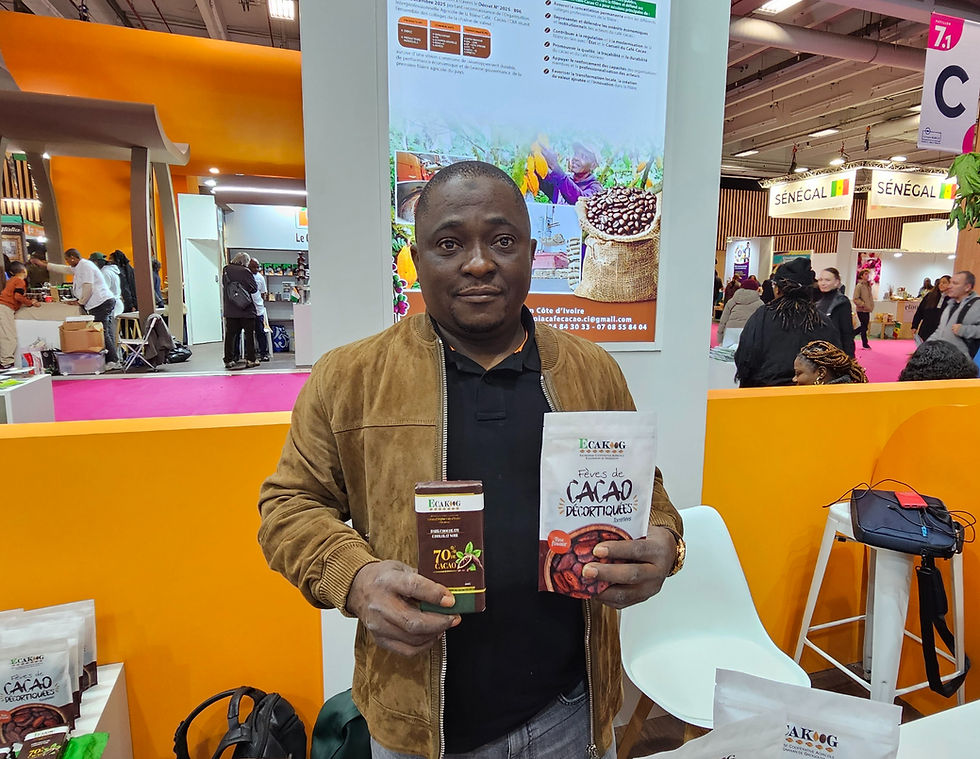
There are people who talk about cacao. And there are people who live it, who have made it their life's work since childhood. Traoré Ousmane is one of those people. A producer himself, son of a producer, he farms nearly 110 hectares of cacao, 60 hectares of palm trees, and 5 hectares of other crops. He is in Paris for the reason men who truly believe in what they do come to places like this: to show, to explain, to convince. And to find partners worthy of what he has built.
ECAKOOG, the Entreprise Coopérative Agricole Koognanan de Grogouya, is based in Lakota, Côte d'Ivoire, roughly 230 kilometres from Abidjan. It operates across seven zones: Tiassalé, Gagnoa, San-Pédro, Biankouma, Toulépleu, Duékoué, and Grogouya. In 2012, when Traoré Ousmane and his fellow planters formalised the structure, there were 521 members and a starting capital of 10,420,000 CFA francs. Today, ECAKOOG brings together 10,533 producers, holds a capital of 137 million CFA francs, and has an annual production capacity of 20,000 tonnes. In just over a decade, the cooperative has multiplied its membership by twenty and its capital by thirteen.
"We started with 521 planters. Today we are 10,533 producers, with an export capacity of over five thousand tonnes today, and we plan to export close to 70% of our volumes in the years ahead.": Traoré Ousmane, Chairman, ECAKOOG
The certifications came one after another, each one the result of precise and documented work: Rainforest Alliance certification in 2015, Fairtrade on March 8, 2017, organic on May 21, 2021. Since October 7, 2020, the cooperative has been officially registered as an exporter.

More Than Beans
What sets ECAKOOG apart in the Ivorian cooperative landscape is its determination not to stop at the raw material. The cooperative produces its own dark chocolate bars, a 70% whose entire process is managed in-house: bean selection, temperature-controlled fermentation, hand-sorting carried out artisanally by women from the communities, and finishing in collaboration with partner chocolatiers. Part of the beans is also sold directly.
The cooperative also produces close to a hundred biological inputs for its members, allowing them to farm without chemical residues, a requirement of the organic certification but also, for Traoré, a deep personal conviction about the relationship between agriculture and the environment. Since 2019, nearly 200,000 trees have been introduced into members' plots: fruit trees, forest species, shade trees. This is not window dressing. It is real, ground-level work.
"We produce close to a hundred biological inputs so that the environment stays stable and consumers can eat cacao without chemical residues. Since 2019, we have introduced nearly 200,000 trees into the fields. That is what allows us to say we are a very ecological cooperative, deeply committed to fighting climate change.": Traoré Ousmane, Chairman, ECAKOOG
This is also what brought the cooperative to Paris. Traoré Ousmane is at the Show to promote Ivorian cacao, he says so clearly, but also to identify financial and industrial partners able to support the next step: a semi-industrial processing unit, modern in scale, that would allow production at a different level, make chocolate bars available to other Ivorian cooperatives, and feed local Ivorian consumption as well. He reminds the room what this cacao means to his country: 40% of national export revenues, 15% of GDP, and nearly six million people who depend on it directly or indirectly.
"We are here to promote our cacao, which is our flagship product. But we are also here to build future partnerships, to develop semi-finished processing, to have a modern processing unit, and to be able to make that available to our fellow cooperatives and to Ivorian consumers.": Traoré Ousmane, Chairman, ECAKOOG
The Reality of the Market
The global cacao market has gone through a historic sequence. After an unprecedented price peak in early 2025, where cacao briefly traded above 12,000 dollars per tonne, prices entered one of the most brutal corrections ever recorded for this commodity, losing more than 65% of their value in the space of a year. In January 2026, the Ivorian government was forced to launch an emergency programme to buy back 123,000 tonnes of unsold cacao blocked with producers, mobilising over 280 billion CFA francs to maintain the guaranteed farm gate price of 2,800 CFA francs per kilogram despite the collapse of international prices. This is the context in which Traoré Ousmane is speaking in Paris, and he is not trying to sugarcoat it.
For cooperatives like ECAKOOG, the situation is made harder by the simultaneous costs of complying with the European Union Deforestation Regulation, the EUDR, which requires exhaustive geo-location of every member's plot. Additional work, additional costs, at precisely the moment when revenues are under pressure.
Traoré Ousmane speaks about this directly, without catastrophising, but without softening anything either. What worries him is not just the price drop itself. It is what it reveals about a certain logic within the industry: after years in which certifications, standards, and sustainability commitments justified higher prices, he senses a temptation to revert to older habits. That, he refuses.
"We were told to produce more, so we produced. And when production goes up, we see the price fall. We have not even reached the production levels we were aiming for, and we are already watching the market drop to a level we never imagined. Losing 65% of value in less than a year is not acceptable.": Traoré Ousmane, Chairman, ECAKOOG

He describes the project that has sustained the industry for decades, with its certifications, its commitments, its sustainability programmes, and the feeling that some players want, after just two good years, for cooperatives to go back to the old ways. He puts it at human scale with a simple image.
"Someone who is used to living on 100,000 — if you bring them down to 30,000 or 35,000, that is going to be very hard for them. An employee earning 500,000, if you want to bring them to 300,000, that is painful. A planter is no different.": Traoré Ousmane, Chairman, ECAKOOG
He talks about what this means in everyday reality. In Africa, a planter does not only support his immediate family. He pays school fees, takes care of his wife, supports an extended family within a solidarity structure that does not renegotiate itself season by season. That is why he cares so much that the price be, in his own words, truly remunerative: not sustainability programmes built all around it, but a fair price at the base that allows a planter to live properly from what he grows.
"It is thanks to cacao that we put our children through school, that we take care of our families. In Africa, a planter looks after a large part of his family. That cannot change in a day or in a year. Better to pay a good price for cacao so that planters can live better, rather than surround everything with sustainability programmes.": Traoré Ousmane, Chairman, ECAKOOG
Fairtrade as a Floor, Not a Ceiling
This is where the Fairtrade certification carries its full weight for him. It guarantees, when prices collapse, a minimum guaranteed price and a collective premium paid to the cooperative, two mechanisms that protect producers to a certain level. He believes in it and encourages the whole industry, chocolatiers included, to invest in it more seriously, not as a marketing label, but as a genuine commercial commitment.
"When prices go down, Fairtrade will be there to support at a certain level so that the planter can live decently. We encourage the industry, the chocolatiers, to invest in the Fairtrade market. That is what is really going to help us.": Traoré Ousmane, Chairman, ECAKOOG
The cooperative is simultaneously working to multiply its direct commercial partnerships, in Europe and in the United States, to cut out intermediaries and bring more value back to the people who produce. He wants to go as far as manufacturing the chocolate in Europe itself, with local partners, to distribute it directly in those markets.
"We need to build direct partnerships, whether in Europe or in the United States. We also need partners where we can manufacture our chocolate over there and put it on distribution markets directly from Europe. That is added value for the producer. That is the fight we are carrying.": Traoré Ousmane, Chairman, ECAKOOG
A Man Who Plays the Long Game
What comes through ultimately in all of this is consistency. Traoré Ousmane is not someone who reacts to events. Thirteen years ago, when he founded ECAKOOG with 521 producers in a village a few kilometres from Lakota, nobody was betting on what it would become. Today the cooperative is present across seven zones of the country, certified to three international standards, and has been exporting for five years.
Today's challenges are real: the market is uncertain, regulatory constraints are heavy, and the transition toward industrial-scale processing requires financing the cooperative cannot mobilise on its own. But Traoré Ousmane has the manner of someone who is used to building under conditions that make nothing easy.
"What is not easy is not worthless. Nothing is impossible. You have to work at it. And when we cross paths with the right partners, we are going to build something together.": Traoré Ousmane, Chairman, ECAKOOG
Côte d'Ivoire remains the world's leading cacao exporter, accounting for around 40% of global production, with six million people depending on the sector directly or indirectly, and a crop that represents 40% of the country's export revenues and 15% of its GDP. In that landscape, men like Traoré Ousmane are less exceptions than proof of what the sector can do when it is organised with rigour and driven by a vision that reaches beyond the next harvest.
This article is based on an interview conducted by AgriLinkage with Traoré Ousmane at the Paris International Agricultural Show, February 2026.
© 2026 AgriLinkage LLC. All rights reserved.


Comments